

Explore stories and insights
Loading...


 8
7 Last-Minute Preparation Tips For JEE Main Exam - Go, Ace It! The JEE Main Session 2 Exams are right around the corner, and tension is rising among students. Are you prepared for the challenges of the national-level exam? The National Testing Agency (NTA) has announced that the exams will be conducted on April 6th, 8th, 10th, 11th, and 12th. It is a crucial exam for all of you who are willing to pursue a career in science. So, with only 4 days left in the exam, now is the time to gear up for the final phase of preparation. Scouring the internet for last-minute revision tips? - You are at the right place! Expert JEE faculty from Narayana Coaching Center brings you seven last-minute tips. But before that, let's take a look at the category-wise weightage of marks in the JEE Main Session 2 Exams. Topic and Chapter-Wise Weightage for JEE Main Exam: You probably know this by now after months of rigorous grind and solving hundreds of question papers. But here is a quick recap of the topic and chapter-wise weightages for the JEE Main Exam to intensify your last-minute preparations. The topics are arranged in descending order of questions. Physics: Chapters Number of questions Marks 1 Modern Physics 5 20 2 Electrostatics 3 12 3 Optics 3 12 4 Current Electricity 3 12 5 Heat and Thermodynamics 3 12 6 Magnetics 2 8 7 Kinematics 1 4 8 Simple Harmonic Motion 1 4 9 Work, Energy and Power 1 4 10 Gravitation 1 4 11 Solids and Fluids 1 4 12 Laws of Motion 1 4 13 Rotation 1 4 14 Centre of Mass, Momentum, and Impulse 1 4 15 Waves 1 4 16 EMI – AC 1 4 17 Unit, Dimension and Vector 1 4 Chemistry: Chapters Number of questions Marks 1 Periodic Table and Representative Elements 3 12 2 Transition Elements and Coordination Chemistry 3 12 3 Solid State and Surface Chemistry 2 8 4 Ionic and Chemical Equilibrium 2 8 5 Thermodynamics and Gaseous state 2 8 6 Chemical Bonding 2 8 7 Nuclear Chemistry and Environment 2 8 8 Atomic Structure 2 8 9 Alkyl Halides 1 4 10 Aromatic Compounds 1 4 11 Stereochemistry 1 4 12 Carboxylic Acid and Their Derivatives 1 4 13 Redox Reaction 1 4 14 Electrochemistry 1 4 15 Hydrocarbon 1 4 16 General Organic Chemistry 1 4 17 Chemical Kinetics 1 4 18 Mole Concept 1 4 19 Solution and Colligative Properties 1 4 20 Carbohydrates, Amino Acids and Polymers 1 4 Mathematics: Chapters Number of questions Marks 1 Coordinate Geometry 5 20 2 Integral Calculus 3 12 3 Limits, Continuity and Differentiability 3 12 4 3D Geometry 2 8 5 Vector Algebra 2 8 6 Statistics and Probability 2 8 7 Matrices and Determinants 2 8 8 Complex Number and Quadratic Equations 2 8 9 Differential Equation 1 4 10 Statics and Dynamics 1 4 11 Differential Calculus 1 4 12 Sets, Function and Relation 1 4 13 Sequences and Series 1 4 14 Binomial Theorem and Its Application 1 4 15 Permutation and Combinations 1 4 16 Mathematical Reasoning 1 4 Now, here you go… 7 Last-Minute Tips to Help You Ace Your Exams: The final lap is the most vital round of preparation. Leave no stone unturned in your JEE Main preparations with this comprehensive last-minute guide: 1.Practise at least one mock test every day: Let's start with the basics! Solve at least one mock test paper to test your ability and knowledge. The more, the merrier! It will also help you familiarise yourself with the test pattern, nature of questions, difficulty levels, etc. 2.Focus on accuracy: Why are you solving mock test papers? The answer is more complex than you think. It is not only to test your aptitude but also your accuracy. Hence, the goal is to increase your precision while strengthening the concepts and just completing the papers. 3. Do a self-analysis: Once the test is over, check the answers and do an in-depth self-analysis. It will reveal your strengths and weaknesses. You will also understand which sections or chapters need extra attention. 4. Clear your doubts immediately: If you doubt any concept, question, or answer, clear it immediately. Do not procrastinate, as you may forget it later. 5. Time yourself: While giving the mock tests, time yourself. It will increase the chances of completing the paper within the allotted time on D-day. Time management is imperative during exams. Start the paper with the area in which you are most comfortable. Prioritising the section will help you attempt most of the questions and increase your chances of scoring more marks. 6.Do not start any new topics: If you have not studied a topic, do not try to study it during the last few days. There must be a reason for you to exclude it in the first place. Starting new topics just before the exam is stressful and confusing. 7.Revise important formulae and reactions every day: Although you have to use the formulae and reactions while solving test papers, remember to revise them every day. Pay close attention to the minute details. 8.Revise the study notes: Solving papers is not enough. You must be in touch with the concepts daily. Go through your study notes thoroughly to cover all the topics and chapters. You can also do it after solving the mock test. This way, you can clarify your mistakes. Some general tips to help you during JEE Main exam preparation: There are two parts to preparing for an exam: one where you study hard and be thorough with the course curriculum. Another aspect is not as technical. Nevertheless, it is equally important. Besides revision tips, here are six practises that will help you focus better and pass the exams with flying colours. 1. Increase your concentration: Before the actual exam, you will need lots of patience and concentration. Try meditating or specific exercises to increase your concentration. 2. Avoid discussing preparations: It is best to avoid discussing preparations with other aspirants or previous candidates. Everyone tends to have their suggestions, and as you know, too many cooks spoil the broth. You may also feel your preparation is inadequate. 3. Ditch self-doubt: Exams such as JEE Main can bring up insecurities and self-doubt. Do not entertain these negative thoughts; they can hamper your performance. Remember, you have done your part to the best of your abilities. 4. Rest adequately: Rest is important before an exam to rejuvenate the body and mind. Ensure that you're getting sufficient sleep. 5. Maintain a healthy diet: Do not ignore your diet amidst JEE Main exam preparations. Eat balanced and nutritious meals that will give you strength. Avoid eating oily and junk food that can make you sick. 6. Prepare early for the exam day: Ensure you have all the essential documents, such as hall tickets, admit cards, and ID proofs, ready at least one or two days before the exam to avoid the last-minute hassle. Carry adequate stationery items with you to the exam hall. Wrapping Up: As the exams knock on the door, it is time to give your best, revise your lessons thoroughly, and most importantly, follow a strategy. However, here is one final tip: JEE Main exams are a mix of preparation and mind games. Poor exam temperament can hamper a student's performance, even if they have more rigorous preparation than those with mediocre ones. Therefore, perseverance, confidence, and the right guidance are keys to cracking the JEE Main exams. Frequently Asked Questions (FAQ) on JEE Main Preparation: Q. Which are the most important chapters in the JEE Main Session 2 Exam? Ans: Here is a list of a few important section-wise chapters for JEE Main Exams: Maths: 1. Statistics and probability 2. Trigonometry 3. Mathematical reasoning 4. 3D geometry 5. Integral calculus Physics: 1. Electromagnetic induction and alternating currents 2. Properties of solids and liquids 3. Rotational motion 4. Experimental skills 5. Work, energy and power Chemistry: 1. Atomic structure 2. Chemical thermodynamics 3. S-block elements 4. Co-ordination compounds 5. Purification and characterisation of organic compounds Q. How do I remember everything I have studied for the JEE Main Exams over the months? Ans: Follow these three tips to remember everything you have studied: 1. Write and practice 2. Solve test papers 3. Revise important topics and formulae every day Bear this in mind—you are actually not forgetting anything. It is just that you are anxious. Keep calm and continue with your focused revision. Q. How should I spend the last day before the JEE Mains Exam? Ans: Try to be as relaxed as possible and not venture into new topics or difficult questions. Rather, go through previously solved papers, study notes and formulas. You can solve a mock test or two. Make sure to get adequate rest and mentally prepare yourself for D-day.
 01 Apr 2023
 8
How to Engage Your Children During Summer Vacations? Students’ schedules these days are packed with school, coaching, co-curricular activities, sports training, etc., which usually keep them busy throughout the day. Because of the same, parents rarely get to spend the desired quality time with their kids. But each year, summer vacations provide a chance for children to recharge themselves by having fun and spending time with their families. They can take a break from their regular schedule and finally unwind. And you, as a parent, might want to take full advantage of it by teaching them new things and bonding better with them. Before we go ahead, we have a question for you. If we ask you to go back to your childhood days, would you distinctly remember a specific summer vacation or a summer activity that stands out as one of your fondest childhood memories with your parents? Now think about this. Are your children making the same kind of fun and adventurous memories with you that they will recall and cherish for their lifetime? That puts you into deep thought. Right? Worry not! In this blog, we bring you some amazing ways to engage your children during summer vacations and make beautiful memories with them. Meet and Greet with Nature Nature is a massive, unending learning environment. Nature delivers several long-term advantages to physical health and mental wellbeing. Children are natural scientists who like exploring the sights, smells, sounds, and textures of their surroundings. Taking children to different natural areas helps them think about more than just where they live and gives them a more well-rounded view of the world. Introducing children to nature's diversity—from distinct species to varying landscapes and weather patterns helps them develop an admiration for the world around them and comprehend their role within it. Here are some nature related activities to engage your children during summer vacations . • Plant a veggie garden • Observe clouds and interpret the shapes formed by them • Go birdwatching and make a bird feeder • Gaze at the beautiful starry nights • Make a flower scrapbook Go Outdoors Summer is a season for stepping out, discovering, and having a good time. Outdoor education enables students to develop important life skills and constructive coping methods. Physical activity is an important component of outdoor play, through which children get the room and flexibility to roam about, expend energy, and break a sweat. They can increase their speed, strength, stamina, and motor abilities by participating in vibrant outdoor activities. This, in turn, helps to improve consciousness, self-esteem, and knowledge of their own body. There are various outdoor summer activities that you can easily practice with your kids. • Vacation travel/ road trip to the city • Go and meet distant relatives • Discover unknown/new areas of your city • Visit a local fair/market/farm • Go camping • Take an industry/factory tour • Go kite flying Brisk the Brain Several types of brain teasers and conceptual puzzles provide countless possibilities to think over a solution. While your kids are at home during their summer vacations, you can encourage them to play brainteasers and games that help them develop the foundations of problem-solving and critical thinking. This will eventually increase their learning, focus, and memory. You can engage your child in mental puzzles that require strong reasoning skills so that the abilities they develop for a game can also be adapted to their school tasks in the future. Some of the related summer activities for kids are mentioned below. • Solve puzzles and brainteasers like Sudoku • Have a summer reading challenge • Do science projects and experiments • Solve Rubik’s cube • Craft a comic book • Create a summer scavenger hunt Art for the Heart The practice of art fosters imagination and creativity, two abilities that help children in their lifelong journeys. Students who are exposed to art think effectively and easily develop creative problem-solving abilities. Children develop self-confidence and self-expression skills by making their own, independent decisions about how to convey what they are thinking and feeling through the medium of art and craft. It nurtures curiosity in the children and enhances their attention span as well. Here are some fun summer activities related to art and craft for your kids – • Paint rocks and marbles • Create wall chalk murals • Make music with utensils • Create newspaper crafts • Learn a new musical instrument • Train the child in a traditional/classical/western dance form Fun with Food – Almost every child loves to be around food. Kitchen and its related activities are the best if you're looking for ways to engage your children during summer vacations . Through these playful tasks, children will develop knowledge regarding different kinds of foods, culture and will also understand its importance in their lives. It will enhance their tender culinary skills and provide them with exposure to the cooking environment. Some of the summer activities combining food with fun are mentioned below – • Prepare lemonades • Describe food like a chef • Assemble and plate a dish • Identify food by smell/taste • Listen to the kitchen sound and guess the utensil involved Summer vacations can be made very engaging and fun for children through inclusion of multiple thoughtful, yet interesting activities. It is the best opportunity for parents to get involved with their children and make wonderful memories with them. So, what are you waiting for? Enjoy this precious time with your kids and let them explore and discover their interests. The Narayana Group wishes you a cheerful summertime with your children!
29 Mar 2023 8
Freedom Fighters of India: Top 10 Unsung Heroes Independence didn’t come to us easily; when we say this in the Indian context, it seems like an understatement. This is because there are just too many sacrifices made by the freedom fighters of India , heard and unheard, from every sect and strata of Indian society to count. It includes young revolutionaries who did not even reach the age of 20. In every corner of the country, you will learn about local freedom fighters who rose and rallied people against the colonisers and sacrificed their lives in the process. While we are aware of the monumental role that some of the well-known freedom fighters played in the Indian independence movement, in a country as vast as India, there are possibly thousands of unknown and unsung freedom fighters about whom we probably have not heard. In this blog, we will learn about these unsung freedom fighters of India . Freedom fighters of India did not follow a single ideology nor believed in a single form of resistance. However, their purpose was the same. Indian freedom fighters used all kinds of methods to show their defiance. These included the following: Pan-Indian Movements and Protests: Non-violent Armed revolts by tribal communities and soldiers Marches, speeches, boycotts, and strikes throughout the country Literary movements, involving the publishing of poems, songs, and articles in newspapers. Through the study of these events, we are informed about many unsung freedom fighters of India who are yet to make their part heard in the incredible story of the Indian freedom struggle. 1.Khudiram Bose (The Boy Revolutionary) Khudiram Bose was only 18 when he was hanged, making him one of the youngest Indian revolutionaries to be executed by the Britishers. Inspired by Aurobindo Ghosh and Sister Nivedita and affected by the partition of Bengal, he became an active revolutionary. He was just 15 at the time of his first arrest. He learned to make bombs and used to plant them to target British officials. Finally, on August 11, 1908, Khudiram was sentenced to death for an attempt to assassinate Douglas H. Kingsford, the then Chief Presidency Magistrate of Calcutta. His sacrifice was so inspirational that his story is now popular folklore in West Bengal but little known outside the state boundaries. 2. Kartar Singh Sarabha Unknown to many, Kartar Singh Sarabha is another very influential freedom fighter of India . His story inspired many revolutionaries, including Bhagat Singh. Kartar Singh was in his teenage years when he joined the Ghadar Party, which was formed in Oregon, USA by Punjabi expatriates with the aim to overthrow the British from India. He returned to India to organise soldiers against the British. He was captured before any revolt was executed for conspiring against the British Raj. He was only 19 when he laid down his life in the service of the nation. 3.Rani Gaidinliu Rani Gaidinliu was born only as Gaidinliu in present-day Manipur. Her revolutionary journey started at the young age of 13 with the Heraka Movement. The Heraka movement was a socio-religious movement against the British clergy who aimed for the religious conversion of the Naga tribes. The movement also wanted Naga self-rule. Gaidinliu soon became the spiritual leader of the movement. She began protesting the British Raj, enjoined her tribe to speak out, and organised guerilla strikes against the British army because of which she received life imprisonment and was released only after India gained freedom. The title ‘Rani’ was given to her by Jawaharlal Nehru. 4.Alluri Sitarama Raju (Hero of the Jungle) Thanks to the popularity of S.S. Rajamouli’s RRR, people outside the Telugu-speaking states are now aware of this name. But the actual story of Alluri Sitarama Raju, a sanyasi and a tribal leader, is still unknown to many. He was the leader of the Rampa Rebellion, a tribal revolt in the Godavari region of present-day Andhra-Pradesh. He used guerrilla warfare techniques to attack and raid police stations for arms and ammunition. He had strong tribal support and his strategies made him hard to locate. The British announced a prize of 10,000 Rupees for his capture. He then surrendered to the police to save the tribesmen from torture and misery. 5.Vallinayagam Olaganathan Chidambaram Pillai Vallinayagam Olaganathan Chidambaram Pillai's contribution to the independence struggle is unique in the sense that apart from organising marches and strikes and fighting legal battles for the poor, he also challenged the British economically by launching the country’s first shipping service, the Swadesh Steam Navigation Company, which used to run ships between Tuticorin and Colombo. He had the utmost respect of the local population. He was tortured by the British in the jail; his shipping company got taken over; and his title of barrister was snatched. He spent his last days in poverty, writing commentaries and compiling old Tamil texts. He was given the title of Kappalottiya Tamizhan (The Tamil Helmsman). 6.Ram Prasad Bismil You may have heard his famous poem, ‘Sarfaroshi ki tammana, Ab hamare dil me hai’, but you may not necessarily know the revolutionary who wrote it, Ram Prasad Bismil. Fluent in both Hindi and Urdu, Bismil was a great poet who used his writing to convey the message of freedom. He planned the famous Kakori train robbery, in which a train carrying money was looted. Along with a few others, he organised HINDUSTAN SOCIALIST REPUBLICAN ASSOCIATION (HSRA), an organisation that sought freedom from the British through an armed rebellion. His actions inspired many to join the organisation, and his writings sing the song of freedom even today. When we talk about the unsung freedom fighters of India , Bismil’s name should always be included. 7.Ka Phan Nonglait She is one of those female freedom fighters of India whose role is largely unknown outside her tribe or the state of Meghalaya. There are so many freedom fighters from the North-east India about whom we know very little. Personalities that gave up everything in the struggle against the British. Ka Phan Nonglait is one such freedom fighter. Hailing from the Khasi Hills of Meghalaya, she is known for her fighting skills, bravery, and courage. She fought against the British even before 1857, i.e., the first war of independence. Along with the leader of her tribe, U Tirot Sing, she launched many attacks on the British soldiers. As a mark of respect, her clan has protected and preserved her house through the years. 8.Matangini Hazra One of the prominent female freedom fighters of India, she rallied thousands of women to take over a police station at the age of 73, during which she was shot and succumbed to her injuries in the process. She was a staunch believer of every aspect of Gandhian ideology, because of which she was given the title “ Gandhi Buri ”. She was active in the independence movements throughout her life and sacrificed herself while doing the same. Age didn’t stop her from marching fearlessly in front of armed policemen. She is one of the most powerful representations of women’s participation in the Indian independence movement. 9.George Verghese Joseph George Verghese was a highly learned and educated Indian freedom fighter from the state of Kerala. He put his immense knowledge of the law to use to help native people escape unlawful convictions by the British. The British passed an act in 1920 that labelled some tribes of Madurai as groups of criminals. When the tribes protested against this, they were killed in a shootout similar to that of the Jallianwala Bagh Massacre. George Verghese opposed this fiercely through his writings and law practice. He had a prominent role in setting up the first trade union in India. He gave up his career as a lawyer to join the call of the Indian freedom struggle led by Mahatma Gandhi. He worked as the editor of The Independent, a newspaper started by Motilal Nehru, where he displayed his literary and intellectual capabilities. He spent the rest of his life fighting for the rights of the people. 10. Kotwal Dhan Singh Gurjar (The Kotwal who led the first war of Independence) When we discuss the unsung freedom fighters of India , Dhan Singh Gurjar’s name should always be mentioned. He was the head of the police station in Meerut during the first war of independence. When the revolt broke out and the sepoys were jailed, the locals marched in fury toward the police station. Dhan Singh, along with his fellow policemen, joined the movement and freed the soldiers. Dhan Singh was considered the chief accused in these activities and was given a death sentence. The British, fuelled by vengeance, also attacked Dhan Singh’s village and murdered hundreds of people. His statue now stands in the same police station where he served as a kotwal almost two centuries ago. Aside from a few personalities we have all read about and know, it is unfortunate that the names of so many great freedom fighters of India are still unknown to us. When we are celebrating our 75 th Independence day, it is time that we recognise their immense contributions and give them the place they deserve in history.
24 Mar 2023 9
Phenomena Explained How are Clouds Formed? Science is an important part of our lives. If you look around yourself, you will be able to witness many scientific phenomena happening in your surroundings. This blog talks about one such common phenomena and tries to explain the science behind it. Before diving deep into the same, we have a puzzle and its clues for you! While walking outside or sitting under the sky, you can often witness a mass of water droplets, ice crystals, or a mixture of both, that is suspended above in the air. These foamy structures float above us and usually appear white. These are sometime higher or lower, bigger or smaller, thick or dense. They have a multitude of waves forming different kinds of shapes. Could you guess what is being talked about? Let us simplify it for you! We are talking about none other than the entities known as clouds and their properties. Formation of clouds takes place when vapors present in the air condense to form tiny droplets of water and further collect to form clouds. As simple as this may sound, it is not so in real! So, tighten your belts because now we will be climbing a little high to know the process of the formation of clouds in detail. We all know that 70% of Earth’s surface is covered in water. As the sun heats up the Earth’s surface, the solar energy evaporates water from water bodies like oceans, rivers, and lakes. Apart from that, the moisture present in soil or ground also starts to evaporate due to the heating effect created by the sun’s radiation. The air in contact with the earth’s surface rises vertically because of heating. As a portion of the air heats up and rises, the air surrounding it cools and descends, creating a sort of invisible hot air balloon as shown in Fig. 1. This is accomplished by convection, the process whereby particles of the medium carrying thermal energy flow from warmer to colder regions. The cargo of the invisible balloon formed doesn’t weigh it down. The more moisture it absorbs just before takeoff, the lighter it gets. Isn’t it interesting? * You might know that as we go up, the atmospheric pressure goes down. This permits the unseen hot air balloon to continue to rise. Now, the internal heat of the balloon starts to disperse, which results in the lowering of its temperature. Formation of clouds happens when water vapors are cooled by the air at the top and condenses into tiny droplets, giving rise to the process of condensation . But have you ever wondered how it expands and goes up higher in the sky? Here is a quick explanation to the same! Due to the continuous process of condensation, the water vapors keep cooling and accumulating at the same height, making the cloud bigger and bigger. And as vapors convert into droplets, the energy that they received during evaporation starts releasing. Due to this, the surrounding air pocket heats up, lifting the cloud and drawing in more moisture from behind. That moisture again cools, condenses, and releases heat, further fueling lift and intensifying the updraft of the cloud as shown in Fig. 2. This is how the formation of clouds takes place. There are various types of clouds present in the sky. The type of cloud formation depends heavily on the temperature and altitude of the troposphere. Not only this, but there are also many other interesting questions and facts related to the phenomenon of formation of clouds that will force you to think about the science behind it. Keep thinking, keep searching and keep learning until you find the answers!
17 Mar 2023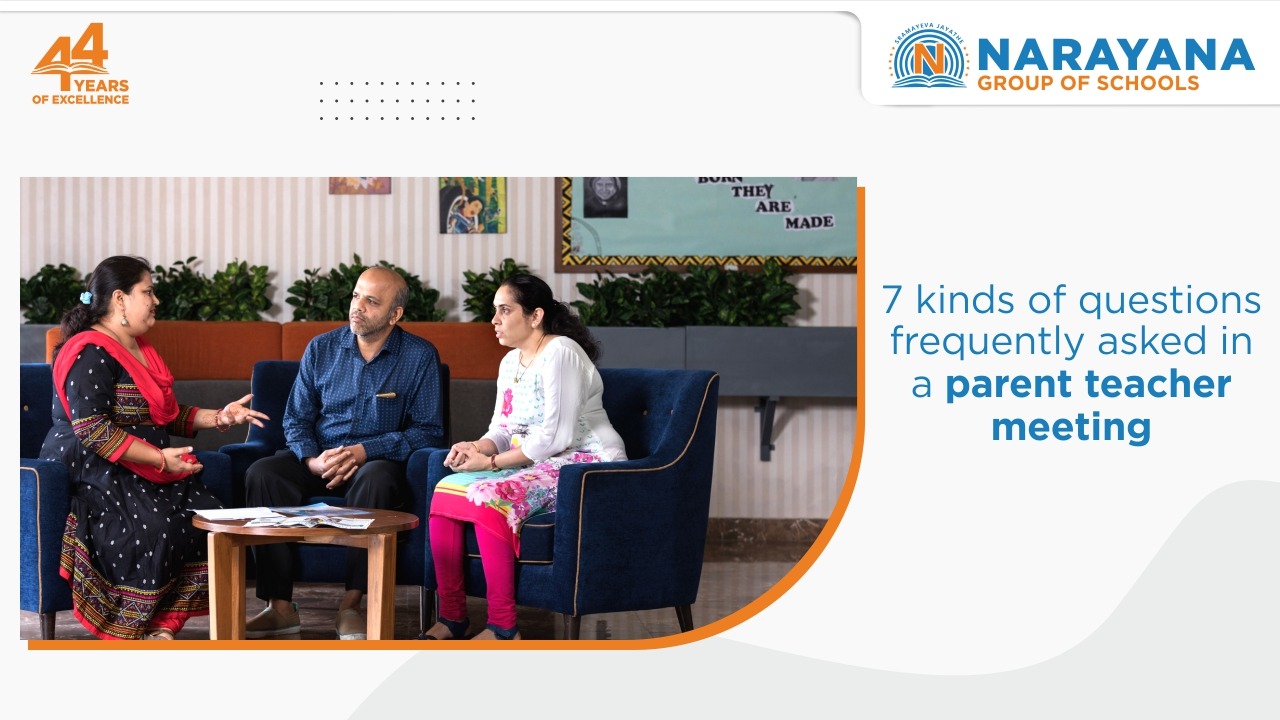 8
7 Kinds of Questions Frequently Asked in a Parent Teacher Meeting As a parent, you understand how important it is to be involved in your child's education at school . If there is an open discussion between parents and teacher, then the child will eventually benefit the most. Efforts in this direction will help secure a great future for your child. The Dussehra holidays are now over, and it’s time for the results. It is possible that you will have doubts and questions. A parent teacher meeting is the most appropriate occasion to have this discussion. But we need to know the right questions to ask. Parent teacher meeting questions should be clear, as you have limited time in these meetings. The questions should also be very relevant to the overall development of your child, including questions about more than just academics. What you can do is categories the types of questions to cover each important area of your child’s student life. In this blog, we will help you find important questions to ask during a parent teacher meeting. 1.General Questions Concerning Your Child At the start of the parent teacher meeting, you can ask basic questions about your child. How does my child behave in school? What do you think my child's talents are? What activity does my child enjoy the most? Does my child encounter any challenges when trying to communicate with you? How do you promote critical and creative thinking in the class? 2.Academic Performance For questions related to academic performance, you will have to ask both the class teacher and different subject teachers. To the class teacher: Is his/her performance in the exams satisfactory? Which subject(s) does the kid have an interest in? Is there any subject that my kid needs extra help with? How does my child perform in quizzes and tests? How is my kid faring in terms of discipline, participation, answering questions, and behaviour in the classroom? Subject teacher : How well is my child performing academically in your subject? My kid isn't clear about some topics; can you let us know what we can do? Are any books or reference materials available? How often do you schedule tests? To language teacher – Is my child a good reader? Is he/she able to comprehend the text? If you think that it will help, can you make my child sit with a kid who behaves well and has good grades in your subject? To 2nd/3rd language teacher – Can you make a separate batch for children who are not native speakers? Because learning a new language is challenging for both children and parents. 3.Emotional Behaviour: Make sure your parent teacher meeting questions include your concerns for your child’s emotional well-being. How is my child in general? Cheerful/cranky/moody, etc.? How is my child’s behavior with teachers and classmates? How do you promote self-confidence in students? 4.Social Behaviour Parent teacher meetings should also be used to inquire about your child’s social life at school. How your child behaves socially impacts their school experience significantly? Is my child good at forming and maintaining friendships? Does my child participate in debates and discussions with other students in the classroom? In the classroom, is my child an introvert or an extrovert? 5.Homework You should also clear all your doubts regarding your child’s homework. How is my child's progress on his homework? Is he/she regular in doing it? According to you, how much time is enough at home to complete the homework? Is homework given every day? Can you provide me with a schedule? 6.Parent’s role You can also ask how you, as a parent, can contribute to your child’s learning at home. In a parent teacher meeting , you should try to understand the teacher’s vision and what they expect from you. What methods can I use at home to improve my child’s learning? How do I help my kid with self-study at home? What can I do at home to support the expectations you have for student behaviour in class? Would you like me to tell you more about my child, including likes, dislikes, special skills, etc., if it helps you understand him/her better? What is the best way for me to prepare my child for tests and assignments? 7.Other issues including sensitive topics (if any) There can be other issues at home that affect your child. Make sure you are open about them with the teacher, as this will help teachers understand your child’s behaviour better. You can also inquire about the school’s policies regarding situations such as bullying and fighting. If it helps you understand the child, should I tell you about my family situation and the kind of issues that the child faces? What is the school's anti-bullying policy? How do we handle a situation like that if it occurs? Parent teacher meetings are one of the most effective tools you have as a parent. Use them to build a rapport with the teacher, understand their teaching style, what are your child’s strengths and weaknesses, and how your child does socially and emotionally while they are at school. We have provided a few questions for you in each category. Choose your questions carefully keeping your child in your mind. Make sure you are prepared with your questions before you walk into the meeting room. Your aim should be to cover each aspect of your child’s education. Want a school that takes care for your children’s unique learning style and provide the best care, guidance, and education? Admissions are open at Narayana for Academic year 2024-25. Leave it to us to sculpt your child's journey towards excellence. Register now!
10 Mar 2023 8
How to Choose the Right Primary School? In the previous blog, we talked about the importance of choosing the right pre-primary school ; in this one, we will address the next and very important stage of students’ lives, i.e., primary education . We will focus on how to choose the right primary school for your children . As per the World Bank data, 26% of the Indian population is below the age of 14. That is why it is essential that we prioritise primary education and identify how schools can contribute most to the overall development of children and help them become ideal citizens of the country. Primary education builds on the foundation laid during the pre-primary stage and teaches many new things for the first time. These include social skills such as communication, cooperation, and sharing; behavioral skills such as patience, concentration, and following instructions; and emotional skills such as empathy, gratitude, and self-confidence, among others. It is important that the schools employ professionals who understand this and also have the skill set to help students through this learning phase. What are the characteristics of a good primary school Creative Teaching Methods: For your kids to learn the skills listed above, teachers should use imaginative games, interesting activities, thought-provoking books, and creative teaching methods. You do not want your child’s skill development to be limited because of a non-creative teaching environment. They should be able to broaden their horizons with the type of primary education they receive. That is why you should make sure to choose a school that strives to make learning both educational and fun. Balanced Curriculum: The right school for your child at this stage would be the one that carefully balances academics and extra-curricular activities, both of which are essential for your child’s overall development. In the later part of this stage, your child will start developing an interest in a specific field. Make sure they get every opportunity to explore their potential in a wide range of academic and non-academic domains. Discipline: Right now, your children are impressionable; the experiences they have at this stage will shape their behavior. They will meet and interact with many new students. It is important to choose a school that emphasizes discipline and considers it an essential part of a child’s education. You can talk to other parents to find out if they have noticed any behavioral changes in their children when they joined a school and what the school’s approach is towards incidents like bullying. Individual Attention: We know that not every child grasps concepts in one sitting; they may take multiple rounds of instruction to grasp a concept that others do in one or two attempts The best primary school in this situation would be the one where there is an emphasis on each kid. You can talk to the teachers and go through the school’s website to learn about the teaching methods in the school. Future-Ready Classrooms: Smart infrastructure is not the need of the future; it is the necessity of the present. Make sure that the school your child attends uses technology effectively. The right primary school will utilize technology where it is needed to facilitate their learning and make them technologically literate. That is why we have smart e-Champ infra at Narayana Schools all across India, which includes well-furnished e-labs, technical equipment, interactive video conference sessions for extempore building, and e-learning modules for interactive demonstrations. Conclusion: While factors such as infrastructure and trained faculty are common for every stage of education, the ones mentioned in this write-up are more important for primary education. Although proximity to home maybe an important factor for you, but you should still consider the quality of school first over any other thing while selecting the right primary school for your child. We hope this has given you more information on the matter. In subsequent articles, we will carry on with this series and emphasize how crucial it is to choose the right high school for your children.
03 Mar 2023

