

Explore stories and insights
Loading...


 8
Summer vacation is a joyful time for every kid and their parents. But, when it is time for schools reopening, children can have various reactions. Some just love going back to school as they will get to meet their friends. While others may not be that enthusiastic regarding this matter. Such behaviour is quite natural among young ones. As parents, we have to understand that our children have spent a significant time away from school. They have gotten used to being in vacation mode and a sudden change in routine may not be well received by them. This may make them reluctant to go back to school. Thus, it is up to us to help them transition. They need to be gently guided back to their regular school routine. Here’s how you can make sure that your child is prepared for school reopening! 6 Tips for Parents to Prepare Their Child for School Here are some tips you can follow to help your child transition from vacation mode to going back to school: 1. Adjust their Sleep Schedule Your child has spent the last 3 to 4 weeks at home. They might have been up late at night watching movies or playing video games and as a result, getting up late. Thus, before they start school, it is essential that you set their bedtimes a little earlier. Doing so will help them easily wake up in the morning and get ready to head out for school. Moreover, during vacations, children have the habit of napping in the afternoon. Try to engage them in some sort of summer activities during this time to help them stay active. It can include going outside to play, solving puzzles, painting, etc. This will prevent them from feeling sleepy during the after-lunch hours at school. 2. Reset Their Meal Timings During summer vacations, children usually get used to having late-night snacks, eating at odd hours, binge munching their favourite food, etc. But with schools reopening, this aspect of their vacation life needs to be brought under control. An excellent tip, in this case, is setting their meal timings the same as what they have on school days. This will help their digestive system slowly adjust and ease the process of transition. 3. Ensure that Your Child Has the Adequate Supplies Now, as your little learner is going back to school, you have to ensure that they have all the supplies that they need. To prevent any misses from your end, you can make a list of back to school supplies like books, pencils, sharpeners, erasers, backpacks, notebooks, pencil boxes, tiffin boxes, water bottles, etc. By doing so, you can be fully sure that they have all that they need. Don’t forget the bottle of sanitiser! Furthermore, young children tend to gain both inches and kilograms during the summer vacation. Thus, before school starts, you can ask them to wear their school uniforms and check whether they fit properly. If not, you can take them out to shop for new uniforms, so that they have a proper appearance on the first day of school. 4. Make Them Read a Little Bit Everyday In the fun and frolic of summer vacation, kids tend to drift far away from their books. Thus, it may be difficult for them to focus on their curriculum when school starts. According to a study involving 2,000 parents, nearly 2/3rd of kids take more than a week to adjust themselves to their school environment after returning from their summer vacation. 58% of them feel grumpy when they have to go back to school and 22% have chances of misbehaving during classes. Additionally, 45% complain of not liking school in the first few weeks. Thus, as parents, we need to take the necessary steps so that they can cope with the situation. An effective solution to this would be to make them study a little every day. If your child is weak in a particular subject, say Maths, you can make him/her practise a few sums every day. This will help your little learner’s brain get back into action, making it easy for them to cope when school begins. 5. Ensure That They Finish Their Holiday Homework As important as it is to enjoy and spend time with your child during his/her summer vacation, so is completing all the holiday homework. Your kid may be reluctant to do it in the first few days when the vacation starts. However, you need to be persistent. Completing a small part of the holiday homework on a regular basis can ensure that your child gets sufficient playtime along with keeping up with their studies. 6. Learn All About the First Day Activities Every school has their own set of first day activities to welcome back its students. It can be a first-day costume competition or sports day. To make sure that your child is ready for them, you can contact their teachers beforehand in order to know all the details. This will help ensure that they have all the necessary supplies to participate in such tasks. Conclusion With schools reopening, some children may suffer from anxiety about having to return to their study lives. To deal with such situations, parents can prepare them mentally by stating all the positives of going back to school like fun activities, learning new things, etc.
 01 Jun 2023
 7
Reading is not just a fundamental skill; it is a gateway to a world of imagination, knowledge, and endless possibilities. As parents, you understand the significance of instilling a love for reading in young children. Developing strong reading habits from an early age not only enhances their language and cognitive abilities but also fosters creativity, critical thinking, concentration, attention span, and empathy. Picture your little one not just as a reader, but as an explorer, a dreamer, and a lifelong learner. Don’t you want that to turn into reality? It will! As in this blog, we will explore effective strategies and practical tips to develop reading habits in young children. By nurturing their habit of reading, we can set them on a path to becoming lifelong learners and avid readers. A reading habit will aid in the development of your child's proficiency in logical thinking and understanding of cause-and-effect connections. Reading habit also contributes to your child's overall learning capabilities in various subjects beyond language and literature. Helping your children develop reading habit will directly contribute to their intellectual, emotional, and social development. Now that we have understood why having good reading habit is important, let us dive in and understand how to develop reading habits in young children. Help them improve their reading abilities Attaining fluency in reading takes time. Your child will have to practise reading for quite some time before they are able to skim through a book smoothly. One of the most important things to remember here is to start at the right level of the book. You can easily find books according to age categories at a bookstore. Start with the level of your child and move up accordingly. Ask them to read aloud, and it will also be helpful for building fluency if they read a single book a few times. Establish a dedicated reading corner If you want your child to develop a reading habit, then one of the best things you can do is create a reading space in your house. Having a dedicated and organised reading space where an individual can go and get immersed in books will help your child immeasurably. Make sure that there is no disturbance in that space, and make it a rule not to disturb them when they are reading there. If your child prefers, then you can also keep eBook readers such as Kindles or iPads. There are books with attractive animations that help your kids get immersed in the story. With a collection of great books to read and a culture at home that promotes reading, your child will develop a regular and healthy habit of reading . Offer diverse reading materials Do not limit your child to one genre or type of book. Make sure that there are different types of reading resources available in your house at all times. There should be no dearth of reading material whenever your child wants to start reading something. Keep fiction, non-fiction, comic books, newspapers, and magazines. This will introduce your child to various writing styles, categories of words, and tones. They will easily get an idea of the kind of language they will have to use in different situations and settings. Engage in shared reading experiences with your child In the beginning, what you can do to develop a reading habit in your child is to read with them. Develop a practise of reading together. Fix a daily reading time. You can each take up a different thing or start a book together. It will not only strengthen your bond with your child but also pass on the message that this is something that is to be done regularly, just like any other daily activity. Set a positive example through your own reading habits It is no secret that kids learn by watching, noticing, and imitating the elders in their home. If you want your child to develop reading habits , you will have to indulge in reading yourself. Set a positive example by showcasing your own love for reading and make a habit of reading books and newspapers in front of them. It will help when it is visible to them that this practise of yours is an important part of your day. Encourage discussions after completing a book When your child has finished reading something, have a discussion about it with them. Do not make it sound like a test, but rather show a genuine interest in what they have understood from the book. Encourage them to ask questions, make predictions, and relate the story to their own experiences. If it’s fiction, then ask what they think about a certain character, how they liked the ending, and if there was any event that you wanted to turn out differently. If it’s nonfiction, then discuss what new information they learned from it. The idea is to take them back to the book and reflect on it critically. This will encourage them to read with more interest and excitement, knowing that they have you to discuss things with when they are done reading. Conclusion Make sure that your child does not feel pressured to read or follow a schedule. For a child to really love reading, the desire to read should come from within; they should be excited to pick up a new book, magazine, or even a daily newspaper. Good books and other reading material should always be around them when they wish to pick up something to read. Your child will definitely develop a good reading habit when the house has a healthy culture and family members are interested in discussing thoughts, ideas, and interpretations of the books one has read. Developing reading habits in children is an important step in fostering their intellectual and personal growth. Remember, developing a reading habit takes time and patience. Encourage your child, provide them with a nurturing reading environment, and make reading an enjoyable and rewarding experience. We, at Narayana Educational Institutions are doing our bit. Are you?
25 May 2023 9
Priya (a girl studying in class VIII): Mom, I am so confused, and my brain seems so messed up. Mother: What happened, dear? Why would you say so? Priya: I am unable to figure out my passion and interest. Some of my friends are doing so many things like they have enrolled for dance classes, cooking sessions, mathematics coaching, and whatnot, and I feel so bad for myself for not having that clarity. Mother: Oh dear! That’s fine! You’re surely going to figure it out soon. Priya: But how Mom? I feel like I am good for nothing. Mother: Relax, dear. We will sit together and sort it out for you. (The conversation ends here but Priya still remains unsatisfied) You might be wondering what this is all about. Right? Well, let us tell you something. These are the actual conversations that happen in any regular household with young children at their home. It isn’t only limited to their hobbies, passion and interests, rather, it encompasses a lot more doubts that children might have when it comes to the choice of subject in high school, their career choices and beyond. We often ask our children, "What do you want to be when you grow up?" when they are still quite little. Also, "What do you do?" is a question we frequently ask one another. This doesn't appear to be harmful in any way. But for youngsters, this is a loaded issue that may lead to a great deal of worry. The answer to this question shapes not just their after-school lives but also, for many, their conception of the world as adults long after they've graduated from high school. If we grownups ask ourselves, "Am I doing or following my passions and interests in my life?", then this might put a lot of us into deep thinking. So, we can easily imagine the anxiety that the young generation might be facing in their lives. Especially with the advent of the internet, where children get so easily influenced by others and put themselves in a zone of comparison with their peers. However, you, as a parent, can play a pivotal role here and assure your children that the process of identifying their passions need not be tense but rather enjoyable. But how would you do that? Worry not! Just keep reading, and you will find what you’re looking for! Every child possesses a world of untapped potential, waiting to be discovered and nurtured. As parents, it is your responsibility to assist your children in identifying their unique skills and passions. By guiding them on this journey of self-discovery, you equip them with the tools to cultivate their talents, pursue their interests, and lead a fulfilling life. This essay explores the impactful ways in which you, as a parent, can support your children in uncovering their skills and passions. 1. Cultivate a Supportive Environment: Parents play a crucial role in creating an environment that encourages exploration and self-expression. By fostering an atmosphere of open communication, trust, and acceptance, children feel safe to share their thoughts, dreams, and aspirations. A supportive environment enables parents to better understand their child's interests and provide the necessary guidance and resources. You can sit with them and perform activities to learn about your child’s interests and passions. 2. Expose Children to Varied Experiences: You can expose your children to a diverse range of experiences, both within and outside their comfort zones by encouraging their participation in extracurricular activities, sports, arts, sciences, and community engagements. Such exposure allows children to explore different fields, discover new interests, and uncover hidden talents. Through varied experiences, children gain insights into their passions. 3. Encourage Curiosity and Inquiry: You can foster a sense of curiosity and inquiry in your children by encouraging them to ask questions, seek knowledge, and explore different subjects. Provide opportunities for them to engage in activities that stimulate their intellectual curiosity, such as reading, visiting museums, attending workshops, or engaging in hands-on experiments. By nurturing their innate curiosity, you can help your children uncover their interests and potential areas of skill. 4. Actively Listen and Observe: You can actively listen to your children, attentively observing their interests, preferences, and behaviors by engaging in meaningful conversations to understand their thoughts, dreams, and goals. By actively listening and observing, you can identify patterns, recognize areas of talent, and gain insight into your child's passions. This awareness enables you to provide tailored support and guidance to your children. 5. Foster a Growth Mindset: You can cultivate a growth mindset in your children by emphasizing the value of effort, perseverance, and resilience. Encourage them to embrace challenges, view setbacks as learning opportunities, and believe in their ability to improve. By fostering a growth mindset, you empower your children to navigate obstacles, take risks, and persist in the pursuit of their skills and passions. 6. Provide Resources and Opportunities: You can provide resources and opportunities to further develop your child's skills and passions. This may involve enrolling them in classes, workshops, or mentoring programs related to their interests. As parents, you can offer guidance in setting goals and support your children in exploring various avenues to enhance their abilities. By providing access to resources and opportunities, you actually fuel the child's passion and facilitate their growth. 7. Lead by Example: You can inspire your children by leading by example. Pursue your own passions and share your experiences with your children. Show them the joy and fulfilment that come from dedicating oneself to something meaningful. By witnessing their parents' pursuit of passions, children are encouraged to explore and embrace their own. Please watch this video to figure out how you can do it and inspire your children in the process. Parents have a profound influence on their children's journey of self-discovery. By helping them figure out their skills and passions, they set their children on a path of self-fulfilment, where their unique talents and passions can flourish, leading to a life filled with purpose and success.
23 May 2023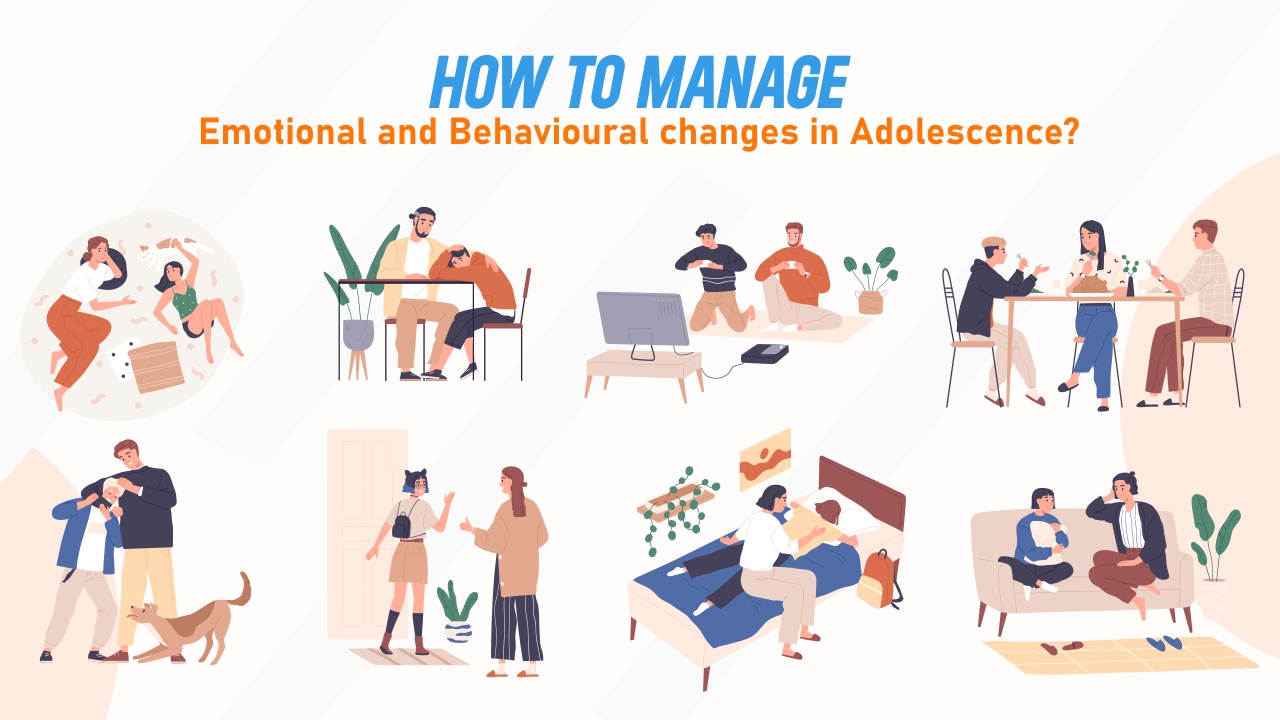 8
There comes a period of time in a kid’s life when they are roughly 10 years old when they start feeling different than normal. They start showing various changes physically, mentally, emotionally, and psychologically. This greatly affects their regular behaviour. This time is particularly challenging for the parents, as sometimes it is noticed that they struggle to understand the reasons for these changes in behaviour and misread them as normal temper tantrums from a kid. If your kid is going through the same thing or is about to enter this age bracket, then this blog is for you. We will help you understand how to manage your kids emotional and behavioural changes in adolescence . Here we have, in simple words, answers to your questions like what adolescence is, what changes you might expect, and how you can ease or help your child while they go through this extremely confusing time. What is adolescence, and what are the changes in adolescence? According to the WHO , "adolescence is the phase of life between childhood and adulthood, from ages 10 to 19." This is the period where kids witness rapid physical, mental, and psychological development. During adolescence, individuals may experience rapid growth, where they can grow several inches within a few months. This growth phase may be followed by a period of slow growth before another growth spurt occurs. This age bracket may slightly vary depending on the biological sex of the child. Females usually go through changes in adolescence roughly a year earlier than males. The period of changes in adolescence may start early or late in different individuals, and there is not much to worry about. However, if you feel that the timing is highly unusual, as in, it has started way early or is getting really late, then you might want to consult a paediatrician. During this time, your kids will mature both physically and sexually; if they are unaware of this phenomenon, it could easily lead to confusion, anxiety, shyness, and various other social complexes. They might also be embarrassed by these changes. This will eventually lead to emotional and behavioural changes in your kids. Emotional and behavioural changes in adolescence include the following: • A growing desire for increased independence from parents • Phases of frustration and negativity • The emergence of abstract thinking abilities • Heightened self-consciousness and sensitivity • Greater influence from peers and social circles • The tendency to compare oneself with others • Fluctuations in energy levels and sleep patterns • The development of a longing for romantic relationships • The maturation of decision-making skills At this time, your job is to provide guidance, support, and comfort. But how will you do that? Keep reading, and we will provide you with just enough answers. How can parents manage behavioural and emotional changes during adolescence? Keep your Kids Informed: One of the most common causes of anxiety among adolescent teens is that they don’t fully understand the changes they are going through. They may understand the concept of physical growth, but other changes, such as sexual, emotional, and psychological, might be complicated for them. Your strategy to deal with behavioural and emotional changes in adolescence should be to keep your kids informed. Have a talk with them, make them understand the expected changes, and clear their doubts. The message that there is nothing unusual about it and that everyone goes through it should be made clear. This will help them dodge any feelings of awkwardness that they might have. Encourage them to talk: If your kids believe that they can talk to you about anything, including these changes, then they won’t hesitate to come to you for help. Due to their recently developed sensibilities, they might overthink about a certain incident with their friends, about the way they look, about their scores compared to others, and many other things. By providing a nurturing and protective environment, you can help your child navigate these emotional and behavioural changes in adolescence. If they talk to you, you can help them effectively cope with the various challenges they encounter, such as mounting academic expectations, peer pressure, and personal and social changes. Ensure that their self-confidence is not affected: During these times, kids might feel that they are being watched constantly by their peers; this can lead to increased consciousness about the way they look, talk, and dress. Although they long for independence from their families at this time, they also feel insecure and struggle to face social pressures. During these times, if they get encouragement from their parents and are motivated to look past these things and focus on their personal growth, then it will help them immensely. Parents can encourage their kids to take on new challenges, learn new skills, and try new sports. This will help with their personality development. When they take up a new skill or a sport, not only will they learn values related to it, but they will also feel more accomplished. Eventually, this will add to their self-confidence and their behaviour around their social circle. Find a balance with their temper tantrums As mentioned before, it is normal for kids during adolescence to feel angry or frustrated and lash out at you or others in the family. During these times, it is important that you do not lose your cool. Your behaviour at these times will act as a model for them as to how to manage confrontations. Try to hear what it is that bothers them and find a solution for it. It is also equally important that you do not give in to every illogical tantrum of your child. You do not want them to develop a behaviour where they lash out at everyone if things do not go their way; dealing with disappointments is also an important part of growing up. The right balance needs to be there. Draw a line and be very clear about the type of behaviour that is acceptable. Do not overindulge It is one of the most common complaints among kids during adolescence that their parents tend to overindulge in their affairs. Whether some of it is necessary or not, they fail to understand. Even when your intentions are to help them and guide them through this time, it is important that you do not come out too strongly. Your kids may or may not be ready to discuss these issues with you right away. Like many, they may feel embarrassed or shy. What you can do in these situations is encourage them to talk to other trusted adults of their choice. This adult can be their aunt, uncle, teacher, or counsellor at the school. Meanwhile, you can try to spend time with them, talk to them about their interests, and share with them yours. Conclusion In order to assist your teenager in managing the confusion and anxiety that come with changes, it is essential to address their fear of the unknown. Encourage them to talk or read to get a better understanding of what they are going through. Try to create a positive perspective out of this; they can view these emotional and behavioural changes in adolescence as an opportunity for personal growth, skill development, and learning. Taking care of their physical well-being is also crucial during this time. Ensure that your teenager receives sufficient sleep, proper nourishment, and regular exercise. A healthy mind and body are better equipped to handle unexpected situations and adapt to change. Reading parenting books can also help you. Here are some of the most recommended parenting books that focuses on teens: 1. Parenting Teens with Love and Logic: Preparing Adolescents for Responsible Adulthood by Foster Cline, MD & Jim Fay 2. The 5 Love Languages of Teenagers: The Secret to Loving Teens Effectively by Gary Chapman 3. Brainstorm: The Power and Purpose of the Teenage Brain by Daniel J. Siegel MD 4. The Grown-Up’s Guide to Teenage Humans: How to Decode Their Behavior, Develop Trust, and Raise a Respectable Adult by Josh Shipp 5. Blame My Brain: The Amazing Teenage Brain Revealed by Nicola Morgan. As it is a period of significant cognitive growth for them, you can recommend your favourite books and movies and have long discussions and debates regarding characters, motivations, themes, etc. Remember, it will feel like a problem only if you treat it like one, take it up as a challenge, and give it your best.
18 May 2023 8
Congratulations on clearing the JEE Mains exam! It's a significant achievement and a testament to your hard work and dedication. However, clearing JEE Main is just the first step towards getting admission to an IIT. So, what stands between you and an IIT is the JEE Advanced 2023. JEE Advanced 2023 is less than a month away, and you might already have a Revision strategy for JEE advanced 2023 . If you don’t, then we would advise you to go through the best revision strategy for JEE Advanced 2023 . You have been doing great till now and we are sure you will continue to do so. Still, we'd like to draw your attention to some mistakes to avoid while preparing for JEE Advanced 2023. These are mistakes that candidates do unintentionally during their JEE Advanced preparation and they end up having a negative impact on their score. • Studying from Multiple Reference Books You can find the list of the best books for JEE Advanced 2023 preparation in our last blog. However, it is important to understand that you do not need to go through all the famous reference books for your JEE Advanced 2023 preparation. Just talk to your teachers, pick the best reference book for a subject, and stick to it throughout your preparation. Studying from multiple reference books will only add to your confusion; your strategy right now should be efficient and focused. • Not giving equitable importance to the subjects We know that the urge to cover more and more of your favourite subject is exciting, but it might be detrimental. There may be a case where your favourite subject paper may be very tough and the subject of your disliking can be very easy paper. This is one of the crucial mistakes to avoid in JEE Advanced 2023 . Also avoid doing the unnecessary syllabus as JEE Advanced exam adheres strictly to the syllabus declared by the IIT’s. Hence, it is advisable that you follow and practise more and more of the concepts mentioned in the prescribed syllabus. • Avoiding self-analysis It is imperative that one do an analysis of their preparation at regular intervals. Self-evaluation works as a check and is very critical for JEE Advanced 2023 preparation . You must always know your strengths and weaknesses at every point. This will include possible adjustments to time spent on specific subjects and study methods. Self-analysis allows you to assess the level of your preparation and adjust your focus to weak areas for improvement. • Concentrating more on 2 subjects This is one of the most common mistakes to avoid in JEE Advanced 2023 preparation . JEE aspirants tend to focus more on any 2 of the 3 subjects, hoping that attempting most of the questions from these subjects accurately will increase their chances of cracking the JEE Advanced exam. The problem with this strategy is the unpredictable nature of the exam itself. The difficulty level of the subjects varies every year, and if you are not able to attempt even 1 of your 2 favourite subjects, then it will seriously affect your result. • Procrastinating revision of your weak areas This is one of the biggest mistakes that aspirants could avoid in their JEE Advanced 2023 preparation. If you have a doubt about any of the concepts, then instantly consult your teacher and practise more questions along the lines of that particular topic. Leaving your weak concepts for later only makes your preparation more vulnerable. You could forget to revise the concepts at the end or not have enough time to perfect them. Moreover, leaving things for the end only adds to the anxiety towards the exam. • Not attempting enough mock tests and previous year's questions online/Computer based mock tests Practising questions from any source is great, but attempting mock tests and previous year's questions will also give you an almost accurate idea of what to expect when attempting a real exam. Additionally, this will teach you time management and help you analyse your strengths and weaknesses. Narayana’s very own nLearn is the perfect educational app for practising IIT-JEE Mock tests or previous year’s questions. Students can create their own tests from the chapters of their choice and effectively evaluate their preparation. Additionally, detailed solutions and advanced evaluation reports from nLearn will help students clear their doubts and improve their weak concepts. • Following a monotonous study schedule Now, this one is tricky. There are many students who would want to stick to one schedule. If you are one of them, then it’s great. You should continue doing so. One timetable or schedule should not be set in stone for all If you feel that following a single daily routine is getting a bit boring or monotonous for you, then you can always make modifications. The modifications should not alter the effectiveness of your old schedule, should not distract you from studies, and should give you enough time to get healthy sleep and rest. For an efficient session, study when you want to study with complete focus and take rests in between. • Not attending to your physical and mental health When you are meticulously preparing for an exam as important as JEE Advanced, it is possible that you might end up ignoring your physical and mental health. Doing this may feel like a necessity to you at the moment, but you should understand that it will eventually take a toll on you. Your JEE Advanced 2023 preparation strategy should involve short breaks, meditations, yoga, healthy sleep, and a whole lot of calmness. Conclusion You understand what works best for you better than anyone else. Our recommendation for the last month of JEE Advanced preparation is to trust the approach you've been following while avoiding the mistakes mentioned above, and we're confident you'll be able to fulfil your dream of studying at the IIT of your choice. The Narayana Educational Institutions extend our warmest wishes to all of you. Good luck and all the best!
13 May 2023 8
Conducted annually by Jawaharlal Nehru Technological University Hyderabad (JNTUH), the Telangana State Engineering, Agriculture, and Medical Common Entrance Test (TS EAMCET) is scheduled to take place from May 10 to May 14 this year. With the exam dates approaching soon, hall tickets have been released by JNTUH TS EAMCET for the registered candidates. This entrance exam for undergraduate study in the fields of engineering, agriculture, and medicine will be administered statewide by computerized testing. This state-level test is required for enrollment in a wide range of professional programs like BE, BTech, BPharm, PharmD, BSc, BFSc, and BVSc degrees at Telangana's universities and private colleges. Seats are distributed using a centralized online counselling procedure that takes into account a candidate's TS EAMCET score and rank. Candidates must get a minimum of 25% of the possible TS EAMCET marks in order to be included in the TS EAMCET rank list. Timeline of TS EAMCET TS EAMCET examination date 2023 Agriculture/Pharmacy: May 10 - 11, 2023 Engineering: May 12 - 14, 2023 Release of preliminary answer key Will be notified soon Date by which objections to the preliminary key must be submitted Will be notified soon TS EAMCET 2023 result Will be notified soon TS EAMCET rank card 2023 Will be notified soon Selection Process of TS EAMCET This section will give you a quick glimpse of the selection process involved for TS EAMCET. -Register for the TS EAMCET 2023 exam. -Download your hall ticket from the official website TS EAMCET 2023 (tsche.ac.in) -Appear for the examination on the scheduled date. -Examine the solutions and the results once the answer key is released. -Participate in online counselling sessions if you qualify the exam. Particulars of TS EAMCET Examination Mode Computer Based Test (Online) Duration of Exam 3 Hours Languages Telugu, English, Urdu Total Questions 160 Section Split For Engineering: Physics - 40 Questions Chemistry - 40 Questions Mathematics - 80 Questions For Agriculture & Medical: Botany – 40 Questions Zoology – 40 Questions Physics - 40 Questions Chemistry - 40 Questions Marking Scheme +1 for every correct answer No negative marking for wrong answers ELIGIBILITY CRITERIA Nationality All applicants must be Indian residents. Those who hold a PIO (Person of Indian Origin) or OCI (Overseas citizen of India) card are eligible TS EAMCET 2023. Domicile Candidates must be residents of Telangana or Andhra Pradesh. Candidates must meet requirements for local or non-local status. Age Limit At the time of admission, applicants should be no less than 16 years old. Applicants aiming for B.Tech. (Dairy Technology), B.Tech. (Ag. Engineering), and B.Tech. (FT) must have turned 17 before December 31, 2023, and must be no older than 22 (or 25 for SC and ST applicants). Educational Qualifications For Engineering/ B.Tech : Candidates must have completed 12th grade or equivalent examination, with optional subject as Mathematics, Physics, and Chemistry, or relevant vocational training in the domains of Engineering and Technology. For Pharma. D : Candidates must have completed a Diploma in Pharmacy from AP/Telangana or have passed Class 12th from a recognized board. TS EAMCET answer key and results The tentative TS EAMCET 2023 answer key will be made available on the official website after the successful conduct of the exam. Regulators will accept candidates’ concerns, if any, to the TS EAMCET answer key after it has been released. The candidates will have an opportunity to voice their concerns for a certain amount of time. However, after reviewing all the responses, the official PDF for the TS EAMCET 2023 exams will be made available. Using the TS EAMCET 2023 answer key, aspirants will be able to estimate their performance in the exam. Once the results are announced, candidates will be able to get their TS EAMCET scores by logging in using their application ID/registration number, TS EAMCET exam hall ticket ID, and date of birth. Some quick last minute preparation tips for your TS EAMCET By this time, you might have done endless revision rounds of your syllabus and prepared yourself completely for the exam day. However, it is very important to remain focused and persistent until the last moment. Here are some quick tips that will help you plan your final leg of the preparation of TS EAMCET in an effective way. -Manage your workflow – Last-minute studying is most successful when time is managed wisely, and revision is given top billing. Try to cut out all the distractions and stay focused by optimizing your study area. -Practice mock tests - To evaluate your readiness and progress, it might be helpful to solve TS EAMCET papers from past years and take practice exams. -Focus on your weak areas – During the last days, you won't have time to thoroughly review your lecture notes and materials. Instead, go over the course content and make a list of the things you don't understand or can't remember. After identifying your areas of weakness, you may better prepare yourself for the test by devoting your study time to those areas while keeping a consistent eye on your strong concepts. -Take short breaks - Even if you're attempting to pack as much material as possible into your head at the last minute, it's still a good idea to take regular study breaks. You should do some physical activity during your study breaks to keep your energy up and your focus sharp. Exercising for as little as five to ten minutes during a study break might help you maintain physical fitness and mental sharpness for when you return to your studies. -Eat healthy - While preparing for an examination, it is essential to consume well, as remaining healthy can improve learning efficiency and concentration. You must take a nutritious diet so as to nourish your body and brain and maintain adequate energy levels. -Pack your essentials – To avoid any kind of hassle, make sure that you pack all the essentials in your bag at least one night before the exam. From your hall ticket and ID card to a pen and water bottle, ensure that you keep necessary stuff with you. Set an alarm and get a good night’s sleep. Keeping the above pointers in mind, you will surely excel in your upcoming TS EAMCET examination and breeze through it seamlessly. So, buckle up yourselves and be ready for your future endeavors! The Narayana Group wishes you all the best for your exam!
08 May 2023

