

Explore stories and insights
Loading...


 19
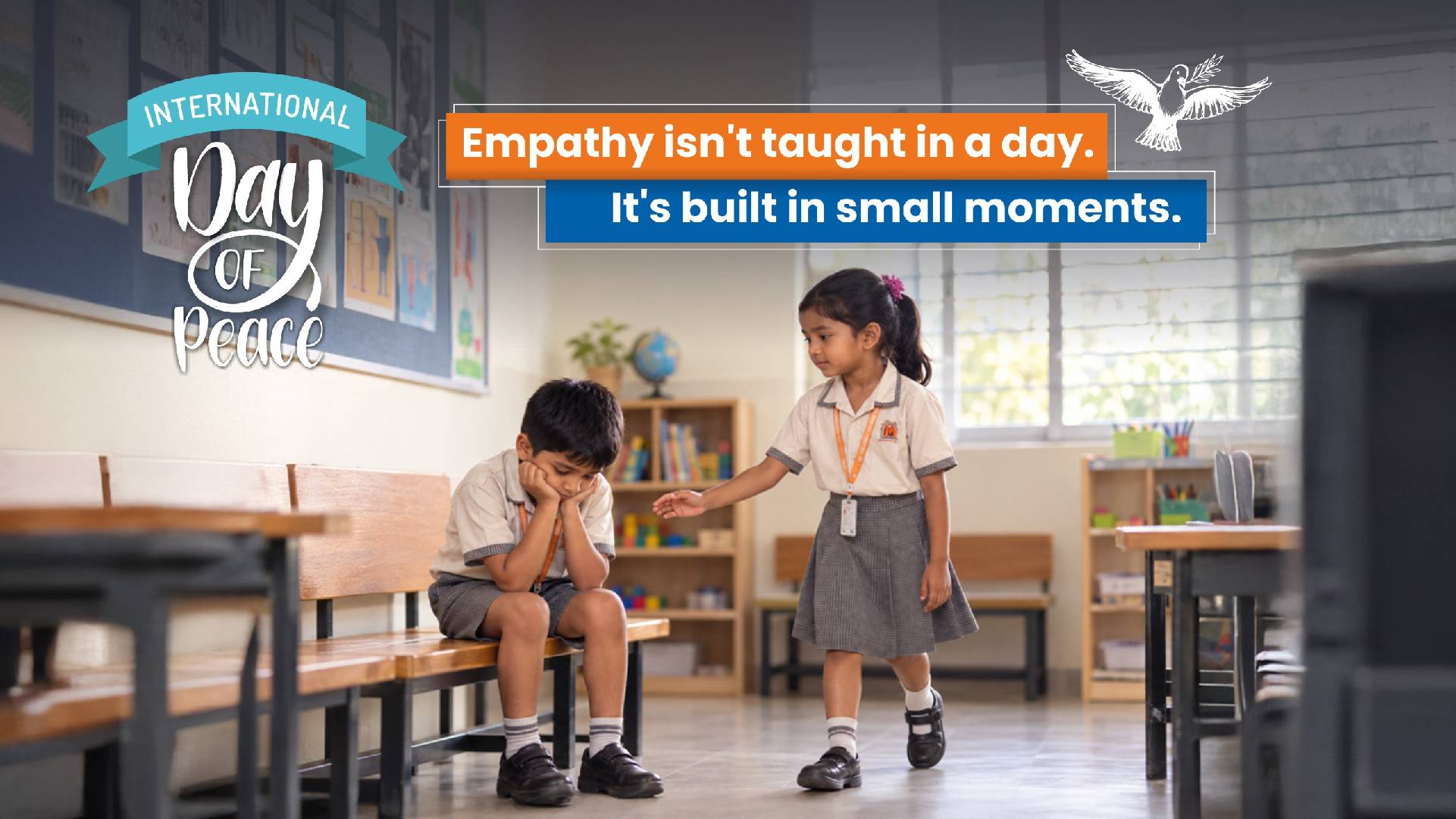
Peace begins with understanding, both of others and of oneself. Children need to learn that everyone has different feelings, abilities and experiences, and that disagreements are a natural part of growing up. Empathy helps them recognise these differences, listen with patience and respond with kindness. Parents can also help children understand that peace within oneself comes from giving every task their best effort, learning from mistakes and being content with the outcome rather than constantly comparing it with others. When children learn to accept themselves, respect others and handle success and disappointment with balance, they develop the emotional foundation needed to build more peaceful relationships. Every year on 21 September, the world marks International Day of Peace . The United Nations set up this day in 1981 to remind everyone that peace starts small, often in a classroom or at home. For parents, peace is not just a big idea; it is a daily habit that can be taught to children. Why Is Empathy Important in Early Education? Empathy means noticing and understanding how someone else feels. Researchers agree that it should be taught early, not left to chance. A 2011 study by Joseph Durlak and his team, published in the journal Child Development , examined 213 school programmes and more than 2,70,000 students. Children who learned social and emotional skills performed better in class, scoring about 11 percentile points higher than those who did not. Kindness and good grades, it turns out, often go hand in hand. How to Teach Empathy to Children at Home? A practical approach starts with simple questions. While reading a bedtime story, parents can be encouraged to ask how a character might be feeling, rather than just asking what happens next. During sibling arguments, children can be asked to guess how the other person feels before deciding who is right. These small, everyday moments teach empathy far better than a single lecture ever could. Peace Education Activities for Kids Peace education activities for kids need not be complicated. Around 21 September, and through the year, simple ideas work well: drawing what peace looks like, writing a kind note to a classmate, or sharing a snack with someone sitting alone. A well-known Canadian programme called Roots of Empathy , created by educator Mary Gordon, brings a baby into classrooms so children can watch and talk about the baby's feelings. The same programme has since been implemented and studied across North America, Europe and Oceania, with research reporting reductions in aggression and bullying alongside increases in empathy and prosocial behaviour. Social-Emotional Learning in Schools: Why It Matters as Much as Marks Some parents worry that time spent on feelings and kindness takes away from studies. Social-emotional learning in schools does the opposite; research shows it tends to support academic learning, rather than compete with it. A calmer, more understanding classroom is usually also a more focused one. Character Building in School Curriculum: What Are CBSE Schools Already Doing? India's National Education Policy 2020 identifies empathy, along with teamwork and cultural awareness, as skills schools should build alongside reading and mathematics. Character building in school curriculum is no longer optional; many CBSE schools' values education programmes already include circle-time talks and value-education periods for exactly this reason, not just around Peace Day, but through the year. How Narayana Schools Promotes Values-Based Learning Narayana Schools promotes values-based learning not as a one-day event, but as part of everyday school life. Regular circle-time discussions, house-based community activities, and dedicated value-education periods give children space to talk about feelings, fairness, and empathy. Complementing this, the Life Skills Programme at the eChamps level (Classes 1–5) nurtures essential skills that shape character and confidence: Communication Skills : Strengthening listening, speaking, reading, and writing abilities to help children express themselves clearly and confidently. Social Skills : Teaching respect, interaction, table manners, and etiquette, ensuring children thrive in group settings and community life. Emotional Skills : Helping children understand that participation matters more than winning, and that both triumphs and setbacks contribute to their growth journey. Together, these initiatives ensure that values are not taught in isolation but woven into the fabric of daily school experiences, preparing children to be empathetic, resilient, and socially responsible individuals. The Larger Lesson Peace, at its smallest, looks like a child pausing before reacting. Teaching that pause patiently, at home and in school, helps children grow into confident, capable people who can chase their dreams with kindness intact, because at Narayana Schools, your dreams are our dreams. Frequently Asked Questions What is International Day of Peace and why is it celebrated? It is a day set by the United Nations in 1981, marked every 21 September, to remind the world that peace begins with small, everyday choices, including how children are taught to treat one another. How can parents build empathy at home? Simple habits help: talking about feelings in stories, asking children to see arguments from another person's side, and encouraging small acts of kindness towards others. What is values-based education? It is teaching that goes beyond marks and subjects, helping children build honesty, kindness, fairness and respect alongside academic knowledge. Why is social-emotional learning important for children? Research shows it helps children manage emotions, get along with others, and even do better academically, making it as important as any other subject.
 17 Sept 2026
 16
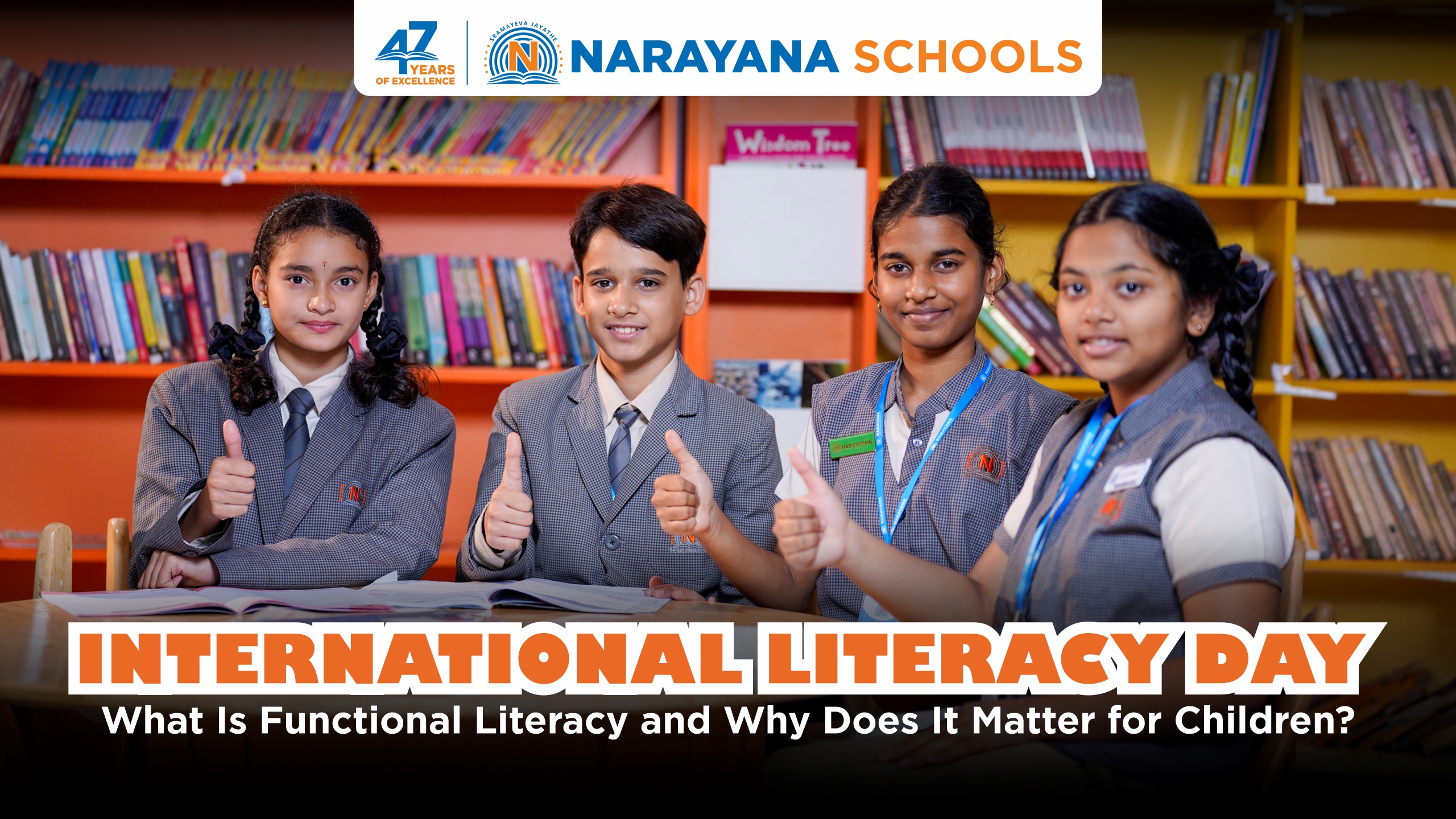
International Literacy Day, observed every year on 8 September, reminds us that literacy is a foundation for learning, communication, participation and lifelong development. But in today's world, literacy means much more than simply being able to read and write. Functional literacy is the ability to understand, use, evaluate and apply information in everyday situations. A child may be able to read a paragraph, for example, but still be developing functional literacy if they struggle to understand a school notice, interpret a timetable, follow written instructions or question misleading information. For children growing up across academic, social and digital environments, literacy must therefore evolve from recognising words to understanding ideas, communicating clearly, thinking critically and applying knowledge in real life. What Is Functional Literacy? Functional literacy goes beyond basic reading and writing. It involves using literacy skills meaningfully in situations children encounter every day. A functionally literate child learns to: understand and interpret information; communicate ideas clearly; follow and apply instructions; evaluate information and distinguish fact from opinion; solve problems and make decisions; use information in academic, social and digital situations. This broader understanding is particularly relevant for International Literacy Day 2026. Literacy is no longer limited to what happens on a textbook page. Children are constantly reading screens, interpreting information, communicating with others, making choices and deciding what information they can trust. Why Is Functional Literacy Important for Children? The Government of India's National Education Policy (NEP) 2020 places foundational literacy and numeracy among the highest priorities, with emphasis on reading, writing, speaking, counting and mathematical thinking. But foundational skills become meaningful when children can use them beyond a classroom exercise. Reading a science instruction and following it accurately, interpreting a graph, understanding a timetable, explaining an idea or questioning a claim online all require children to do more than recognise words. They require comprehension, reasoning and application. At Narayana Schools, this broader approach to literacy is reflected across learning stages and programmes. How Does Functional Literacy Develop in School? Functional literacy develops progressively. It begins with early language and communication skills and gradually expands into comprehension, critical thinking, problem solving, digital awareness and real-world application. eKidz : Building Literacy Before the First Textbook Literacy begins before a child encounters their first textbook. At Narayana Schools, the eKidz programme introduces early literacy through language-rich, play-based learning that supports communication, listening and cognitive development. Stories, conversations, phonological awareness and print-rich environments help children connect sounds, words and meaning. For parents, even a simple activity such as reading a picture book together can build these skills. Instead of only asking a child to identify words, questions such as “What happened?” or “What might happen next?” encourage comprehension, prediction and conversation. The goal is to move from simply recognising words to beginning to understand and interpret them. eChamps : Helping Reading Lead to Understanding As children progress, literacy must develop from basic recognition into meaningful communication and comprehension. The eChamps programme builds communication skills across listening, speaking, reading and writing, alongside activity-based and experiential learning. This matters because effective literacy is not simply about producing correct answers. Children also need to understand what they read, express what they think and connect what they learn with their experiences. When reading leads to understanding and communication, literacy becomes a tool for learning rather than an isolated academic skill. From Reading Text to Reading the World Functional literacy becomes particularly important when students begin using information independently. A science instruction needs to be followed accurately. A graph needs to be interpreted. A news report needs to be questioned. Information from different sources may need to be compared before a conclusion is reached. The OECD describes reading literacy in terms that extend beyond decoding text, including understanding, using, evaluating, reflecting on and engaging with texts. It also highlights the importance of distinguishing fact from opinion and assessing information across digital sources. This makes digital literacy an increasingly important part of functional literacy. Parents can support this development through simple everyday activities: comparing two news reports, identifying the source of an online claim or asking children what evidence supports a particular statement. Life Skills: Turning Literacy Into Everyday Action Not every literacy challenge looks like a reading exercise. Understanding emotions, communicating clearly, making decisions, solving problems and working effectively with others all require children to interpret situations and respond appropriately. Narayana Schools' Life Skills Programme supports these abilities through communication, interpersonal skills, decision making, problem solving and emotional awareness. This connects literacy with something children encounter constantly: real life . A conversation about peer pressure, a disagreement with a friend or a difficult choice can become an opportunity to practise communication, reasoning and decision making. In this sense, literacy is not only about understanding written information. It is also about understanding situations and responding thoughtfully. Catalyst Lab: Where Learning Meets Experience The Catalyst Lab at Narayana Schools takes this experiential approach further through activities centred around Resilience, Perseverance, Reflection and Gratitude. The Mindset Development and Well-being Lab at the Vadavalli Campus in Coimbatore provides students opportunities to explore areas such as stress management, goal setting, mindfulness, emotional intelligence, leadership, teamwork and self-awareness. These experiences add another dimension to literacy education. Students are not only learning to understand words and information. They are also learning to understand themselves, communicate with others and respond thoughtfully to real situations. That ability to interpret, reflect and act is an important part of becoming functionally literate. Does Literacy Stop at Primary School? No. Functional literacy continues to develop as children encounter increasingly complex information. At the eTechno programme , students engage with more complex texts, subject-specific vocabulary, data and digital information while developing conceptual understanding. At this stage, literacy becomes closely connected with critical thinking, communication and problem solving. Narayana's structured curriculum, experiential learning and personalised support are designed to address learning needs across stages. The journey therefore moves from: recognising words → understanding ideas → communicating clearly → evaluating information → applying knowledge. How Can Parents Build Functional Literacy at Home? Schools play an important role, but everyday experiences at home can reinforce functional literacy. Parents can encourage children to: Read and discuss stories rather than focusing only on reading fluency. Ask questions about what they read , including what happened, why it happened and what might happen next. Interpret everyday information , such as timetables, notices, instructions or charts. Question information online by asking where a claim came from and what evidence supports it. Discuss real-life situations , giving children opportunities to practise communication, problem solving and decision making. These small activities can help children understand that literacy is something they use every day—not simply something they demonstrate in an examination. What Is the Real Test of Literacy? The real test of literacy is not whether a child can recognise words on a page. It is whether they can use what they understand. The World Bank describes foundational learning as the base for lifelong learning, cognitive development and participation in society. That is the larger purpose of literacy education at Narayana Schools: helping students move from recognising words to understanding ideas, from writing answers to communicating clearly, and from consuming information to evaluating it. When literacy becomes a daily habit of reading, questioning, calculating, communicating and thinking, it becomes a foundation for lifelong learning and the confidence to fulfil dreams, because at Narayana Schools, your dreams are our dreams. Curious how literacy builds through the years? Explore how Narayana's eKidz , eChamps and eTechno programmes grow with your child, from first stories to critical thinking. Frequently Asked Questions About Functional Literacy What is functional literacy? Functional literacy is the ability to understand, use, evaluate and apply information in everyday academic, social and digital situations. It goes beyond basic reading and writing to include comprehension, communication, critical thinking and problem solving. Why is functional literacy important for children? Functional literacy helps children use what they learn in real-life situations. It supports their ability to understand instructions, communicate clearly, evaluate information, solve problems and make informed decisions. What is the difference between literacy and functional literacy? Basic literacy generally focuses on the ability to read and write. Functional literacy goes further by enabling a person to understand, evaluate and use information effectively in everyday situations. How does digital literacy relate to functional literacy? Children increasingly encounter information through digital platforms. Digital literacy helps them assess online information, identify sources, distinguish fact from opinion and use digital information thoughtfully. How can parents develop functional literacy at home? Parents can encourage reading and discussion, ask comprehension questions, involve children in interpreting everyday information, discuss online claims and use real-life situations to practise communication and decision making. At what age does functional literacy begin? Functional literacy develops progressively. Early language, listening, communication and comprehension skills form the foundation, which continues to develop as children encounter more complex academic, social and digital situations. How does Narayana Schools approach functional literacy? Narayana Schools develops literacy progressively through programmes and learning experiences including eKidz, eChamps, eTechno, the Life Skills Programme and Catalyst Lab, connecting language and academic learning with communication, critical thinking, problem solving and real-world application.
08 Sept 2026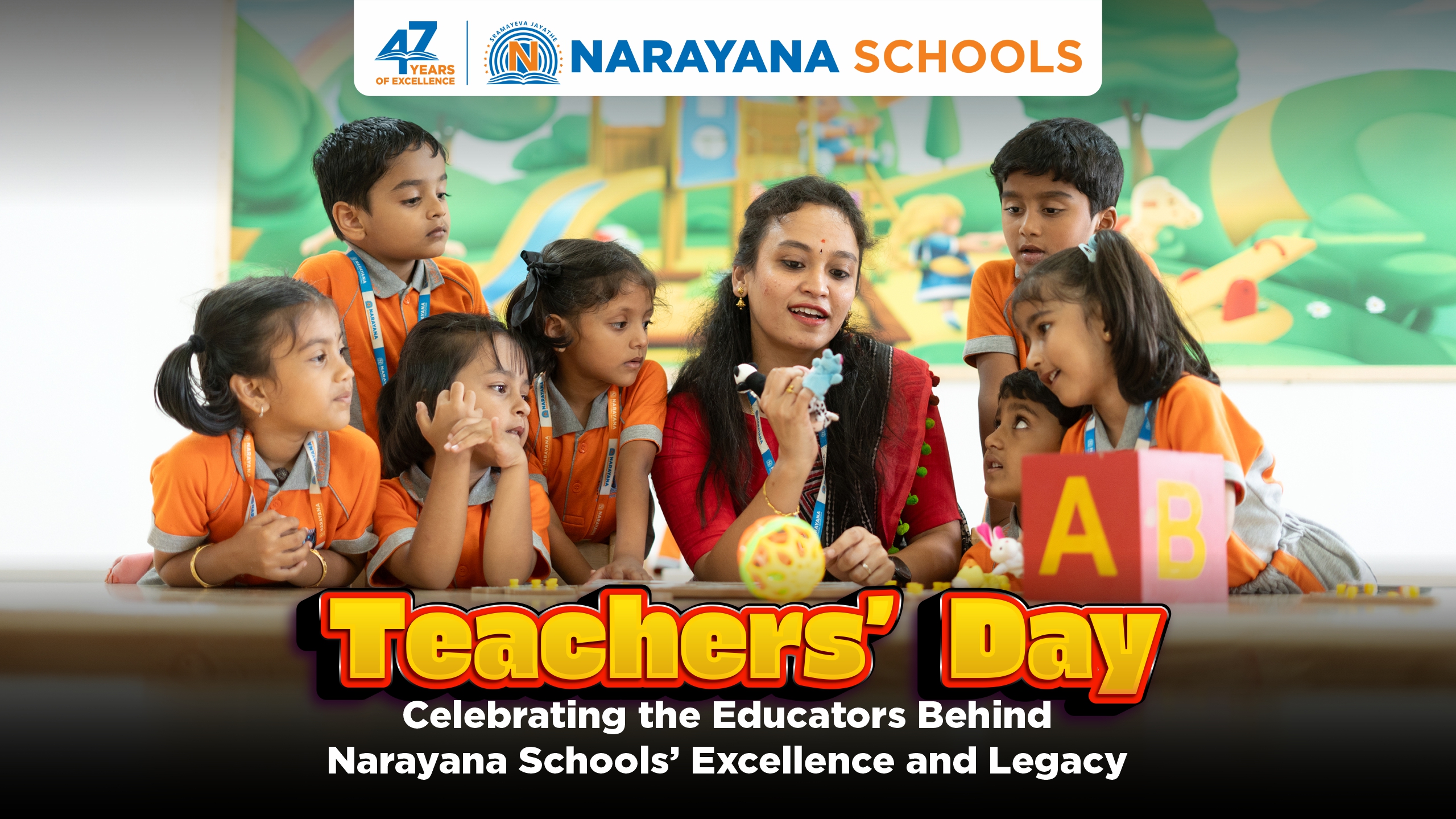 24
Ask most adults what they actually remember from school and it is rarely the syllabus. It is a teacher who noticed something: a struggle, a spark, a question nobody else had bothered to answer properly. That is the quiet thread running through Teachers’ Day at Narayana Schools . Not a date to tick off but a tribute to the people who turn a classroom into somewhere curiosity can actually survive. Why is Teachers' Day celebrated? 5 September in India marks the birth anniversary of Dr. Sarvepalli Radhakrishnan , philosopher, scholar and India's second President, whose conviction that education could transform a nation is exactly why the day exists at all. It's also why India instituted the National Teachers' Awards back in 1958 , recognising educators whose work goes well beyond the classroom register. For parents, Teachers’ Day 2026 is worth using for something other than a greeting card. It is a small window to talk to your child about what a teacher actually does for them, academically, yes, but also in terms of confidence and character. Aspire Summit: Celebrating the people behind excellence Narayana Schools gives this idea a proper stage through its annual Aspire Summit, where teachers, mentors and academic leaders are recognised for the kind of work that doesn't always show up on a report card. As Seema Pawar , Senior Biology Faculty at Narayana Schools , puts it: "Teaching is not simply about completing a syllabus. It is about recognising potential, building confidence and helping every student believe that a difficult challenge can be overcome." That's not a throwaway line. It describes what happens quietly, every day: a teacher clocking who's fallen behind, who needs to be pushed harder, who just needs someone to believe they can do it. Teachers who inspire and mentor Md. Illiyas , a Life Skills Trainer at Narayana Schools , points to a different kind of reward altogether: "The most rewarding moment for a teacher is not always a high score. It is seeing a student who once hesitated begin to ask questions, participate confidently and take ownership of learning." None of this happens by accident. Narayana invests in ongoing training for its faculty, with a pedagogy built around personalised support rather than one size fits all instruction. This is arguably what defines schools with the best teachers , not just educators who know their subjects well, but those who can understand different learners and adapt their approach accordingly. Sakshi Mishra , eKidz Pre-Primary Resource Person at Narayana Schools , puts the challenge simply: "Every student learns differently. The responsibility of an educator is to keep adapting, finding new ways to make classes meaningful and ensuring that no learner feels left behind." Recognising dedication through Aspire Summit What the Aspire Summit does well is give ordinary, unglamorous dedication a proper platform. Chaithali S. Reddy , Senior Coordinator at Narayana Schools , explains why that matters: "Recognition at the Aspire Summit is meaningful because it celebrates the effort behind educational outcomes. It reminds every educator that dedication in the classroom creates an impact that can last far beyond the academic year." Making Teachers' Day meaningful for children Teachers' Day can also become a lesson in gratitude and reflection. Children can: Write a personal note describing one specific moment when a teacher made learning easier or more meaningful. Identify an educator's quality they admire, such as patience, clarity, discipline or encouragement. Reflect on how teachers contribute to confidence, curiosity, values and growth beyond examination marks. The Aspire Spirit Every doubt resolved, every difficult concept finally understood, every bit of confidence rebuilt after a bad test all adds up to something larger than any single year's results. This Teachers' Day, Narayana Schools’ faculty are being celebrated for exactly that: not just subject teachers, but the ones shaping how their students think and who they become. Narayana Schools celebrates its educators not simply for teaching subjects, but for shaping thinkers, achievers and responsible individuals. We believe when educators are empowered and excellence is recognised, students gain stronger foundations to dream, strive and achieve, because at Narayana Schools, your dreams are our dreams .
05 Sept 2026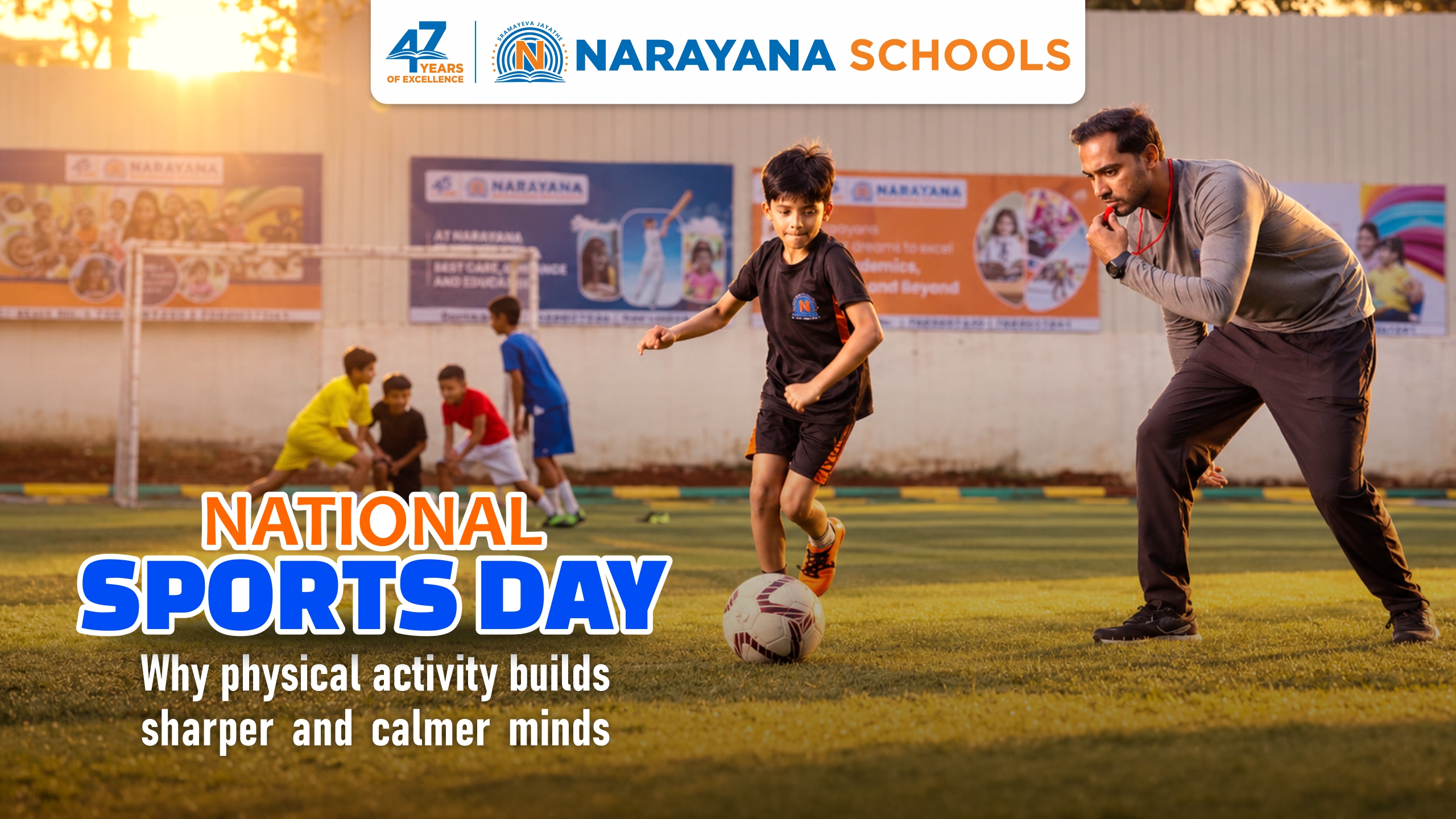 24
What if the hour spent on a football field could also strengthen concentration, emotional balance and problem solving? That is the bigger lesson behind National Sports Day , observed in India on 29 August to commemorate hockey legend Major Dhyan Chand , whose birthday is celebrated as a tribute to his contribution to Indian sport. The day has been observed since 2012 . Active bodies support active minds Regular physical activity for children is linked with attention, executive function and cognitive performance. A meta-analysis of 31 intervention studies involving children aged 6 to 12 found positive effects of physical activity on executive functions and attention. A systematic review of randomised controlled trials found that 80% of the included studies reported positive effects of physical activity on cognition. Sport can help children manage emotional pressure Exercise is not simply about physical fitness. Research involving 21 systematic reviews and 375 randomised controlled trials found that exercise reduced symptoms of depression and anxiety among children and adolescents aged 5 to 18. Team sports can additionally provide opportunities to practise communication, cooperation, resilience and handling setbacks. Parents can help by treating sport as part of a healthy routine rather than removing it whenever examinations approach. Sixty minutes can make a difference The World Health Organization (WHO) recommends an average of 60 minutes of moderate to vigorous physical activity each day for children and adolescents aged 5 to 17, including play, sports, active travel and physical education. A practical routine could combine cycling, football, badminton, swimming, dancing, running or active games according to age, ability and interest. At Narayana Schools sport is part of holistic learning Narayana Schools’ nSports Programme combines age-appropriate physical education with fitness, leadership, discipline, teamwork, sportsmanship and perseverance . eKidz (Nursery – UKG): Builds foundational movement skills such as throwing, catching, balancing and kicking. EChamps (Classes 1 – 5): Introduces sports including throw ball, kabaddi, badminton, football, Frisbee, Kho-Kho and athletics. ETechno (Classes 6 – 10): Introduced to basketball, volleyball, etc., and develop advanced sporting skills through specialised training, conditioning and competitive leagues. Inclusive participation: Encourages every student to participate, discover interests and build confidence. Summer Sports Camp: Provides structured holiday training guided by coaches. Narayana Premier League (NPL): Creates opportunities to compete across grade, house and zone levels. Sports Achievement Reward Policy: Recognises sporting excellence with cash rewards ranging from ₹ 1,000 to ₹ 10,000 for student achievers at district, state, national and international levels. International participants receive ₹ 10,000 , while national-level gold, silver and bronze medallists receive ₹ 6,000, ₹ 5,000 and ₹ 4,000 , respectively, encouraging students to pursue sporting excellence with greater motivation. With nSports spanning 550+ school campuses with 660 Physical Education teachers , the focus extends to nurturing fit, confident and resilient individuals, as we believe every step on the field can build the character and confidence needed to pursue bigger dreams, because at Narayana Schools, your dreams are our dreams .
28 Aug 2026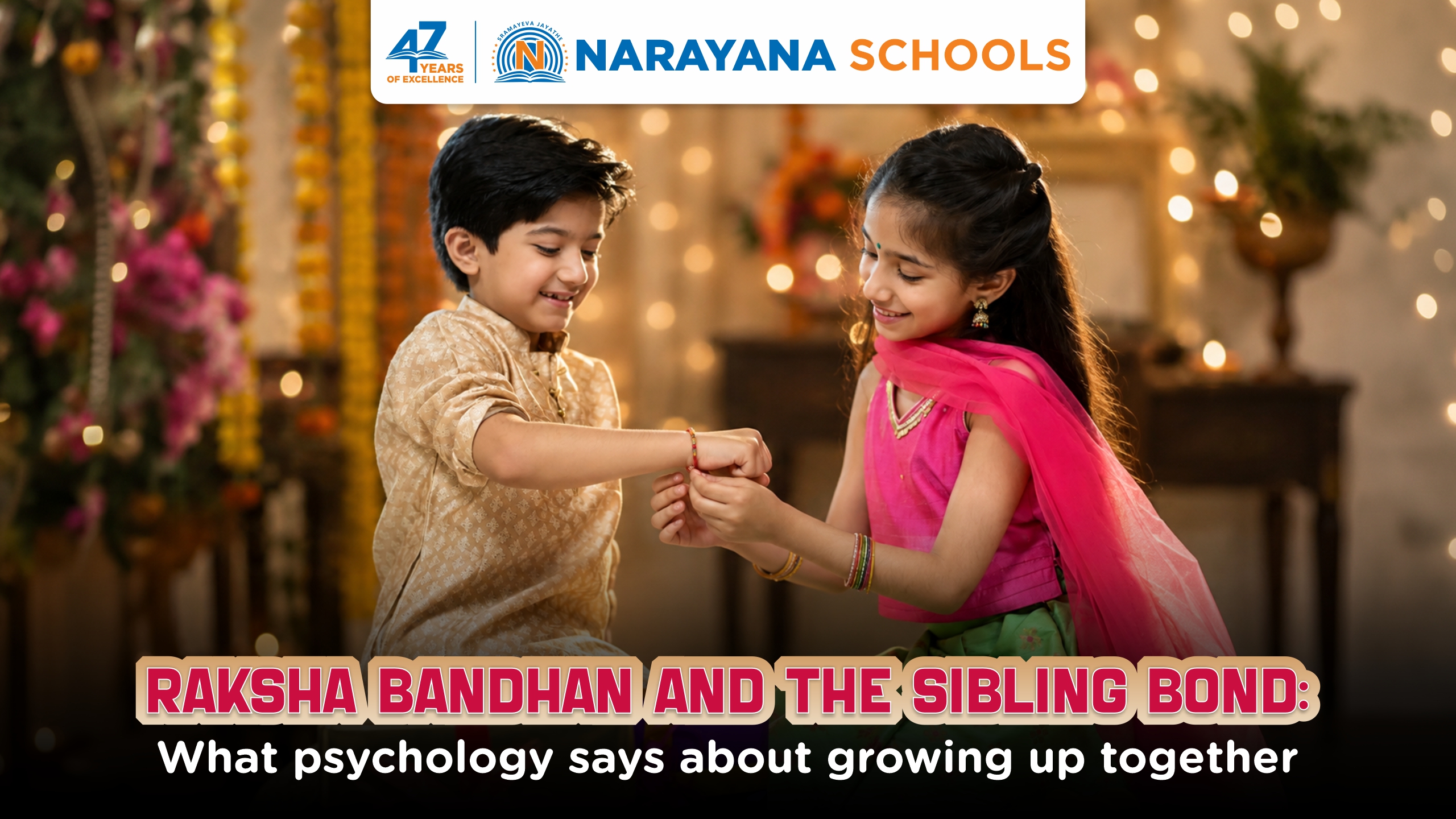 16
Raksha Bandhan (a festival celebrating the bond of love, care and protection between siblings) honours a relationship that begins long before the rakhi (a sacred thread tied around a sibling’s wrist as a symbol of love and protection ) is tied. The teasing, arguments, shared secrets, borrowed belongings and occasional acts of unexpected kindness are all part of growing up together. Psychology suggests that sibling relationships can become an important setting for learning empathy, emotional regulation, communication and conflict resolution. A review by researchers at the University of Oregon found that supportive sibling relationships can strengthen self-regulation and emotional understanding. Siblings become everyday social teachers Children naturally learn negotiation, cooperation and communication through everyday sibling interactions. Parents can give siblings a shared task , such as planning a family game night, arranging a bookshelf or preparing a simple snack together, with each child responsible for one part. When siblings disagree over a toy, game or activity, parents can ask each child to suggest one solution that would be fair to both , rather than immediately deciding who is right. During family activities, rotating responsibilities such as choosing the game, setting the table or selecting a weekend activity can help children practise decision-making and cooperation . An Indian study published in the International Journal of Indian Psychology explored how sibling relationships can contribute to social and emotional competence through communication, socialisation and emotional regulation. Arguments can become lessons in conflict resolution Sibling disagreements can provide practical opportunities to learn negotiation, compromise, apology and relationship repair. Instead of immediately settling an argument, parents can ask: “What happened from each side?” , followed by “What would make this fair for both?” For recurring conflicts, children can jointly create three family rules , such as no shouting, taking turns speaking and asking before borrowing belongings. After an argument, encourage a repair action , such as returning a borrowed item, apologising for hurtful words or agreeing on how the situation can be handled differently next time. A 2026 scoping review of 57 studies identified negotiation and compromise among the most frequently studied sibling conflict-management strategies. Parents should intervene immediately when disagreements involve physical aggression, intimidation or persistent emotional harm. For ordinary age-appropriate disagreements, allowing children some space to negotiate can help build conflict resolution skills in children and emotional regulation. Warmth matters more than perfect harmony Siblings do not need to agree all the time to have a healthy relationship. Research has linked greater sibling warmth and lower conflict with fewer emotional and behavioural difficulties among children and adolescents. Simple rituals such as shared meals, games, storytelling or celebrating achievements together can strengthen sibling bonding . Avoid the comparison trap Comparing marks, appearance, talents or behaviour can turn natural differences into rivalry. Research on sibling relationships highlights parental differential treatment as an important factor in children's adjustment. Recognising individual strengths helps siblings experience the family as a space of belonging rather than competition. Make Raksha Bandhan about reciprocity The rakhi can become a starting point for conversations about care, respect and responsibility rather than a one-sided promise of protection. Children can write appreciation notes, create handmade gifts or plan a sibling activity together. The deeper lesson is simple: growing up together means learning to support, respect, forgive and stand beside one another. Sibling relationships can change dramatically from childhood to adulthood. A 2026 longitudinal study tracking sibling relationships from ages 7 to 30 found that levels of sibling intimacy and conflict change throughout childhood, adolescence and early adulthood , highlighting that sibling relationships continue to evolve rather than follow a fixed pattern. This Raksha Bandhan, beyond the rakhi and sweets, lies an opportunity to nurture one of childhood's longest relationships: a sibling bond built on affection, understanding and shared growth .
25 Aug 2026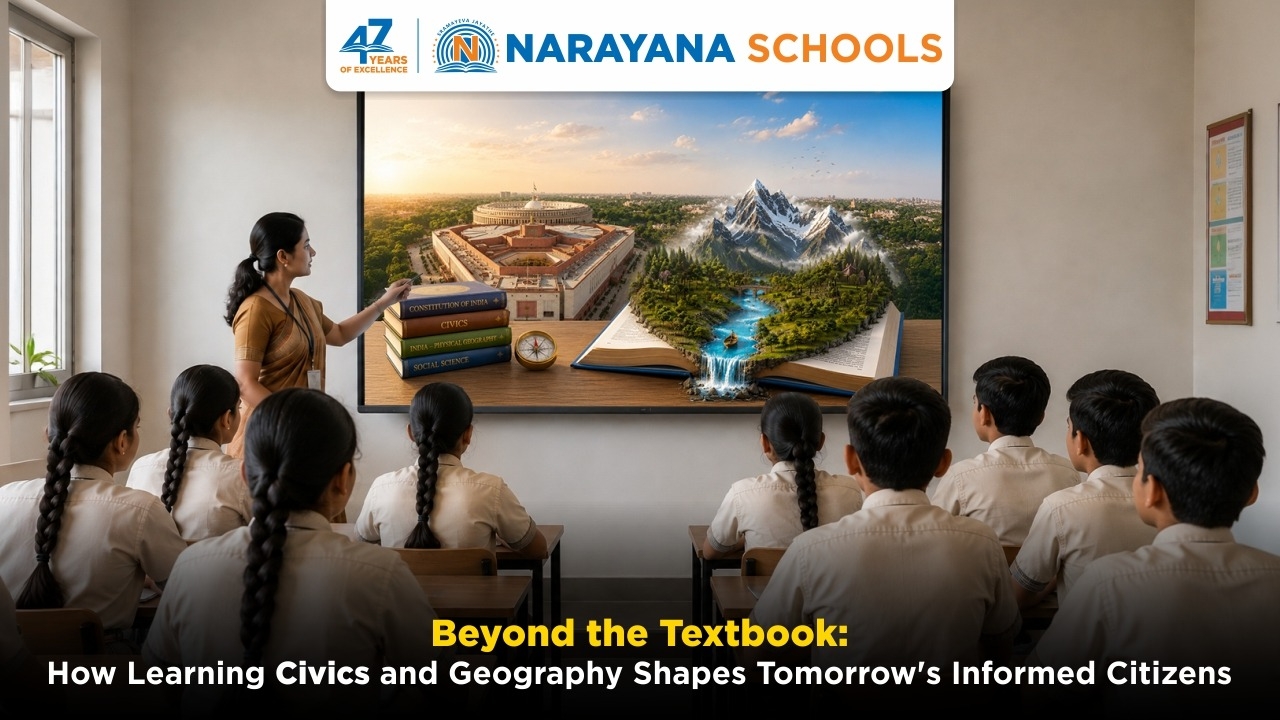 15
What connects a flood in Assam, a new law in Delhi and a farmer’s livelihood in Punjab? Civics and Geography . These subjects are not simply about memorising constitutional provisions, maps or rivers. They explain how India functions, why communities develop differently and how decisions made at one level can affect lives elsewhere. For Indian parents, this makes social science education , civic awareness and geography learning powerful tools for raising informed, thoughtful and responsible citizens. Civics turns students into active citizens Learning the basics of Indian Constitution , Parliament, elections, fundamental rights and duties helps children understand how democracy works. Discussions around real issues can develop critical thinking , rather than reducing civics to textbook answers. For example: When a neighbourhood faces a problem such as overflowing garbage or unsafe roads, children can explore which local authority is responsible, what citizens can do and how a democratic grievance system works. This turns a textbook lesson on local governance and civic responsibility into a real-life problem-solving exercise. UNESCO’s Global Citizenship Education (GCED) framework identifies critical inquiry, media literacy, decision-making, problem-solving and social responsibility as important civic competencies. Geography makes the world make sense Why does one region face floods while another experiences drought? Why are cities expanding rapidly while some communities depend on agriculture? Geography education in India helps children connect climate, resources, population, migration, livelihoods and development. For example: The El Niño phenomenon shows how changes in ocean temperatures in the Pacific can influence weather patterns far beyond the region, including rainfall patterns in India. Studying El Niño helps children understand the links between climate, monsoons, agriculture, water availability and livelihoods , turning a geographical concept into a real-world lesson. Maps, satellite imagery, local observations and case studies can transform geographical facts into meaningful understanding. Connect the two and watch thinking change A new highway is not merely a line on a map. It can influence employment, migration, land use and local governance. A water shortage involves geography, economics, public policy and community behaviour. This interdisciplinary learning helps children understand that real-world problems rarely belong to one subject. Teach children to question information News, social media and artificial intelligence can expose children to enormous amounts of information. Organisation for Economic Co-operation and Development (OECD)research highlights the importance of evaluating evidence, recognising different perspectives and comparing possible solutions. Comparing two reports about the same issue can become a practical exercise in media literacy for students . Turn learning into everyday action Follow one local civic issue and identify the authorities responsible for addressing it. Map local water bodies, green spaces or traffic hotspots. Discuss how a new policy could affect different communities. Conduct family debates where children argue different sides of an issue using evidence. Prepare citizens for a complex future The OECD’s Programme for International Student Assessment (PISA) defines global competence around examining local and global issues, understanding different perspectives and taking responsible action. The ultimate purpose of civics and geography learning is therefore bigger than examination success. These subjects can help children understand India, question information intelligently, appreciate diverse perspectives and participate meaningfully in society. Beyond the textbook lies the real lesson: knowing how a country works is the first step towards helping shape how it grows. At Narayana Schools, learning extends beyond textbooks through opportunities that encourage students to learn, connect and enact . Debates and discussions encourage students to examine different perspectives, question ideas and develop critical thinking. Speeches and extempore activities build confidence, articulation and the ability to express ideas clearly. Model United Nations (MUN) introduces students to global issues, diplomacy, collaboration and responsible decision-making. Such experiences help students connect Civics and Geography with the real world , understand their roles and responsibilities and participate more confidently in society. By creating opportunities to think, question, communicate and take informed action, we help students develop the awareness and confidence to dream boldly and build those dreams , because at Narayana Schools, your dreams are our dreams .
22 Aug 2026

