

Explore stories and insights
Loading...



 19
From questions about black holes to fascination with rockets, space often sparks a child’s first encounter with science. This makes World Space Week 2026 an ideal opportunity for parents to transform curiosity into meaningful learning. Celebrated globally from 4-10 October , World Space Week was proclaimed by the United Nations in 1999 to honour the contribution of space science and technology to humanity. The dates commemorate the launch of Sputnik 1 on 4 October 1957 and the coming into force of the Outer Space Treaty on 10 October 1967 . The 2026 theme, Rocket Revolution , highlights how advances in rocket technology are making space more accessible than ever before. With the right guidance, space curiosity can become a pathway to observation, experimentation and scientific thinking. 5 Ways to Turn Space Interest into Real Scientific Thinking 1. Encourage Questions and Not Just Answers Research in science education consistently shows that inquiry-led learning improves understanding and retention. Instead of explaining everything, encourage children to ask: Why do rockets need fuel? How do astronauts live in space? Why does the Moon appear different each night? This develops critical thinking skills , the foundation of scientific discovery. 2. Connect Space with Everyday Life Many children do not realise that space technology powers Global Positioning System (GPS) navigation, weather forecasting, disaster monitoring and telecommunications. Linking classroom science to daily life helps build practical understanding of STEM education and its real-world impact. 3. Follow India’s Space Journey India provides a powerful source of inspiration. ISRO's Chandrayaan-3 Moon landing, the Aditya-L1 solar mission and continued launch vehicle innovations have demonstrated how world-class science can emerge from Indian classrooms and laboratories. India was also the first country to reach Mars orbit on its maiden attempt through Mangalyaan and has developed NavIC , its own satellite navigation system. India’s space story is now expanding beyond government-led missions. Skyroot Aerospace , a Hyderabad-based private space company, successfully launched Vikram-1 on 18 July 2026 , marking the first orbital launch by a private Indian company from Indian soil . The four-stage rocket carried multiple payloads into Low Earth Orbit, demonstrating the growing capabilities of India’s private space sector. With upcoming missions such as Gaganyaan and advances in space docking technologies, India continues to expand the boundaries of exploration, innovation and private participation in space. These achievements help children view science not as a distant dream but as a realistic career pathway. 4. Replace Passive Screens with Active Exploration Simple activities can make a significant difference: Night-sky observation journals Moon-phase tracking Model rocket projects Space documentaries followed by discussions Science exhibitions and astronomy club participation Hands-on experiences strengthen scientific reasoning far more effectively than passive consumption. 5. Build Strong Foundations in Mathematics and Science A study published in Nature Human Behaviour found that early interest in science often predicts later engagement in STEM fields. However, curiosity alone is not enough. Consistent development of mathematics, physics and problem-solving skills is essential for future scientists, engineers and innovators. 6. Why World Space Week Matters for Indian Parents? As India expands its space ambitions, future careers will increasingly require expertise in space science , robotics , artificial intelligence , engineering and data science . World Space Week provides a timely reminder that nurturing scientific thinking can begin at any age and in any classroom. 7. How Narayana Schools Turns Space Curiosity into Real Science? At Narayana Schools , space curiosity comes alive through STEM-focussed learning, Olympiad preparation, scientific enquiry, innovation-driven activities, competitive academic programmes and experiential learning opportunities that encourage students to think beyond textbooks and explore the possibilities of the universe. This year, in line with the World Space Week 2026 theme, Rocket Revolution , Narayana Schools conducted an interactive session to sensitise students to the rapid advances in rocket technology and India's growing space capabilities. The successful Vikram-1 mission by Hyderabad-based Skyroot Aerospace was used as a real-world example to inspire students, spark curiosity and encourage them to explore how science, technology and innovation can turn ambitious space ideas into reality. NSS Space Competitions (National Space Society) Narayana Schools students take part in global competitions of the National Space Society , including the Space Settlement Contest (formerly run by NASA ). It provides opportunities for students to engage with space-related concepts, imagine future habitats and explore ideas connected to space science, engineering and human settlement beyond Earth. Narayana students won a record 99 awards in the 2024-25 edition . International Olympiad on Astronomy and Astrophysics (IOAA) Narayana Schools' focus on scientific excellence also extends to international astronomy competitions. At the 19th International Olympiad on Astronomy and Astrophysics (IOAA) 2026 , held in Hanoi, Vietnam , Narayana Schools students Akshat Srivastava, Pranjal Dixit and Sumant Gupta won Gold Medals for India as part of the five-member Indian team . Their achievement reflects the depth of scientific understanding, problem-solving ability and astronomical knowledge required to compete at the global level. The Four Club Framework Beyond the regular curriculum, some campuses of Narayana Schools has structured co-curricular learning into a dedicated four club framework, designed to develop future-ready learners through hands-on, meaningful and joyful experiences: Pixel Palette: A digital creativity club where students explore design, digital art and visual storytelling. Synergy X: A STEM and aerospace focused club encouraging hands-on experimentation, engineering thinking and scientific exploration. This is where space curiosity truly takes flight, with students building, testing and tinkering like young engineers. Idea Vault: A club centred on financial literacy, entrepreneurship and innovation, helping students think like builders and problem solvers. Global Vox: A public discourse and diplomacy club that builds articulation, global awareness and confident communication. Guided by the EDGE framework, Explore, Design, Grow and Excel , these clubs take students from curiosity towards deeper application through interactive, activity-based experiences. The journey culminates in Clubs Culmination , Narayana Schools' annual celebration where students showcase the skills, ideas and projects developed through the clubs. Every practice and initiative at Narayana Schools stems from one belief: that a child's curiosity, nurtured well, can grow into real science and a dream fulfilled, because your dreams are our dreams . Frequently Asked Questions What is World Space Week and when is it celebrated? World Space Week is celebrated globally from 4-10 October. The United Nations proclaimed it in 1999 to honour the contribution of space science and technology to humanity. The dates mark the launch of Sputnik 1 on 4 October 1957 and the Outer Space Treaty coming into force on 10 October 1967. The 2026 theme is Rocket Revolution. How can I turn my child's interest in space into real scientific thinking? Encourage questions rather than only giving answers, and connect space to everyday life through GPS, weather forecasting and telecommunications. Replace passive screen time with active exploration such as night-sky journals, Moon-phase tracking and model rocket projects. Alongside this, build strong foundations in mathematics, physics and problem-solving. Why is mathematics important for children interested in space science? Curiosity sparks interest, but it is not enough on its own. Consistent development of mathematics, physics and problem-solving skills is essential for future scientists, engineers and innovators. These skills help children move from asking "what happens?" to understanding "why does it happen?" How does Narayana Schools support students interested in space and science? The eChamps programme (Classes 1-5) uses activity-based learning in Classes 1-2 and experiential learning in Classes 3-5. The eTechno programme (Classes 6-10) builds depth in science and mathematics along with Olympiad preparation. Students also take part in National Space Society competitions. In Synergy X, the STEM and aerospace club, they experiment, build and test ideas like young innovators.
 07 Oct 2026
 18
Gandhi Jayanti , observed on 2 October , marks the birth anniversary of Mahatma Gandhi , born in 1869 . The day commemorates his contribution to India’s freedom movement and his enduring principles of truth, non-violence, peace, self-discipline, service and self-reliance . In recognition of Gandhi’s enduring philosophy of non-violence, the United Nations observes 2 October , his birth anniversary, as the International Day of Non-Violence . Gandhi’s significance extended beyond the freedom movement. His approach to education, known as Nai Talim , meaning New Education, connected learning with practical work and everyday life. It emphasised the holistic development of the hand, head and heart , while encouraging self-reliance, dignity of work, cooperation and service to others. This reflected Gandhi’s belief that education should not only impart knowledge but also build character and prepare children to contribute responsibly to society. These principles remain relevant in 2026, when education increasingly values experiential learning, character development and social responsibility. For children, Gandhian values need not remain ideas discussed during a school assembly. Truth can shape how a mistake is handled, non-violence can guide disagreements, and service can turn empathy into action. Simple Gandhi Jayanti activities for students can make these principles easier to understand and practise. Truth: Say What Really Happened Early/Pre-primary years: Encourage children to tell the truth about a small mistake and explain what happened. Primary: Maintain a one-day “truth diary” recording honest choices. Middle and secondary: Discuss situations such as copying homework, hiding marks or sharing unverified information. Gandhi placed truth at the centre of his philosophy, making honesty one of the most relevant Mahatma Gandhi values for students . Ahimsa (non-violence): Choose Peace Over Anger Early/Pre-primary years: Practise using kind words instead of pushing or shouting. Primary: Role-play a disagreement and find a peaceful solution. Middle and secondary: Try a ‘pause before reacting’ challenge for one week. India’s National Curriculum Framework includes ahimsa, empathy, respect, forgiveness and compassion among values to be fostered through school culture. Cleanliness: Care for Shared Spaces Early/Pre-primary years: Put toys and learning materials back after use. Primary: Conduct a five-minute home or classroom clean-up. Middle and secondary: Track daily waste and identify ways to reduce it. These Gandhi Jayanti activities for kids connect cleanliness with responsibility for shared spaces. The Swachh Bharat Mission was also launched on Gandhi Jayanti in 2014 . Simplicity and Self-Discipline: Need Before Want Early/Pre-primary years: Use an existing toy rather than asking for another. Primary: Create something using materials already available at home. Middle and secondary: Track unnecessary purchases, screen use or food waste for a week. Gandhi’s writings encouraged simplicity and avoiding unnecessary accumulation. Service and Empathy: Help Without Expecting a Reward Early/Pre-primary years: Help with a simple household task. Primary: Help organise classroom materials or make a kindness card. Middle and secondary: Participate in a book collection, cleanliness drive or another small community-service activity. Research on school-based kindness and mindfulness programmes has found improvements in children’s social competence, self-regulation and prosocial behaviour. Gandhi Jayanti Beyond One Day Gandhi values in education become meaningful when practised through classroom routines, family conversations and everyday actions. At Narayana Schools, the Life Skills programme incorporates soft skills, experiential activities, clubs and experiences that encourage responsibility, empathy, teamwork and leadership. These activities on Gandhi Jayanti can therefore become habits that continue throughout the year. At Narayana Schools, nurturing truth, empathy, responsibility and service through everyday learning helps children develop the values and confidence to fulfil their dreams, because your dreams are our dreams . FAQs What are the five Gandhian values children can practise? Truth, non-violence, cleanliness, simplicity and service can be introduced through age-appropriate everyday activities. How can Gandhi Jayanti be celebrated at school? Schools can organise storytelling, role-play, cleanliness activities, kindness projects, discussions, art activities and community-service initiatives. How can parents teach Gandhian values at home? Simple routines such as speaking truthfully, resolving disagreements peacefully, reducing waste, sharing responsibilities and helping others can make these values practical.
01 Oct 2026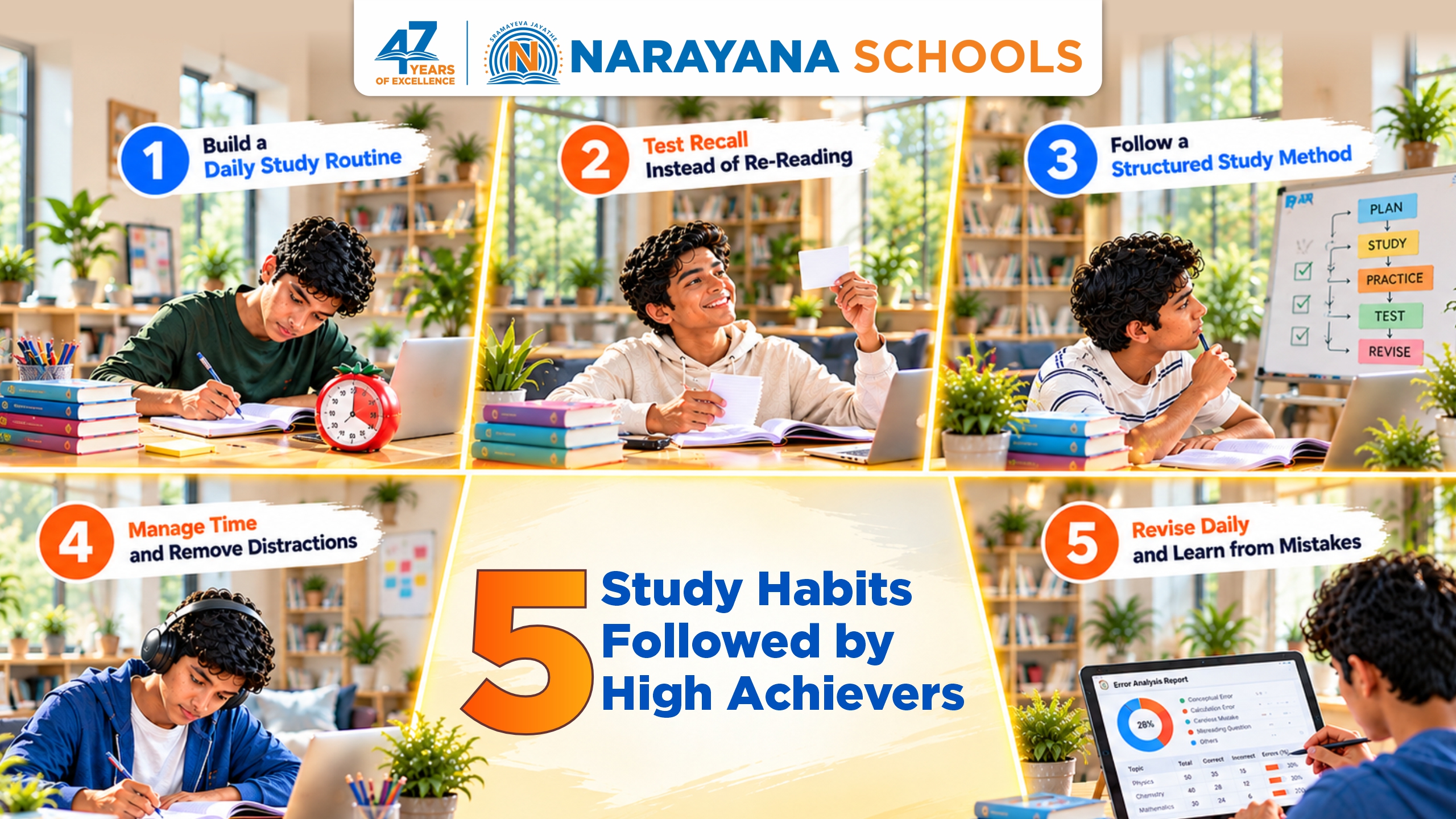 44
A high scorer’s desk rarely looks dramatic. No all-night study marathons or complicated colour-coded charts. Often, it is a fixed routine, focussed practice and consistent revision. These study habits answer a practical question: how to study effectively , rather than simply what to study. The study habits followed by CBSE achievers are usually built around consistency, active recall (retrieving information from memory), focussed practice, time management and learning from mistakes. Build a Daily Study Routine Daily habits of successful students in school often begin with a consistent schedule. A fixed study time helps students develop a predictable rhythm and reduces the effort needed to decide when to begin. Learning how to build a daily study routine like a high scorer does not mean studying for longer hours. It means making regular study a dependable part of the day. Test Recall Instead of Re-Reading One of the most effective study habits for students is active recall. Instead of repeatedly reading a chapter, students can close the book and explain a concept, solve questions or recall key points from memory. These are useful study tips to improve concentration and memory and among the best study techniques for scoring high marks , because they help reveal gaps in understanding. Follow a Structured Study Method Good preparation needs structure. At Narayana Schools, the Microschedule helps organise learning and practice into planned academic activities. The CDF approach, covering Concept, Definition and Formula , helps students build clarity around important concepts before applying them. Regular Daily Practice Tests and Weekly Tests provide opportunities to practise questions, reinforce learning and check progress. For students preparing for exams, the Pomodoro Technique can also support focussed study. It uses 25-minute focussed sessions followed by short breaks, helping students divide preparation into manageable blocks. Manage Time and Remove Distractions How toppers manage time before exams is not simply about studying continuously. Focussed study blocks, short breaks and clear priorities can make preparation more manageable. These time management tips for students include keeping the phone away, preparing study materials beforehand and focusing on one task at a time. The study tips for exam preparation that work best are often simple enough to repeat every day. Revise Daily and Learn From Mistakes How to stay consistent with studying every day is easier when revision becomes a small daily habit. Revisiting yesterday’s concepts for 10–15 minutes can strengthen retention without creating last-minute pressure. At Narayana Schools, Personalised Error Analysis and Correction on the nLearn app (digital learning) helps students identify where they went wrong, understand the reason for the error and work on correcting it. This turns mistakes into opportunities for improvement rather than simply marking answers as right or wrong. Narayana Schools and Everyday Study Discipline The best study habits for school students are not about studying endlessly. They are about building a cycle of learning, practice, testing, analysis and correction. From the Microschedule, CDF and Daily Practice Tests to Weekly Tests and Personalised Error Analysis and Correction on the nLearn app, Narayana Schools builds academic discipline into the learning process. Ultimately, good study habits grow through repetition. With consistent practice, focussed preparation and the right guidance, students can develop the confidence to work towards their goals to achieve their dreams, because at Narayana Schools, your dreams are our dreams . FAQs 1. What study habits do high achievers follow? High achievers often follow a consistent study routine, use active recall, practise regularly, manage distractions, revise daily and learn from mistakes. 2. How many hours do high achievers study daily? There is no fixed number of hours that guarantees academic success. Consistent, focussed study is generally more useful than simply increasing study hours. 3. What are the best study techniques for exams? Active recall, regular practice, daily revision and focussed study sessions can support effective exam preparation. The Pomodoro Technique, with 25-minute study sessions followed by short breaks, can also help structure study time. 4. How can students improve their study habits? Students can start by setting a fixed daily study time, using active recall instead of repeatedly re-reading, practising regularly and reviewing mistakes. At Narayana Schools, the Microschedule , Daily Practice Tests , Weekly Tests and Personalised Error Analysis and Correction provide structured support for these habits. 5. What time should students start studying? There is no single ideal study time for every student. Choosing a consistent slot that fits the daily schedule, such as after school or before dinner, can make it easier to maintain a routine. 6. How do high achievers avoid distractions while studying? Preparing the study environment beforehand can help. Keeping the phone away, having required materials ready and focusing on one subject or task at a time can reduce unnecessary interruptions. 7. How can students stay consistent with revision? Small daily reviews can make revision easier to maintain. Revisiting previous concepts for 10–15 minutes, practising questions regularly and correcting mistakes can help build a consistent revision routine.
29 Sept 2026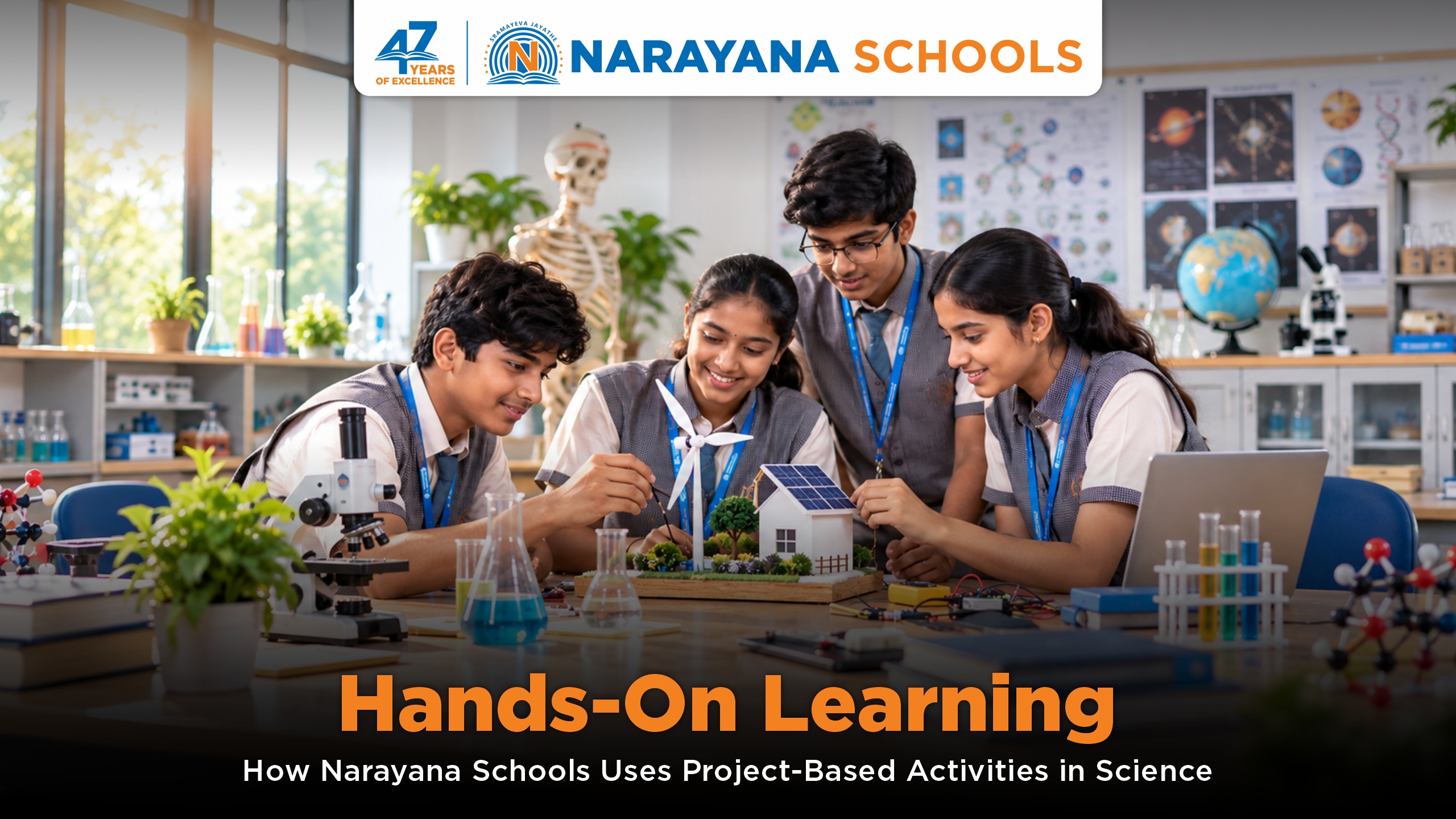 18
Inside a Narayana Schools science lab, learning does not always begin with a definition in a textbook. It can begin with a question, an experiment or a problem that needs solving. A student may build a simple circuit, observe a reaction, test an idea or investigate why an experiment produced an unexpected result. This is the essence of hands-on science learning : concepts become easier to understand when students can see, test and experience them. At Narayana Schools, this approach develops progressively. From activity-based learning in the early years to experiential learning and increasingly advanced applications in higher classes, students gradually learn to connect concepts with real experiences. This progression forms an important part of the Narayana Schools science curriculum , helping children move from understanding ideas to applying them. 1. From Activities to Experiences: Building Concepts from the Early Years The foundation begins with the eChamps programme (Classes 1–5), where learning focuses on developing conceptual understanding rather than relying only on memorisation. The approach changes as children grow, allowing them to engage with concepts in ways suited to their stage of learning. For Classes 1 and 2, activity-based learning introduces children to concepts through age-appropriate activities. Instead of simply reading about shapes, measurements, plants or everyday scientific phenomena, children can interact with materials, observe changes and explore ideas through guided tasks. These activity-based science teaching methods make abstract concepts more accessible and encourage children to learn through curiosity and discovery. For Classes 3 to 5, experiential learning takes this foundation further. Students are encouraged to observe, investigate, experiment and apply what they learn. A lesson on plants, for instance, can extend beyond identifying their parts to observing how different conditions affect growth. Mathematics and science concepts can similarly be explored through practical activities that encourage students to compare, question and draw conclusions. This progression demonstrates how experiential learning helps students grasp scientific concepts . Instead of asking children only to remember what they have been taught, it gives them opportunities to discover how and why things work. 2. How Narayana Schools Implements Project-Based Learning in Science As students progress into the eTechno programme for Classes 6–10 , learning becomes more structured, application-oriented and connected to deeper scientific concepts. This is where project-based learning and practical application can become more sophisticated. So, how Narayana Schools implements project-based learning in science is not limited to a single project or activity. Unlike a one-off project, it integrates experiments, practical tasks and problem-solving into the learning journey, allowing students to repeatedly learn, apply, investigate and refine their understanding of scientific concepts as they progress through the grades. Narayana Schools has dedicated laboratories for subjects such as physics, chemistry, biology and computer science, while several schools also have robotics facilities. These spaces give students opportunities to explore scientific principles beyond the textbook. They can investigate how circuits work, observe chemical reactions, explore biological processes or design and programme simple robotic models. This approach reflects project-based learning in science education , where students can engage with a question or problem, investigate it, apply relevant concepts and arrive at an understanding through the process. 3. Why Project-Based Learning Improves Scientific Understanding? The question of why project-based learning improves science understanding is closely connected to the relationship between experience and conceptual knowledge. A student who reads that an electrical circuit needs a complete path may remember the definition. A student who builds a circuit, discovers that the bulb does not light up and investigates the missing connection experiences the same concept as a problem to solve. This is one of the key benefits of experiential learning in science . Students can connect an abstract principle with something they have observed or experienced, making the concept more meaningful and easier to apply in a new situation. David Kolb's experiential learning model similarly describes learning as a cycle involving experience, reflection, conceptual understanding and further experimentation. In science, this can encourage students to observe what happens, think about why it happens and then use that understanding to investigate further. 4. From Activity to Application: How Project-Based Learning Works in Schools Understanding how project-based learning works in schools requires looking beyond the activity itself. The purpose is not simply to keep students busy with practical tasks. A well-designed activity connects what students do with what they are expected to understand. For example, building a bridge from simple materials can introduce questions about strength, balance, structure and load. Testing household substances with natural indicators can turn a chemistry concept into an investigation. Growing crystals over several days can help students observe processes that cannot be understood as effectively through a single classroom explanation. These science experiments for school students encourage observation, questioning, prediction and analysis. They also help students understand that making mistakes is part of the process of finding an answer. 5. Hands-On Science Activities for CBSE Students The approach can be particularly valuable for hands-on science activities for CBSE students , where understanding concepts and applying knowledge are important parts of learning. Examples of project-based science activities that Narayana Schools students engage in include: The approach can be particularly valuable for hands-on science activities for CBSE students , where understanding concepts and applying knowledge are important parts of learning. Examples of project-based science activities at Narayana Schools and other Indian schools can include: Observing plant growth under different conditions Testing household substances with natural indicators Designing and testing a simple water filtration system Investigating how different surfaces affect friction Exploring air pressure through simple experiments Building models to understand the solar system, planetary motion, renewable energy (such as solar or wind power), etc. Designing structures to explore strength, balance and load Investigating heat transfer using different materials Studying the effect of different materials on sound absorption Designing a rainwater harvesting model Investigating how changes in light affect shadows and reflection Conducting experiments to test scientific predictions and analyse the results For younger children, these activities may involve simple observation and exploration. For older students, they can involve greater planning, measurement, analysis and problem-solving. This progression also reflects the benefits of project-based learning for young learners in science . Children can develop curiosity and confidence while gradually learning how to investigate a question and support an observation with evidence. The Larger Lesson A child who builds, tests, observes and questions is doing more than completing a science activity. The child is learning how to think. That journey begins with activity-based learning, develops through experiential learning in schools and gradually moves towards deeper conceptual understanding, application and problem-solving. Through hands-on science learning , project-based learning and practical experiences, students can learn not just what a scientific concept means, but how it works and where it can be applied. This is what makes learning more meaningful: when a concept moves from the page into an experiment, a project or a problem that a student can investigate. At Narayana Schools, learning is designed to help students understand, explore and apply knowledge with growing confidence in order to fulfil dreams, because your dreams are our dreams . FAQs What is project-based learning in science? Project-based learning in science education asks children to investigate a real question over several sessions, planning, testing and drawing conclusions, rather than reading a chapter and answering questions at the end. How does hands-on learning improve science education? It turns abstract facts into something observed and tested, linked to stronger, longer-lasting understanding than reading alone. Why is project-based learning important for students? Beyond content, it builds planning, patience and the ability to explain reasoning, skills a textbook rarely tests. What are examples of science projects for school students? Common examples include building simple circuits and small robots, testing which household liquids are acidic using natural indicators, growing crystals to observe evaporation, and constructing model bridges to test load and balance. How does Narayana School teach science through activities? Narayana's science labs are built for exactly this: separate, well-equipped spaces for physics, chemistry, biology and computer science, alongside robotics labs at several schools where children design and programme simple machines. What is the difference between traditional and project-based learning? A traditional science lesson often ends where a project-based one begins, with a fact stated rather than a problem posed. Project-based learning flips this order: children attempt a task first, and the underlying concept is explained through what goes wrong. How do hands-on activities help in understanding scientific concepts? By letting a child see a concept fail or succeed in real time, which tends to make the underlying idea easier to recall later. Is project-based learning effective for CBSE students? India’s National Education Policy 2020 calls for experiential, hands-on learning from the middle stage onward, aligning with the wider shift towards CBSE schools using hands-on science teaching methods . At Narayana Schools , this approach is reflected in the progressive science curriculum, where students move from activity-based learning to experiential learning and increasingly application-oriented projects, experiments and problem-solving as they advance through the grades. Research also consistently links hands-on, experiential approaches with stronger science learning and achievement.
28 Sept 2026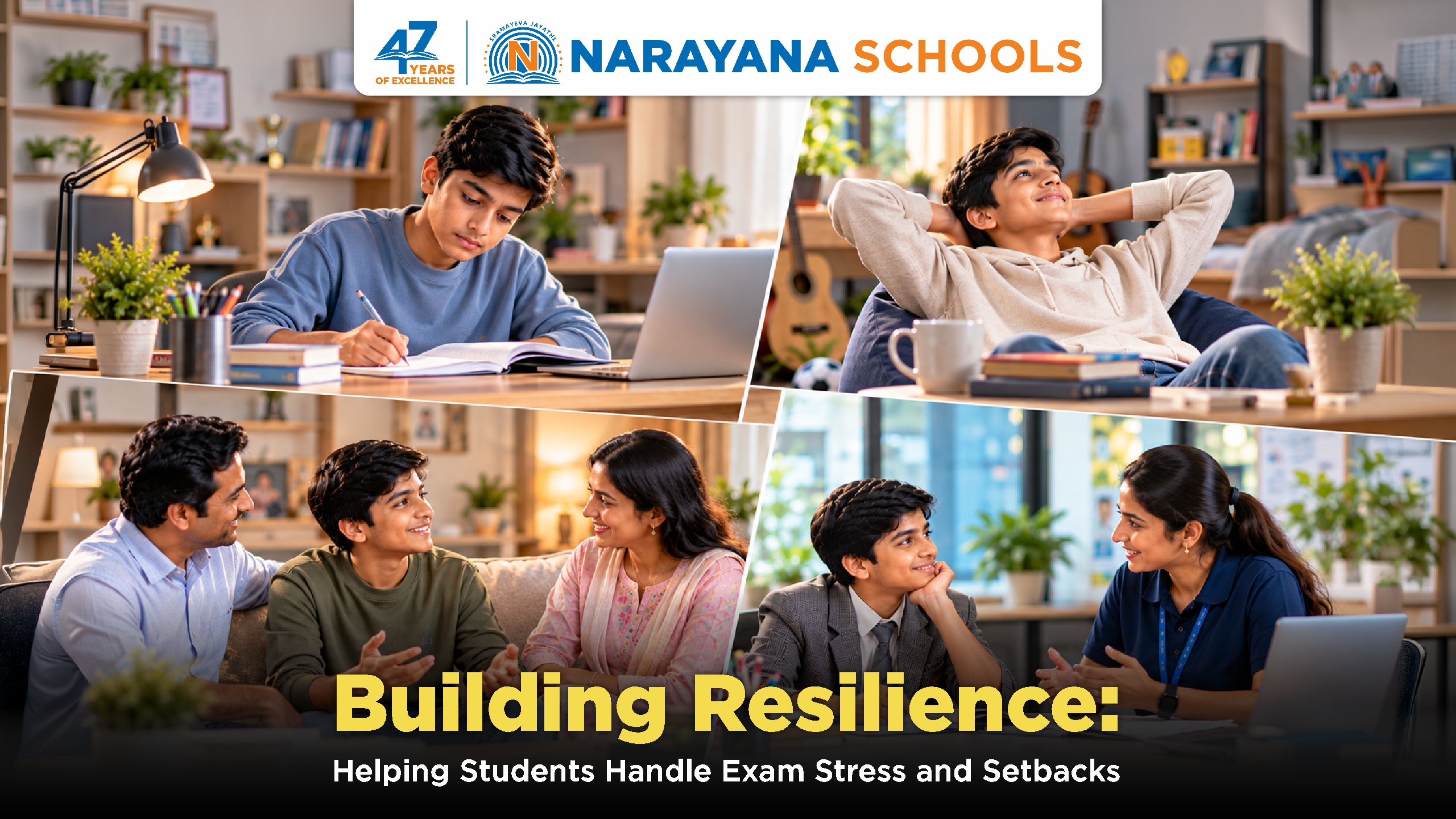 52
The night before a big test, a child stares at a formula that made perfect sense that morning but now looks like a foreign language. Hands turn cold, breathing becomes shallow and concentration seems to disappear. This is exam stress , and it is an experience many parents recognise, particularly when an important examination is approaching. While some pressure can encourage preparation, too much exam pressure can make studying feel overwhelming. Learning how to manage that pressure is therefore not only about performing well in an examination. It is also about developing student resilience , so that children can handle challenges, learn from setbacks and continue moving forward. 1. What Is Academic Resilience and Why Does It Matter? Academic resilience is the ability to respond to academic challenges and setbacks, such as a poor grade, a difficult examination or a disappointing result, and continue learning and moving forward. It does not mean avoiding academic stress altogether. Rather, it involves developing the confidence and coping skills needed to manage challenges, learn from them and try again. This idea is closely related to what psychologists Andrew Martin and Herbert Marsh described in 2008 as "academic buoyancy" : the ability to cope with the ordinary setbacks and pressures that students encounter in everyday academic life, such as a disappointing grade, a difficult test or a missed deadline. Their work helped highlight an important point: resilience is not simply something a child either has or does not have. It can develop gradually through experience, practice and appropriate support. This makes building resilience in students an important part of education. A difficult examination does not have to become a lasting source of discouragement. With appropriate support, a setback can become an opportunity to understand what went wrong, adjust study strategies and approach the next challenge with greater confidence. 2. Signs of Academic Burnout Parents Should Not Ignore However, resilience does not mean expecting children to cope with unlimited pressure. Prolonged study stress can gradually affect motivation, concentration, sleep and emotional wellbeing. Signs of academic burnout may appear quietly. A child who once enjoyed a subject may begin avoiding it, sleep patterns may change, or small questions about homework may trigger unusual frustration or tears. Physical symptoms can also accompany exam anxiety in students . Headaches, stomach aches, restlessness or difficulty sleeping before a test may sometimes be linked to stress, although persistent or concerning symptoms should be discussed with an appropriate health professional. Recognising these changes early can make it easier to understand what a child is experiencing. That understanding creates the foundation for practical stress management for students , both at home and at school. 3. How to Handle Exam Stress: Practical Habits for Home So, how to handle exam stress without making the examination period feel even more stressful? Small, consistent habits can make revision more manageable. Breaking study time into shorter, focused sessions can prevent large syllabus from feeling impossible. Short breaks, adequate sleep, hydration, regular meals, slow breathing, and some physical activities like stretching, walking, etc., can also help create a healthier study routine. These simple e xam stress relief tips work best when academic conversations are balanced with ordinary family interactions. During an intense revision period, conversations about friends, hobbies, school experiences or everyday interests can give children valuable mental breaks. It is equally important to create space for children to express what feels difficult. Talking through a challenging topic can help identify whether the problem is lack of preparation, confusion about a concept or exam fear. For example, a child may say that a chapter feels difficult because it has not been revised enough, because a particular concept is still unclear or because the thought of getting the answer wrong is creating exam fear . These concerns can sometimes look similar from the outside, with the child avoiding a subject, becoming frustrated or saying that they cannot study. A calm conversation can help parents identify the real concern instead of assuming that the child simply needs to study harder. Once the underlying difficulty is clearer, the right support becomes easier to provide, whether that means revisiting a concept, changing the study approach or helping the child manage anxiety about the examination. 4. Coping with Exam Failure: Turning a Bad Result into a Comeback The approach to handle exam stress becomes especially important when an examination does not go as expected. Coping with exam failure starts with the way the result is discussed at home. A disappointing mark can feel like a judgement on ability, but it can also provide information about what needs to change. Research associated with Stanford psychologist Carol Dweck's work on mindset has highlighted the importance of focusing on effort, strategies and learning rather than treating ability as completely fixed. For example, recognising that additional practice improved performance in a difficult subject can reinforce the value of effective strategies. For parents wondering how to support a child who failed an exam , the conversation can therefore focus on what happened and what can be changed next time. Questions about preparation, difficult concepts, time management and revision methods can be more constructive than comparisons with siblings or classmates. This is also where overcoming fear of failure becomes possible. A setback becomes less intimidating when children learn that one result does not define their ability or future progress. 5. A Common Misconception Worth Addressing It can be tempting to protect children from every academic difficulty in the hope of protecting their confidence. However, manageable challenges can provide opportunities to practise problem solving, persistence and emotional regulation. This does not mean deliberately creating failure or dismissing genuine distress. Instead, it means allowing children to experience age appropriate challenges while providing appropriate guidance and support. In this sense, how to build resilience in students after failure is not about making setbacks disappear. It is about helping children understand that setbacks can be examined, learned from and overcome. Over time, this can change the way a child views difficult situations. Rather than seeing a poor result as the end of the road, a student can begin asking what can be learned from it and what could be attempted differently next time. 6. How Schools Can Support Students with Exam Anxiety Resilience becomes even stronger when the support received at home is reinforced at school. How schools can support students with exam anxiety is therefore an important part of the wider conversation around mental health during exams . In India, the Ministry of Education's Manodarpan initiative provides psychosocial support and counselling resources for students and other members of the education community. Such initiatives reflect the importance of addressing emotional wellbeing alongside academic preparation. At Narayana Schools, supporting students through examination pressure goes beyond academics. DISHA , the dedicated mental wellness programme, has been supporting students since 2017, helping them navigate academic, social and emotional challenges, including exam anxiety , fear of failure and academic pressure. With 130+ counsellors and psychologists , DISHA provides confidential, non-judgemental support to help students understand and manage stress, work through performance-related worries, build confidence after setbacks and develop healthier ways of coping with pressure. DISHA also conducts group sessions, parent workshops and teacher training to create a stronger support system around students. Teachers are equipped to recognise signs of emotional or academic distress, while parents gain guidance on supporting their children at home. Through this integrated approach, Narayana Schools places mental health during exams alongside academic preparation, helping students manage challenges, recover from setbacks and continue moving towards their goals. 7. Building Resilience Beyond the Examination Ultimately, student resilience is about more than recovering from one difficult test. A child who learns to reflect after a disappointing result is also developing skills that can be useful in many areas of life. For parents asking how to help my child cope with exam stress , the answer does not have to involve eliminating every difficult emotion. It can begin with listening without judgement, establishing manageable routines, encouraging healthy breaks and helping children separate one result from their sense of self worth. Likewise, learning how to bounce back from a bad exam result can begin with a simple conversation: what was difficult, what worked, what did not and what could be tried differently next time? With consistent support at home and school, daily habits to reduce student stress during exam season can gradually become habits for life. Children learn that pressure can be managed, mistakes can be examined and progress can continue after setbacks. That is the larger purpose of resilience. A child who learns to recover from a difficult examination is learning something that extends far beyond a report card. With patience, guidance and the right support, challenges can become stepping stones towards greater confidence, persistence and growth. At Narayana Schools, that journey is rooted in the belief that every child has the potential to pursue meaningful goals, dreams and keep moving towards them, because your dreams are our dreams . Frequently Asked Questions 1. What are the signs of exam stress in students? Common signs may include difficulty concentrating, irritability, changes in sleep, restlessness, headaches, stomach aches, loss of motivation or persistent worry about examinations. When symptoms are severe, persistent or interfere with everyday functioning, professional guidance may be appropriate. 2. How can I help my child overcome fear of exams? A calm study routine, realistic goals, adequate sleep and regular breaks can help. It is also useful to discuss specific concerns rather than focusing only on marks. Identifying whether the fear comes from difficult concepts, lack of preparation or performance expectations can make support more targeted. 3. Is it normal for students to feel anxious before exams? Some degree of nervousness before an examination is common. A moderate level of pressure can sometimes encourage preparation. However, intense or persistent anxiety that interferes with sleep, concentration, daily activities or wellbeing requires greater attention and appropriate support. 4. What is academic resilience and why does it matter? Academic resilience refers to the ability to respond constructively to academic challenges and setbacks. It matters because students inevitably encounter difficult subjects, disappointing results and other challenges. Resilience can help them learn from these experiences rather than becoming discouraged by them. 5. How much stress before exams is considered unhealthy? Stress becomes concerning when it is intense, persistent or begins affecting sleep, eating, concentration, relationships, attendance or everyday functioning. There is no single level that applies to every student, so changes in behaviour and wellbeing are important indicators to watch. 6. What should parents say to a child who did badly in an exam? A supportive conversation can begin by acknowledging the disappointment without making the result a judgement about the child's ability. Questions such as "What felt most difficult?" and "What could be changed next time?" can help shift attention towards learning and practical next steps. 7. Can exam stress affect a student's long-term mental health? Persistent, unmanaged stress can affect emotional wellbeing and daily functioning. This does not mean that ordinary examination stress will automatically cause long-term mental health problems. Early recognition, healthy routines, supportive relationships and appropriate professional help when needed can provide important protection. 8. What are quick stress-relief techniques for exam day? Slow breathing, taking a brief pause, drinking water, stretching, using positive self-talk and focusing on one question at a time can help manage immediate tension. Good preparation and sufficient sleep before the examination can also reduce avoidable stress. 9. How do CBSE schools support students with exam anxiety? CBSE schools can support students through counselling, teacher guidance, structured revision, regular feedback and classroom practices that encourage students to discuss academic concerns. At Narayana Schools, this support is complemented by DISHA, the dedicated mental wellness programme, which has 130+ counsellors and psychologists supporting students with academic, social and emotional concerns. Through individual support, group sessions, parent workshops and teacher training, DISHA helps students understand and manage exam anxiety, academic pressure and other challenges that may affect their wellbeing. This combination of academic guidance and mental wellness support can help students approach examinations with greater confidence and resilience. 10. What role do teachers play in building student resilience? Teachers can help students view mistakes as opportunities to learn, provide constructive feedback, encourage effective study strategies and create an environment where asking for help is comfortable. Consistent encouragement and timely support can help students develop greater confidence in handling academic challenges.
26 Sept 2026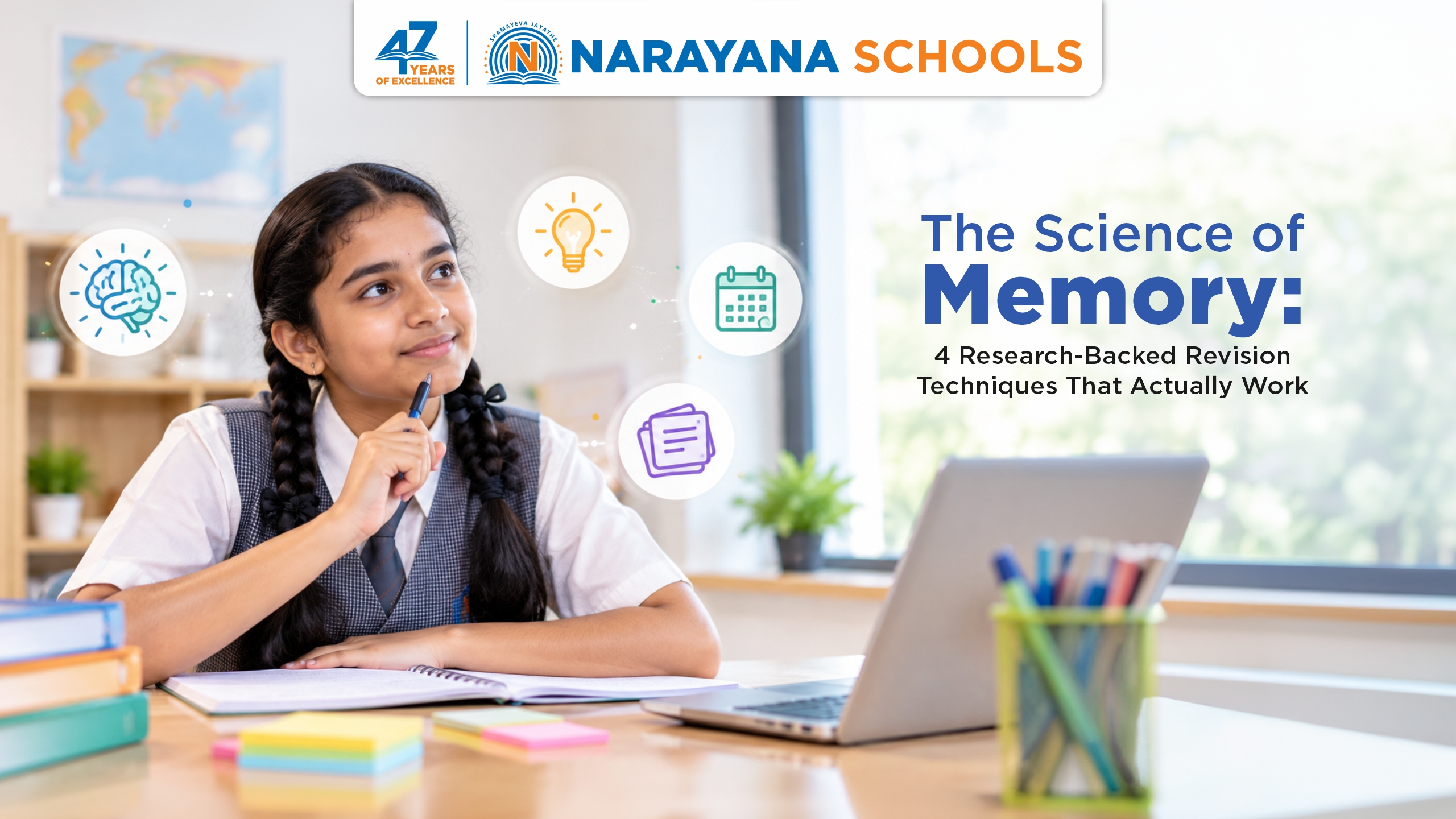 28
A child spends three hours "revising" - book open, highlighter in hand, the same paragraph read four times over - and still stumbles through the exam a week later. Every parent has watched this scene with quiet confusion. The child worked hard. Why did nothing stick? Cognitive psychology has a clear answer: how a child studies matters more than how long they study. Decades of research on memory point to a handful of revision techniques that genuinely improve recall and a few popular habits that quietly waste effort. Here is what the evidence actually says and what families can do with it at home. Why Re-reading and Highlighting Feel Productive but Rarely Work? In a landmark 2013 review published in Psychological Science in the Public Interest , cognitive scientists John Dunlosky, Katherine Rawson and colleagues assessed ten common study methods. Re-reading and highlighting - the two techniques students reach for most - were rated low utility . They create a comforting sense of familiarity with the text without building the retrieval strength needed on exam day. Recognising a sentence is not the same as recalling it. 1. Active Recall Beats Passive Review The strategy Dunlosky's team rated most effective is practice testing , also known as active recall or retrieval practice. In influential experiments at Washington University in St. Louis, psychologists Henry Roediger and Jeffrey Karpicke found that students who closed their books and tried to recall material remembered significantly more a week later than those who simply reread it - even though the re-readers felt more confident at the time. At home, this can be as simple as closing the textbook and asking a child to explain a chapter aloud, or using blank-page recall: writing down everything remembered before checking the notes. 2. Spaced Repitition Fights the Forgetting Curve The German psychologist Hermann Ebbinghaus first mapped the "forgetting curve" in the 1880s, showing how quickly new information fades without review. A large 2006 meta-analysis by Nicholas Cepeda and colleagues, published in Psychological Bulletin , found that when the same total study time is divided across several shorter revision sessions, learning is retained for longer than when that time is spent in one prolonged cramming session . In other words, revisiting a topic at spaced intervals gives the brain repeated opportunities to retrieve and consolidate the information, making it easier to recall later. A practical approach is a simple revision calendar: revisiting a topic after one day, then three days, then a week, rather than saving every chapter for the night before a test. 3. Interleaving: Mixing Topics On Purpose Alternating between related topics or question types - rather than mastering one before moving to the next - is called interleaving. Research by psychologist Doug Rohrer and colleagues on mathematics learning found that interleaved practice improved students' ability to choose the correct method for a problem, a skill blocked practice does not build. Families can encourage students to vary subjects or different types of problems within a single revision session instead of repeatedly practising the same type of problem. 4. Sleep Is Part of Studying, Not a Break From It Alternating between related topics or question types, rather than completing all the questions on one topic or practising one question type repeatedly before moving to another , is called interleaving . For example, instead of solving 10 consecutive quadratic-equation problems, a student might practise a quadratic equation, followed by a trigonometry problem, then a linear equation and another quadratic problem. Research by psychologist Doug Rohrer and colleagues on mathematics learning found that interleaved practice improved students’ ability to choose the correct method for a problem , a skill that blocked practice does not build. Families can encourage students to vary subjects or different types of problems within a single revision session instead of repeatedly practising the same type of problem. A Common Misconception Worth Addressing Many parents assume a child who studies quietly for long stretches is learning well. Dunlosky's research suggests the opposite may be closer to the truth: techniques that feel slightly effortful - self-testing, spacing, mixing topics work precisely because they demand more from memory. How Narayana Schools Builds These Habits Into the Classroom? These findings shape Narayana Schools' own pedagogy . Regular formative assessments and structured practice tests, built into programmes from eChamps (Classes 1-5) to Senior Secondary (Classes 11-12), are designed around retrieval practice rather than one-off exams. Term planning is deliberately spread throughout the academic year rather than being concentrated in the period leading up to board exams, reflecting the recommendations of Cepeda’s research. Confidence in an exam hall is built quietly, over months, through the right kind of practice at home and in the classroom. Helping a child study smarter - not just longer - is one of the most lasting gifts a family can give, because at Narayana Schools, your dreams are our dreams. FAQs Which revision method actually works best? Testing yourself is better than reading notes again and again. Trying to remember something without looking at the book helps it stick far better than just re-reading it. How often should a child go over the same topic? Brief and frequent. Revisiting a topic briefly the next day, again a few days later, then once more after a week, helps the brain hold onto it far longer than one big push at the last minute. Does sleeping less before an exam really hurt memory? Yes, it does. Studies show that when someone doesn't get enough sleep, their brain struggles to retain what they've learned. A good night's sleep before an exam matters more than an extra hour of studying. Is underlining or highlighting notes a bad habit? It's not harmful, but it doesn't help much either. It makes the material feel familiar, but familiar isn't the same as remembered. Testing yourself works far better. What can parents do at home to help, without taking over the studying? Simple things go a long way-asking the child to explain what they studied in their own words, keeping a fixed study timetable instead of last-minute cramming, and making sure bedtime stays consistent during exam time.
19 Sept 2026

