

Explore stories and insights
Loading...


 8
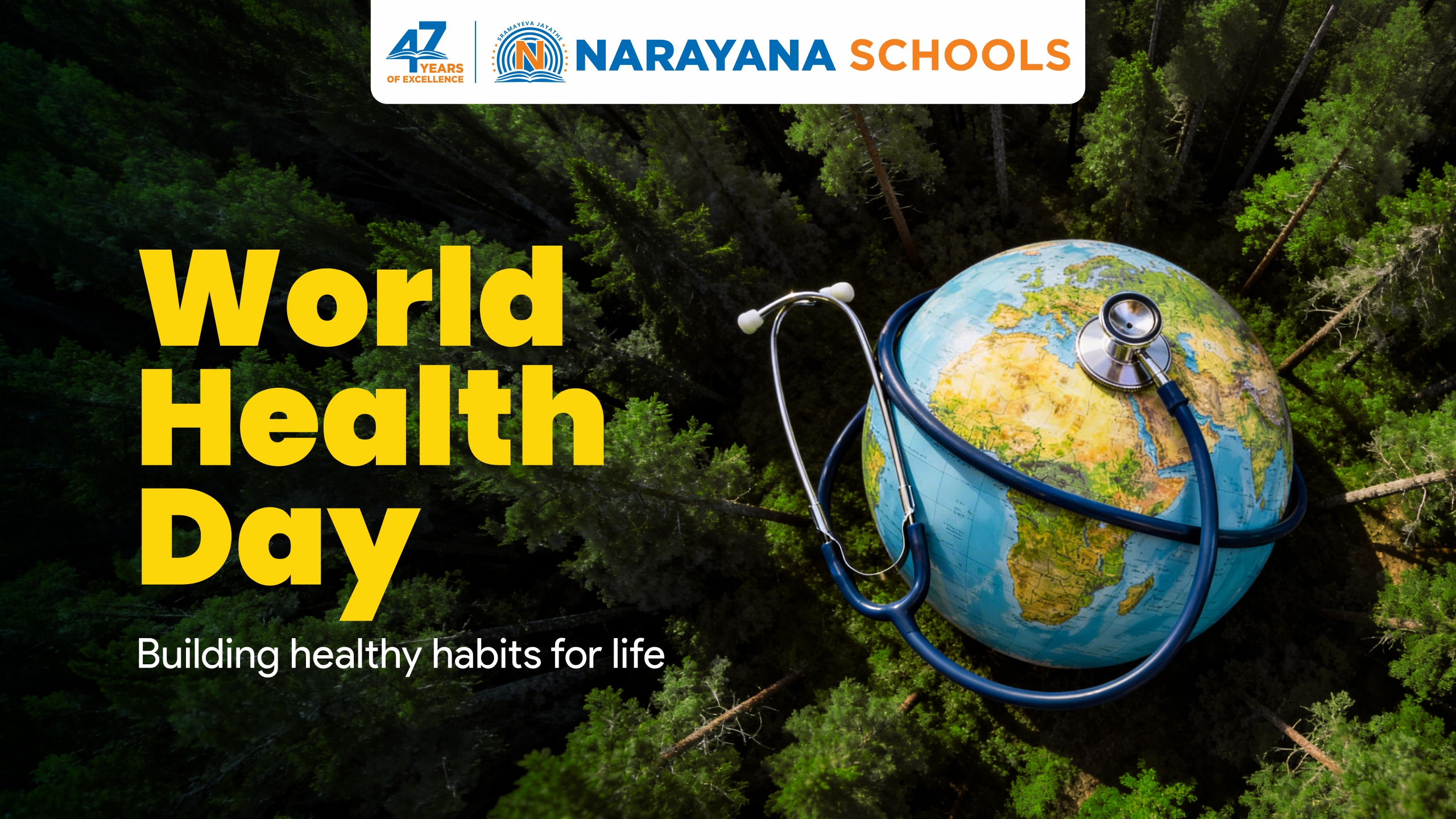
Observed every year on 7th April , World Health Day marks the founding of the World Health Organization in 1948 . This global initiative highlights pressing health concerns and promotes awareness around public health, preventive healthcare, child wellness and healthy lifestyles. Why World Health Day matters? Established to emphasise that health is a state of complete physical, mental and social well-being, not merely the absence of illness. Increasing relevance for school-going children in India due to rising lifestyle diseases, stress and digital dependency. Public health research shows early habit formation strongly influences lifelong health outcomes. The science behind healthy habits Behavioural science shows consistent routines like balanced nutrition, exercise and sleep strengthen discipline and decision-making pathways. Studies by the Indian Council of Medical Research indicate structured lifestyles improve cognitive performance, immunity and emotional stability. Preventive healthcare reduces long-term health risks and promotes sustained well-being. Practical ways to build healthy habits at home Establish consistent routines for meals, sleep and physical activity to build discipline and stability. Encourage outdoor play and limit screen time to support physical fitness and mental well-being. Promote balanced diets with essential nutrients to ensure proper growth and development. Foster open conversations around emotions to strengthen mental health and resilience. Ensuring the right approach Gradually building habits is more effective than forced routines, ensuring long-term consistency. Monitoring progress and adapting to age-specific needs supports sustainable development. Modelling healthy behaviours within the family reinforces learning through observation. World Health Day highlights the importance of building strong health foundations early in life. Structured habits, informed choices and guided learning contribute to lifelong well-being. In a fast-paced digital world, prioritising holistic health is essential for raising confident, capable individuals. In alignment with this, Narayana Schools implements structured programmes that nurture physical, mental and emotional health from an early stage. nSports: Building Physical Strength and Confidence eKidz (Nursery-UKG/PP2) : Focuses on enjoyable, age-appropriate physical activities that develop coordination, balance and motor skills, while fostering teamwork and a love for active play. eChamps (Class 1-5) : Promotes physical development through an outcome-oriented approach, helping students grow into confident, active and fit individuals. eTechno (Class 6 and above) : Balances physical fitness with mental development, encouraging resilience, discipline, teamwork and sporting excellence. DISHA Mental Wellness Programme: Supporting Emotional Well-being A comprehensive initiative designed to promote mental and emotional health through counselling, guidance and wellness support. Backed by a team of 130+ counsellors and psychologists. Group Assistance Programme : Awareness sessions to normalise mental health conversations and build resilience. Personal Assistance Programme : One-on-one confidential support for emotional growth and coping. Parent Assistance Programme : Guidance to help families support children’s emotional needs effectively. Yoga Veekshan: Integrating Mind and Body A structured programme aligned with NEP 2020 , incorporating yoga, mindfulness and breathing techniques into daily routines. Practices such as Angamardana, Upa Yoga and Yoga Namaskar enhance physical strength, flexibility and spinal health. Pranayama and meditation techniques improve emotional balance, reduce stress and enhance concentration. Thopukarnam (Brain Yoga) and mantra practices support memory, focus and mental clarity. Eye care practices and yogic lifestyle guidance further promote overall well-being and long-term health. We ensure that this integrated approach helps students develop not only academically but also holistically, because strong foundations in health are essential to achieving dreams, as at Narayana Schools, your dreams are our dreams .
 06 Apr 2026
 9
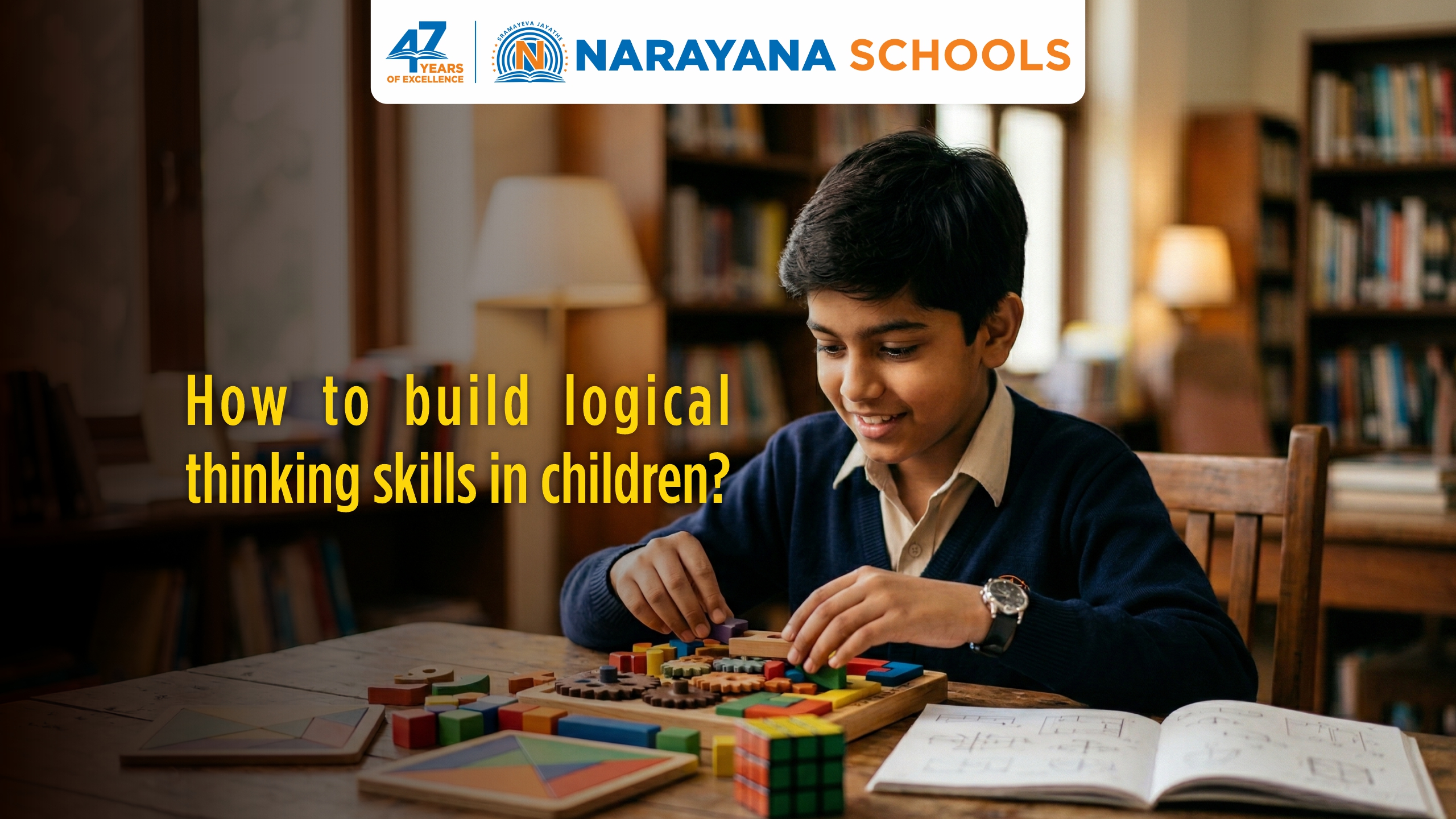
In today’s rapidly evolving world, logical thinking skills in children are no longer optional, they are essential for academic success, competitive exams and future careers. Research by the Organisation for Economic Co-operation and Development (OECD) highlights that problem-solving, reasoning and analytical thinking are among the most critical 21st-century skills. The focus, therefore, lies in gradual, structured and consistent development . Why logical thinking matters? Logical thinking forms the foundation of mathematics, science, coding and decision-making . Studies in educational psychology show that strong thinking skills improve academic performance, comprehension and adaptability . It enables children to analyse situations, identify patterns and make informed decisions. The science behind logical thinking Cognitive research shows that active problem-solving strengthens neural pathways , improving memory and understanding. Activities involving patterns, puzzles and reasoning enhance executive functioning , including planning and attention control. Gradual exposure prevents cognitive overload and supports long-term retention and conceptual clarity . Building logical thinking at home Encourage puzzles, strategy games and mental maths to develop pattern recognition and reasoning . Promote discussion-based learning by asking ‘why’ and ‘how’ questions to stimulate analytical thinking . Connect concepts to real-life situations, helping children apply logic beyond textbooks. Maintain structured routines that balance practice with reflection. Free platforms that strengthen logical skills Platforms Age Group Description URL Khan Academy 8–18 years Builds conceptual clarity through step-by-step problem-solving. https://www.khanacademy.org/ Code.org 6–16 years Develops computational and logical thinking through coding. https://code.org/ Blockly Games 7–14 years Uses visual logic puzzles for beginners. https://blockly.games/ Scratch 7–14 years Encourages creativity alongside logical sequencing. https://scratch.mit.edu/ Gradual and age-appropriate development Start with simple pattern recognition and games in early years. Progress to structured problem-solving and coding-based logic. Introduce higher-order reasoning tasks during secondary stages. This phased approach ensures confidence, consistency and deeper understanding . Ensuring the right approach Focus on understanding rather than speed or rote memorisation. Select platforms and activities that are interactive, distraction-free and age-appropriate . Monitor progress through application of concepts rather than scores alone. Encourage persistence, as logical thinking develops over time through practice. In essence, building logical thinking skills in children is a gradual and continuous process rooted in science, structure and real-world application. When supported with the right mix of home strategies and free online learning platforms , children develop the ability to think critically, solve problems effectively and adapt confidently, preparing them not just for examinations but for life.
02 Apr 2026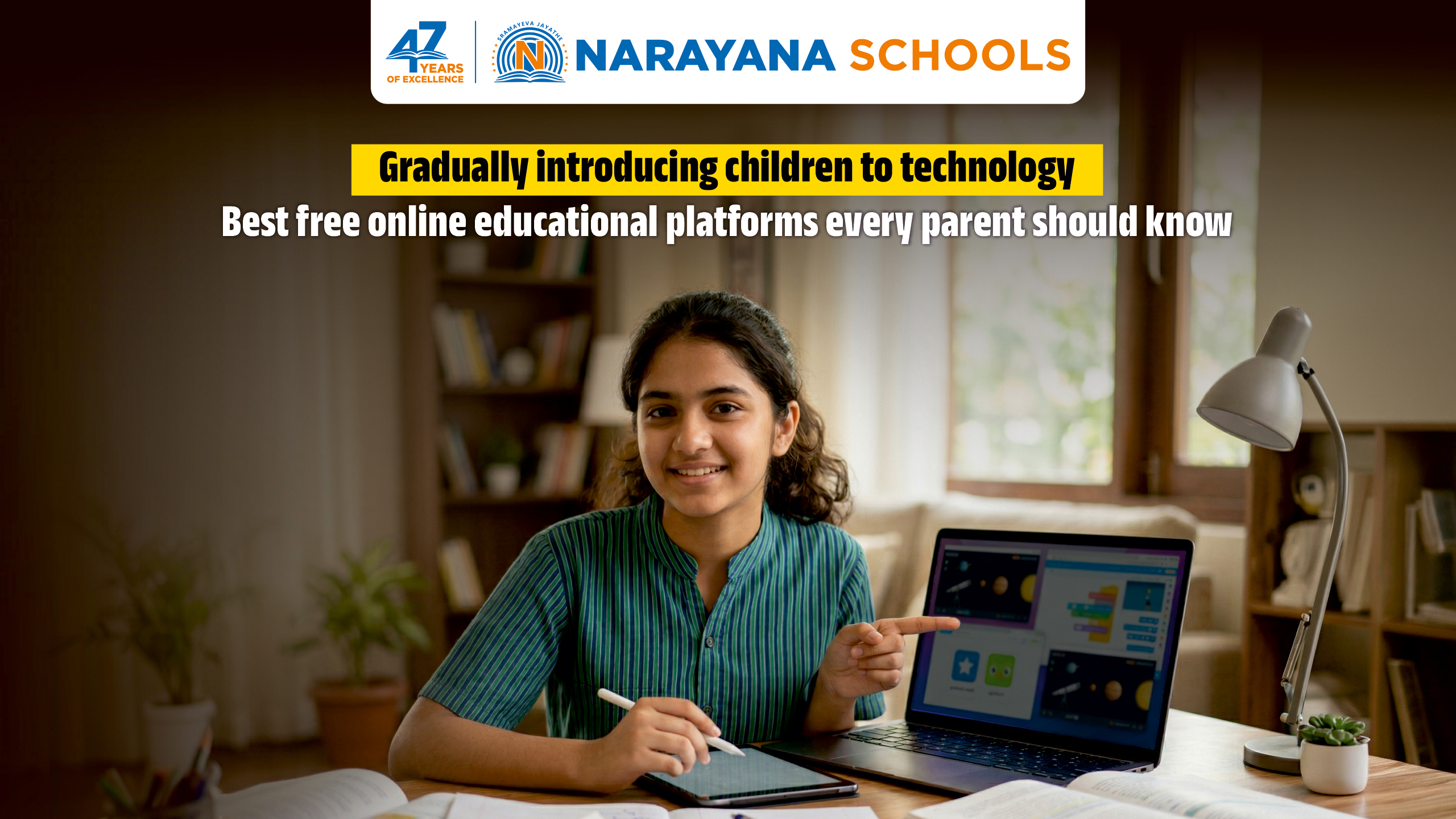 8
In an increasingly digital world, technology is no longer optional in education, it is essential. The focus today extends beyond merely limiting screen time to ensuring that children engage with technology in a safe, purposeful and productive manner, where digital learning platforms and online education are utilised meaningfully and effectively. A gradual and guided introduction to technology helps children build familiarity, confidence and digital discipline without feeling overwhelmed. Research shows that when introduced in a structured manner, technology enhances cognitive development, creativity and problem-solving skills, while also fostering digital literacy, independent learning and adaptability for future academic and real-world environments. Why technology must be seen as a learning tool, not a threat: The science behind digital learning Research by the United Nations Educational, Scientific and Cultural Organization (UNESCO) highlights that digital tools expand access to quality education, bridge learning gaps and promote inclusive, equitable learning experiences across diverse backgrounds. Cognitive and neuroscience studies, including those from Stanford University , show that interactive and multimedia-rich digital environments enhance engagement, conceptual understanding and long-term retention by activating multiple areas of the brain and encouraging active participation. Evidence from cognitive psychology demonstrates that techniques such as quizzes, problem-solving tasks, spaced repetition (reviewing at increasing intervals) and retrieval practice (recalling learned information) significantly strengthen memory consolidation and learning efficiency. Gradual and guided exposure to such structured digital platforms fosters digital literacy, critical thinking, creativity and independent learning, enabling children to view technology as a tool for exploration , innovation and knowledge building rather than distraction. Free online educational platforms that add value Platform Age Group Description Benefits URL DIKSHA ( Digital Infrastructure for Knowledge Sharing) 6–18 years Government-led digital infrastructure for school education in India Curriculum aligned learning across Indian boards https://diksha.gov.in SWAYAM ( Study Webs of Active Learning for Young Aspiring Minds) 13+ years National online education platform offering certified courses Structured courses from school to university level https://swayam.gov.in NPTEL ( National Programme on Technology Enhanced Learning) 15+ years Online initiative by IITs and IISc for technical education Advanced technical and engineering concepts http://nptel.ac.in Khan Academy 8–18 years Platform offering free educational videos and exercises Concept-based learning in history, politics, economics, finance, maths, science, computer science and more https://www.khanacademy.org/ Scratch 7–14 years Visual programming platform designed for children Beginner coding through storytelling and games https://scratch.mit.edu/ Code.org 6–16 years Non-profit platform promoting computer science education Interactive coding and computer science basics https://code.org/ Duolingo 8+ years Language learning app with gamified lessons Gamified language learning and cognitive development https://www.duolingo.com/ Tinkercad 10–16 years Online tool for 3D design, modelling and electronics simulation Hands-on learning of design and basic electronics https://www.tinkercad.com/ Blockly Games 7–14 years Educational games teaching coding through visual blocks Visual coding through fun, logic-based games https://blockly.games/ MIT App Inventor 12–18 years Beginner-friendly platform for building mobile apps Introduction to app development and logic building https://appinventor.mit.edu/ TypingClub 8+ years Online platform to improve typing skills Builds typing speed and digital literacy https://www.typingclub.com/ Canva 10+ years Easy to use graphic design and content creation tool Enhances creativity and digital design skills https://www.canva.com/ National Geographic Kids 6–14 years Engaging science and nature content focused on real-world topics Builds curiosity, enhances awareness of the environment and improves general knowledge https://kids.nationalgeographic.com/ NASA Kids’ Club 6–12 years Space-themed educational activities and games Encourages STEM interest, develops curiosity about space and fosters exploration skills https://nasa.gov/kidsclub BBC Bitesize 8–16 years Curriculum-based resources with interactive lessons across subjects Supports exam preparation, strengthens subject understanding and reinforces concepts https://bbc.co.uk/bitesize Funbrain 6–12 years Educational games and reading materials for foundational learning Improves reading skills, enhances engagement and builds core academic abilities https://funbrain.com CoolMath Games 8–14 years Maths-focussed games designed around puzzles and logic Strengthens logical reasoning, problem-solving skills and numerical confidence https://coolmathgames.com/ TED-Ed 10+ years Animated educational videos explaining complex concepts simply Enhances conceptual clarity, critical thinking and retention through visual learning https://ed.ted.com/ CrashCourse 13+ years In-depth subject-based video lessons across disciplines Builds deeper understanding, supports advanced learning and improves analytical skills https://youtube.com/@crashcourse Peekaboo Kidz 5–10 years Simple engaging videos explaining basic science concepts Introduces early learners to science, builds curiosity and simplifies foundational topics https://youtube.com/@peekabookidz Gradual acclimatisation to technology Educational psychology supports phased and scaffolded exposure , where guided usage and structured routines gradually build digital discipline, confidence and reduce cognitive overload in early stages. As familiarity increases, supervised engagement helps develop self-regulation and executive functioning skills , including time management, focus, planning and responsible usage. A gradual shift towards independent exploration within safe boundaries fosters critical thinking and digital judgement , ensuring technology is used as a balanced and productive learning tool rather than a source of distraction. Ensuring safety and productive usage Research from the American Academy of Pediatrics emphasises supervised screen use, age-appropriate content and clearly defined digital boundaries, supported by parental controls and monitoring to create a safe and secure digital environment. Guided interaction, including co-viewing and open discussions, helps children develop critical understanding, digital awareness and ethical judgement , enabling them to navigate online content responsibly. Consistent routines and structured limits strengthen self-regulation, impulse control and responsible usage , ensuring technology remains a productive and balanced part of learning. How to identify the right platforms? Alignment with school curriculum Credibility and academic backing Interactive and concept-based content Absence of excessive distractions or advertisements Ease of use and intuitive design, enabling children to navigate independently without confusion or cognitive overload Strong privacy and data protection practices, ensuring a safe and secure digital environment Opportunities for skill-building beyond academics, such as creativity, problem-solving and basic digital literacy Selecting the right platforms ensures that technology remains educational rather than purely entertaining . Long term benefits of guided and gradual introduction to tech and tech use Research by the Organisation for Economic Co-operation and Development (OECD) indicates that structured and early exposure to digital tools enhances digital literacy, problem-solving abilities and adaptability for future readiness. Over time, such guided engagement also builds independent learning habits and information evaluation skills , enabling children to navigate digital environments with confidence while making informed and responsible choices. In essence, the key lies in gradually introducing technology in a structured and purposeful manner. When children are supported with the right guidance and balance, educational technology platforms transform into powerful allies like fostering curiosity, strengthening knowledge and preparing learners for a digitally driven future. At Narayana Schools, this philosophy is brought to life through age-appropriate digital platforms designed to align with every stage of learning. nLearn Kids for eKidz (pre-primary) and eChamps (primary) : Technology is thoughtfully integrated into early learning to spark curiosity and engagement. The platform offers a safe, immersive and child-friendly environment through animated videos, interactive stories, games and simulations. Supported by smart boards, e-books and audio-visual activities, it enhances focus, encourages participation and nurtures creativity, critical thinking and a love for discovery from an early age. nLearn for eTechno and above (middle, secondary and senior secondary) : As learners progress, the platform evolves to support deeper conceptual understanding and competitive readiness. With features like ASTRA (Advanced Student Tutoring & Resource Assistant) , students receive instant doubt resolution and personalised practice. Interactive modules, eBooks and exam simulations designed to mirror Board examinations and competitive exams like IIT-JEE/NEET (UG) help strengthen conceptual clarity, problem-solving skills and overall academic performance. We ensure that technology is not merely introduced, but thoughtfully and progressively integrated into the learning journey, empowering students to grow into confident, capable and future-ready individuals who dare to dream boldly and pursue those dreams with conviction, because at Narayana Schools, your dreams are our dreams .
31 Mar 2026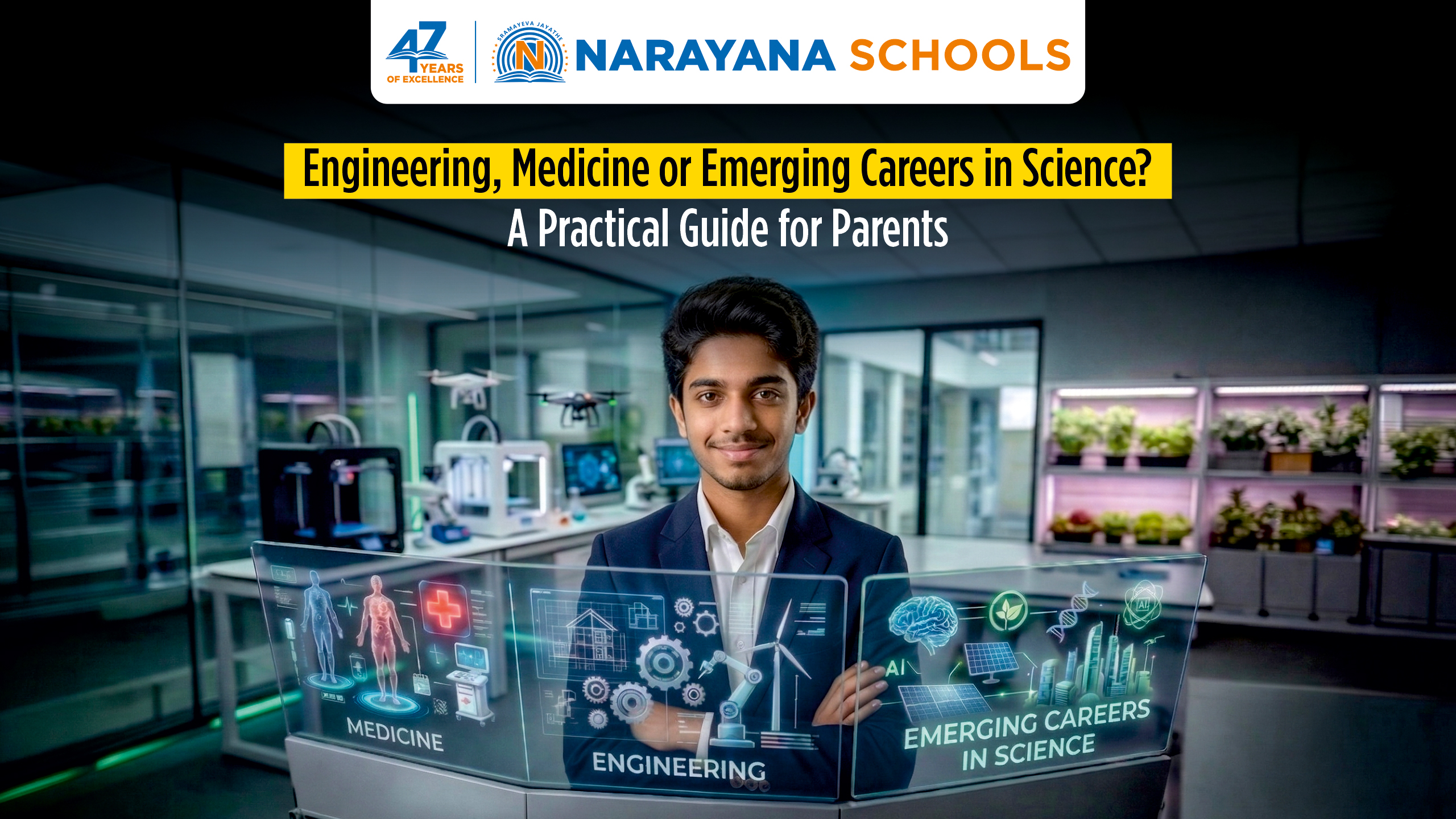 8
In today’s rapidly evolving world, choosing between science-oriented career paths such as engineering and medical careers in India, along with emerging opportunities within the field of science, has become more complex than ever. While traditional routes like engineering and medicine continue to hold strong academic and professional value, the rise of domains such as data science, artificial intelligence, robotics, design, environmental science, etc., has broadened the scope of success within the scientific landscape. For families, this decision is no longer driven by prestige alone, but by a thoughtful alignment of a child’s aptitude, interests and the long-term relevance of these science-focused careers. Why career choice today requires a broader perspective? Reports by the World Economic Forum highlight that over 60 percent of future jobs will require skills that are still evolving. This makes future-ready skills , adaptability and continuous learning more important than choosing a single fixed career path early. Understanding traditional pathways: Engineering and Medicine Engineering and medicine both demand strong analytical thinking and problem-solving abilities , but differ in their core focus areas. Engineering emphasises mathematics, design and technological innovation, while medicine centres on biology, clinical reasoning and patient care, with a strong focus on applying knowledge to real-world health challenges and societal well-being. Research from National Council of Educational Research and Training notes that success in these fields requires sustained academic commitment, conceptual clarity and high levels of perseverance over many years. The rise of emerging careers Fields such as AI and machine learning, biotechnology, behavioural sciences, sustainability studies, etc., are gaining prominence. According to industry analyses, these domains integrate interdisciplinary learning and offer diverse career trajectories beyond conventional roles. The science behind aptitude and interest alignment Cognitive psychology studies from Stanford University show that students perform better and remain motivated when career paths align with natural aptitude and intrinsic interest. Long-term engagement is significantly higher when learning feels meaningful rather than imposed. Key factors to consider before choosing a career path Academic strengths and subject-wise performance Interest patterns and curiosity-driven learning Career scope, stability and evolving job markets Emotional readiness for rigorous professional training Financial investment and duration of study Balanced decision-making emerges when all these factors are considered together rather than in isolation. Practical and doable approaches for families Encouraging career exploration through internships, projects and field-specific exposure such as coding competitions and hackathons for technology, science fairs and lab workshops for research-oriented fields, medical camps or hospital visits for healthcare, and design challenges or portfolio-building activities for creative science domains Using aptitude assessments and structured career counselling to identify strengths, interests and suitable science career pathways Facilitating discussions with professionals across domains to give children real-world insights into various science careers and evolving opportunities Supporting flexible thinking rather than fixed career labels, allowing children to explore interdisciplinary paths and adapt to emerging fields within science. Educational research confirms that exposure-based decision-making reduces uncertainty and improves long-term satisfaction. Ensuring the right choice without pressure The Organisation for Economic Co-operation and Development emphasises that supportive family environments enhance confidence and reduce performance anxiety. When decisions are guided by informed discussions rather than comparison, students are more likely to commit fully to chosen paths. Choosing between engineering , medicine or emerging careers within science oriented fields is ultimately about preparing children for a dynamic future. When decisions are rooted in awareness, aptitude and evolving opportunities, these science focussed career pathways become not just choices, but meaningful journeys towards growth, innovation and fulfilment.
25 Mar 2026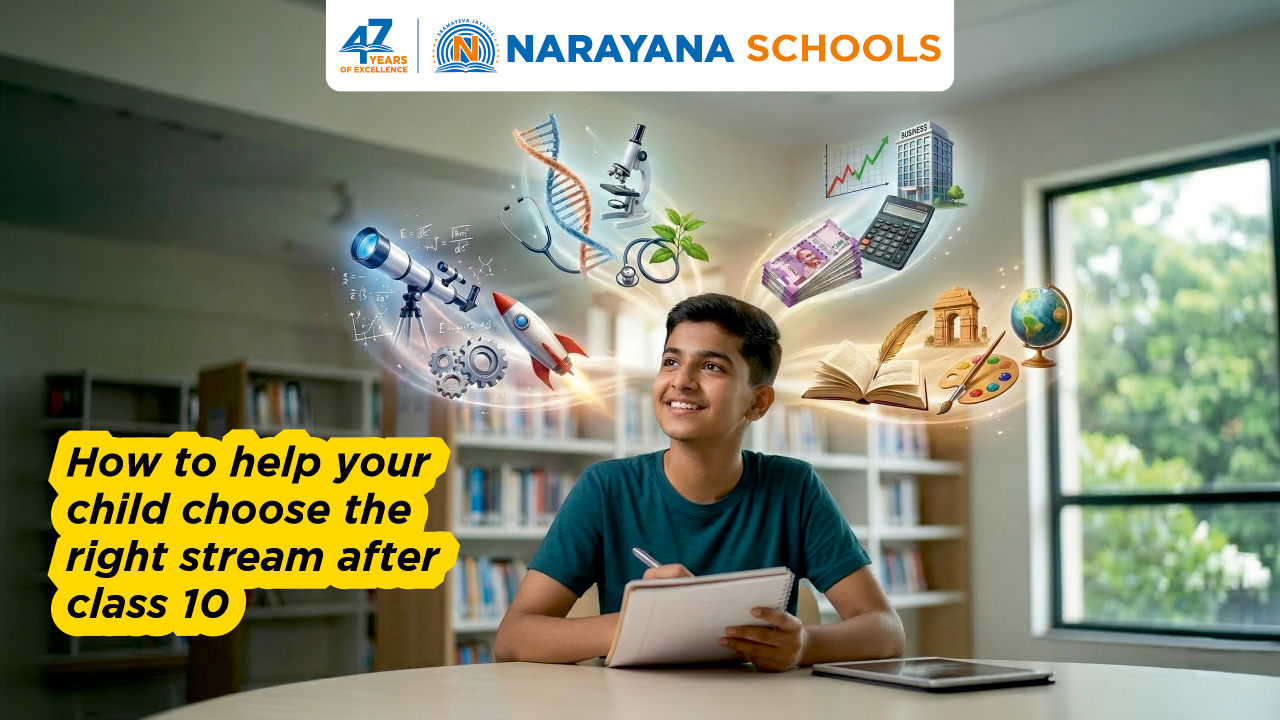 8
The transition after Class 10 board exams is one of the most significant academic turning points in a student’s journey. Choosing between Science, Commerce and Humanities streams in India influences subject exposure, higher education pathways and future career opportunities. Educational researchers emphasise that thoughtful stream selection after Class 10 should combine academic strengths, interests, aptitude and long-term goals rather than relying solely on marks or social trends. Here are key factors families can consider while guiding children through this important decision. Understanding why stream selection matters Educational policy experts from the National Council of Educational Research and Training (NCERT) highlight that early academic choices shape subject depth in Classes 11 and 12, which in turn influence university admissions and professional pathways. Selecting the right stream helps students build stronger conceptual foundations and maintain sustained academic motivation. Balancing Interest with Academic Performance Marks provide useful indicators but should not be the sole deciding factor. Studies in educational psychology show that intrinsic interest significantly improves perseverance, creativity and academic engagement. A student’s sustained interest in subjects such as economics or design often leads to deeper engagement, stronger conceptual understanding and better long-term outcomes than pursuing a path driven solely by external expectations or perceived popularity. Recognising Aptitude and Cognitive Strengths Psychometric research from University of Cambridge suggests that students perform best when learning aligns with natural aptitude. Subject-specific skills and interests often guide success across streams. Strong problem-solving skills and curiosity for scientific concepts support success in science-based subjects, while an inclination towards business awareness, data interpretation and financial thinking aligns well with commerce. Similarly, an interest in languages, creativity, critical thinking and understanding society supports success in humanities. Exploring Career Pathways Early The World Economic Forum identifies emerging careers in technology, finance, environmental science and creative industries. Understanding how different streams connect with fields such as engineering, medicine, business, law, data science or public policy helps families view stream choice as the beginning of a broader career journey. Using Aptitude Tests and Counselling Support Career guidance research supports the use of aptitude assessments, career counselling and subject orientation sessions . Government-backed initiatives such as the National Career Service (NCS) by the Ministry of Labour and Employment , the Career Guidance Portal by the Central Board of Secondary Education (CBSE), and counselling frameworks recommended by the National Council of Educational Research and Training (NCERT) provide structured support for stream selection. These platforms help identify learning styles, problem-solving patterns and academic preferences, enabling more informed, balanced and research-backed decisions. Creating an Environment for Open Discussion Adolescents benefit when decisions emerge through collaborative conversations rather than pressure-driven choices. Educational studies show that supportive dialogue reduces anxiety and builds confidence during academic transitions. Ensuring Flexibility and Future Readiness Modern education systems increasingly encourage interdisciplinary learning. Understanding that careers evolve and skill sets can expand over time helps students approach stream selection with confidence rather than fear. Choosing the right stream after Class 10 ultimately reflects a balance between aptitude, curiosity and future possibilities. When guidance is informed by research, thoughtful discussion and awareness of evolving careers, students gain the clarity needed to pursue academic paths with confidence and purpose.
18 Mar 2026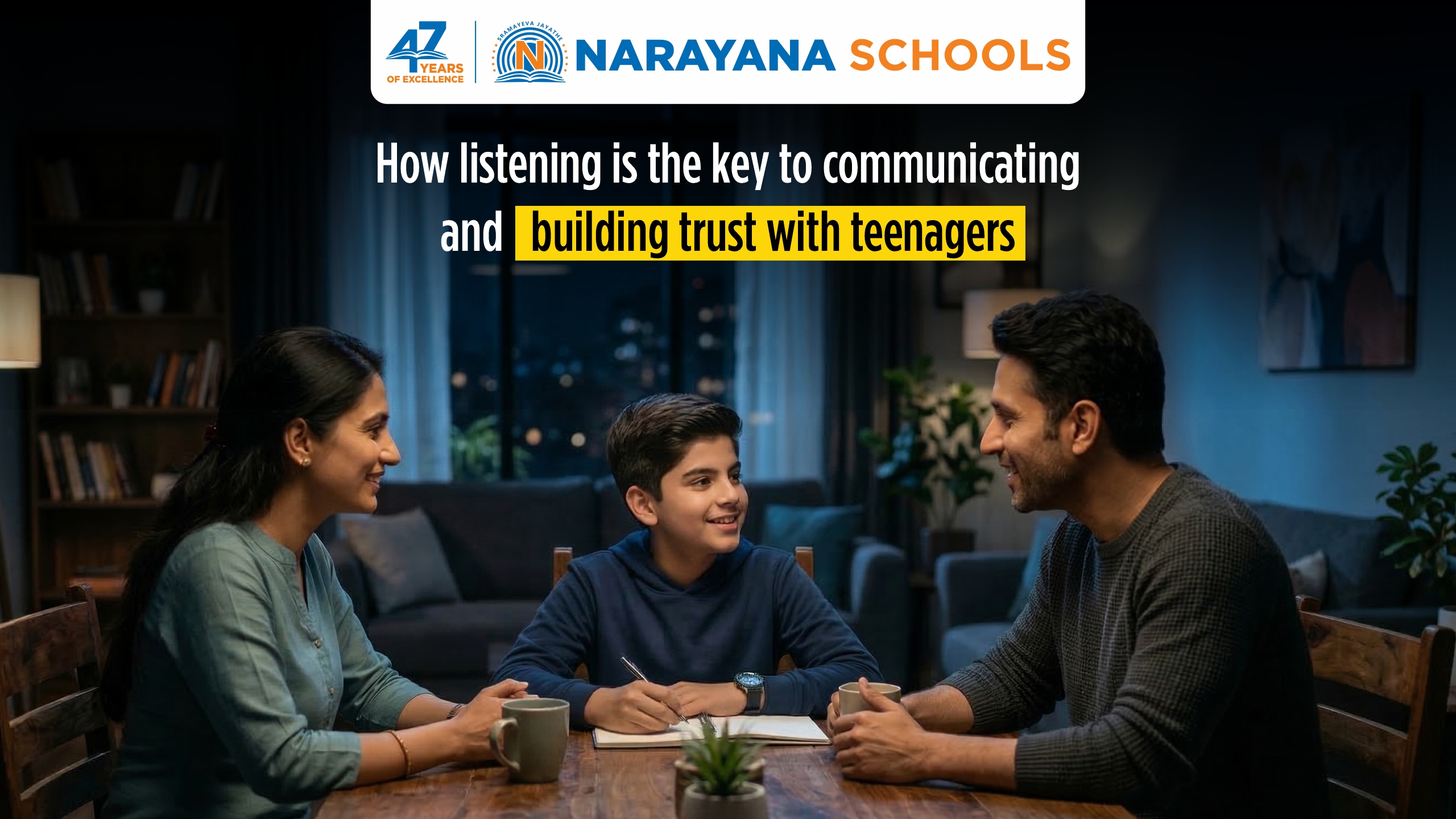 9
Adolescence is a crucial developmental stage when identity, independence and emotional awareness evolve rapidly. During this period, parent-teen communication , active listening and trust building with teenagers significantly influence emotional well-being, academic confidence and long-term decision-making. Research in developmental psychology shows that listening-based communication strengthens relationships far more effectively than one-sided lecturing. Understanding the Adolescent Brain Neuroscientific research from Harvard University highlights that the teenage brain is still developing, particularly the prefrontal cortex , responsible for reasoning, impulse control and decision-making. Emotional centres mature earlier than rational processing systems, making supportive listening essential for helping teenagers regulate emotions and think through decisions. Listening Builds Psychological Safety Studies by American Psychological Association show that adolescents who feel genuinely heard by adults are more likely to discuss academic pressures, friendships and personal concerns. This sense of psychological safety encourages openness and strengthens trust within families. The Limitations of Constant Lecturing While guidance remains important, constant lecturing may unintentionally create resistance. Behavioural studies published in the journal Developmental Psychology suggest that teenagers respond more positively to authoritative yet empathetic communication than to directive instruction alone. Communication and Academic Confidence Research from University of Cambridge indicates that teenagers who regularly discuss school experiences at home develop stronger motivation, improved problem-solving abilities and greater resilience when facing academic challenges. Practical Approaches That Encourage Dialogue Creating distraction-free moments for daily conversations. Encouraging teenagers to express thoughts and perspectives freely. Responding with curiosity before offering corrections or advice. Acknowledging emotions before discussing solutions. These strategies are widely recommended in adolescent development research because they nurture mutual respect, emotional intelligence and healthy communication patterns . Long-Term Impact on Future Success The World Economic Forum identifies communication, empathy and collaboration as essential future skills. Teenagers raised in environments that prioritise listening and respectful dialogue often develop stronger interpersonal abilities, leadership qualities and self-confidence. Ultimately, meaningful listening lies at the heart of effective communication with teenagers. When young people feel heard, understood and respected, trust grows naturally. This trust strengthens emotional security, encourages open dialogue about challenges and equips teenagers with the confidence to navigate academic pressures, relationships and the complexities of an evolving world. At Narayana Schools, a part of students’ well-being is supported through the DISHA Mental Well-being Programme , which focuses on nurturing emotional health, resilience and supportive peer networks. And a key initiative within DISHA is the Buddy System that is designed keeping teenagers in mind . Since students spend a significant portion of their time in school, peer support can play a powerful role in addressing emotional concerns and promoting a positive campus environment. Goals of the Buddy System To provide accessible, ongoing support for students experiencing feelings of loneliness, hopelessness or helplessness that may lead to unhealthy or risky behaviours. To reduce stigma around mental health and increase awareness among students. To encourage empathy, compassion and a supportive environment across the campus. To promote healthy help-seeking behaviour among students and ensure that no student feels alone when facing challenges.
13 Mar 2026

