

Explore stories and insights
Loading...


 9
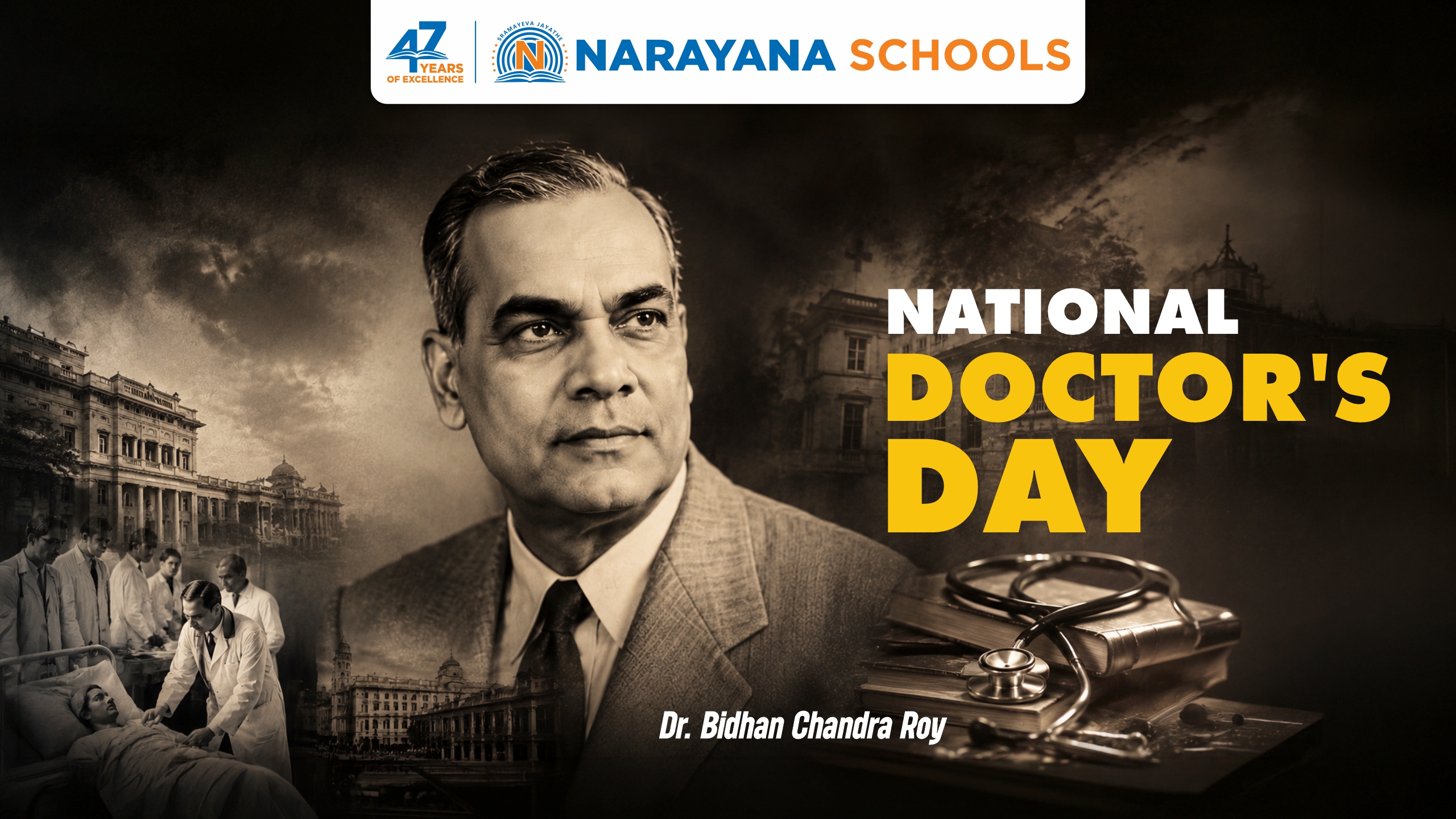
Every year on 1st July, National Doctor’s Day is observed in India to honour Dr. Bidhan Chandra Roy , a visionary physician, freedom fighter and one of the architects of modern healthcare in India. This day serves as a reminder of the dedication, compassion and invaluable contributions of doctors to society, while also encouraging awareness about healthcare and medical ethics among future generations. Why 1st July? The date holds deep significance as it marks both the birth and death anniversary of Bidhan Chandra Roy . A Bharat Ratna awardee and former Chief Minister of West Bengal , he was not only a qualified and distinguished physician but also a visionary leader who played a pivotal role in shaping India’s medical infrastructure and public health systems. Roy earned his medical degrees ( Member of the Royal College of Physicians - MRCP and Fellow of the Royal College of Surgeons - FRCS) from St. Bartholomew’s Hospital , making him one of the few Indians of his time to achieve both qualifications simultaneously. As a doctor and reformer, he made far-reaching contributions to medical education and healthcare delivery. He strengthened medical training standards, advocated for structured curricula and ethical practice, and played a key role in expanding access to quality healthcare. He was instrumental in the establishment and development of major institutions such as Indian Medical Association and Medical Council of India , and was closely associated with founding premier healthcare and teaching institutions like Jadavpur TB Hospital , Chittaranjan Seva Sadan , and R. G. Kar Medical College and Hospital , which significantly improved public health access, especially for women and the underprivileged. The Government of India established this day in 1991 to honour his legacy and recognise the contributions of doctors across the nation. The purpose beyond showing gratitude National Doctor’s Day is not merely symbolic. It highlights the importance of healthcare awareness in India , ethical medical practices and trust between doctors and families. Studies published in The Lancet (British Medical Journal) indicate that strong doctor-patient relationships significantly improve treatment outcomes and recovery rates. Respecting healthcare professionals Research in behavioural science shows that children exposed to discussions around caregiving professions develop higher levels of empathy and social responsibility. Encouraging awareness of medical careers in India also broadens aspirations beyond conventional fields. Challenges doctors face today Doctors in India often work long hours under immense pressure. According to World Health Organization (WHO) reports, doctor-to-patient ratios in developing countries remain a concern. This makes it crucial for families to foster respect for the profession while also discussing mental health in healthcare professionals . Making it meaningful for children Introduce real life stories of doctors and their impact on society. Encourage curiosity about science and healthcare careers . Promote basic health awareness and hygiene practices at home. Engage children in discussions around empathy and service. In a post-pandemic world, the significance of doctors has grown immensely. The focus is shifting towards future ready healthcare systems , preventive care and interdisciplinary medical research. For parents, this is a chance to nurture informed and compassionate individuals who respect and value healthcare systems. So, in essence, National Doctor’s Day in India is a reminder that healthcare is not just a profession, it is a commitment to humanity. Building awareness at home ensures that the next generation grows up valuing both science and service, creating a healthier and more empathetic society. How Narayana Schools nurture future medical professionals? At Narayana Schools, medical career awareness is not introduced as an afterthought. It is systematically embedded into the learning journey from an early stage. Through integrated NEET (UG) programmes like N-Spark, Medi Spark, etc . , students receive structured academic training that aligns school education with competitive exam requirements, ensuring conceptual clarity and exam readiness. Dedicated foundation courses at the school level gradually build aptitude in Biology, Chemistry and Physics, helping students make informed career choices without academic pressure. Regular career guidance sessions, seminars and expert interactions expose students to real-world insights from medical professionals, helping them understand the scope, responsibilities and ethics of the profession. Olympiad and research oriented programmes further enhance analytical thinking and scientific curiosity, skills essential for success in modern medical education. Students are also encouraged to participate in community awareness initiatives , fostering empathy, social responsibility and a deeper appreciation for healthcare systems. By combining academic intensiveness with real world exposure, we create an environment where students do not just dream of becoming medical professionals or prepare for exams like NEET (UG), but also develop the mindset, discipline and compassion required to fulfil the dream of becoming responsible healthcare professionals, because at Narayana Schools, your dreams are our dreams .
 25 Jun 2026
 11
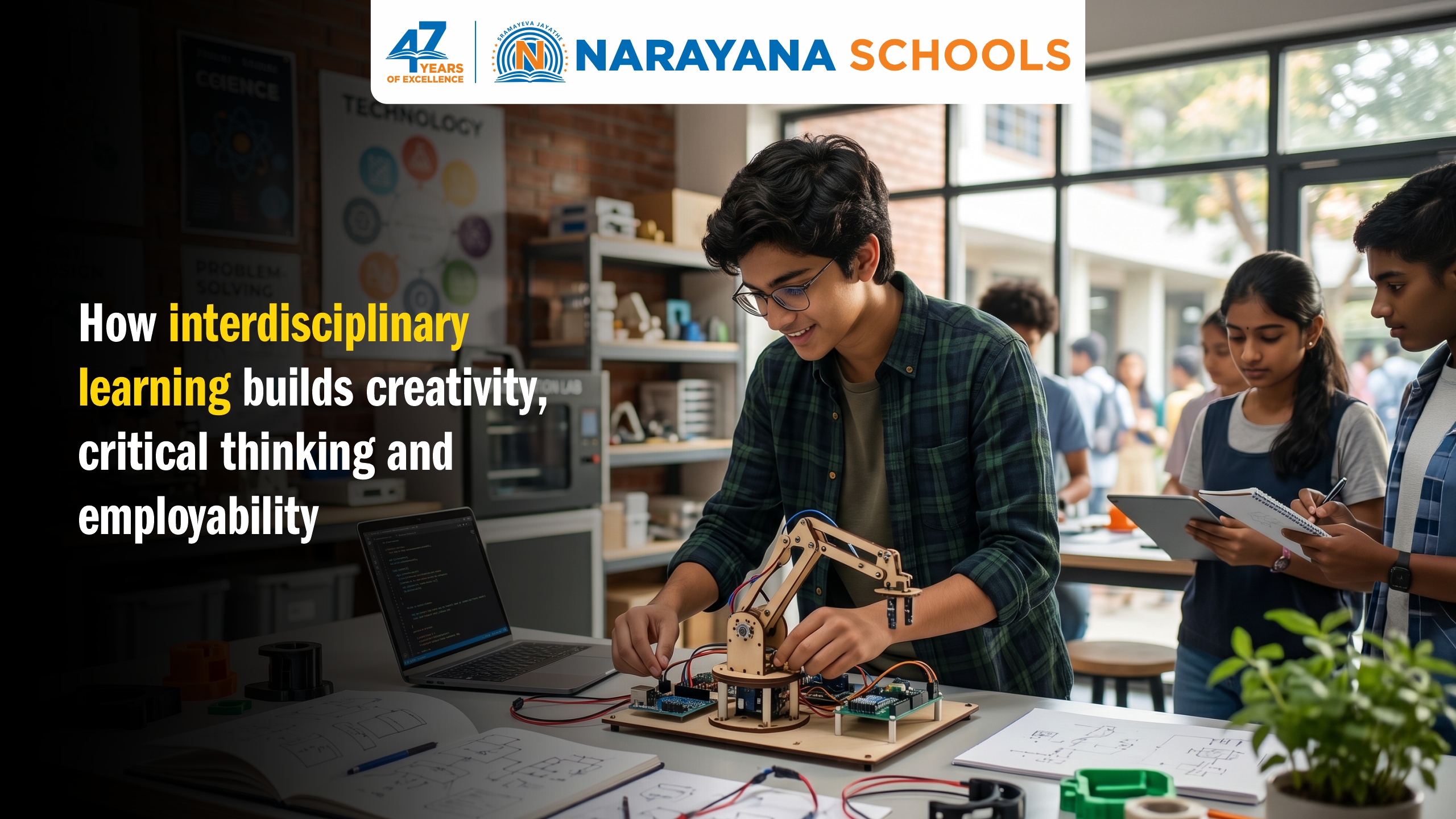
The boundaries between subjects are no longer as rigid as they once were. In today’s world, solving real life problems demands knowledge that cuts across disciplines. Modern careers clearly reflect this shift, with high-frequency trading merging mathematics, finance and computer science, sports analytics combining athletic insight with data science, and bioinformatics integrating biology with advanced data engineering. These dynamic, hybrid roles demonstrate that the modern workplace actively values the ability to connect diverse fields and think beyond conventional silos. The concept of interdisciplinary learning , often traced back to educational philosopher John Dewey , who advocated experiential and connected learning in the early 20th century, has gained renewed importance in modern education systems. Today, global frameworks such as the United Nations Educational, Scientific and Cultural Organization’s (UNESCO) Education for Sustainable Development (ESD), the Organisation for Economic Co-operation and Development (OECD) Learning Framework 2030 and the World Economic Forum’s Future of Jobs Report , along with national policies like the National Education Policy (NEP) 2020 , strongly promote this approach to build creativity, critical thinking and employability skills among students. Why interdisciplinary learning is essential today? Real world problems such as climate change, public health and AI require knowledge from multiple subjects, not isolated streams. The World Economic Forum highlights that over 60% of jobs demand cross-functional and hybrid skills. NEP 2020 promotes multidisciplinary education in India , allowing flexible subject combinations. Traditional rote learning limits application, whereas interdisciplinary learning improves real world readiness. Better understanding and retention with interdisciplinary learning Cognitive research shows the brain strengthens neural connections when concepts are linked across subjects. Learning the same concept in different contexts improves long term memory retention. Studies from Harvard Graduate School of Education indicate improved problem-solving skills through integrated learning. Exposure to varied domains enhances adaptability and faster information processing. Building creativity through connections Creativity increases when students connect ideas from unrelated fields (e.g., science + art, maths + design). Interdisciplinary tasks encourage experimentation, innovation and original thinking. Students learn to approach problems with multiple solutions instead of a single fixed method. Activities like project based learning and design thinking naturally foster innovative thinking skills . Strengthening critical thinking Exposure to multiple perspectives helps students evaluate information logically rather than memorise it. Encourages questioning, analysing evidence and forming independent opinions. Improves decision-making by comparing different approaches and outcomes. Builds critical thinking skills for students , which is essential for both academic and life success. Enhancing employability and future readiness Employers prefer candidates who can work across domains (e.g., tech + communication, data + business). Hybrid roles such as data analysts, UX designers and sustainability experts require interdisciplinary knowledge. Builds collaboration, communication and adaptability which are key skills for the future workforce . Directly improves student employability in India by aligning learning with industry needs. Careers are evolving faster than degrees New roles like AI ethicist, climate analyst and behavioural economist did not exist a decade ago. Job markets are shifting faster than traditional degree structures can adapt. Interdisciplinary learning prepares students for careers that are still emerging. Focus shifts from ‘what to study’ to ‘how to think and adapt’. Practical Steps for Parents to Support This Approach Encourage participation in project based learning at home (science models, real life problem solving). Promote reading across subjects like science, economics, history, language, etc. Support involvement in Olympiads, hackathons and competitions. Explore new age courses after 12th that combine multiple disciplines. Focus on skill development (communication, analysis, creativity) rather than marks alone. Interdisciplinary learning is a necessity driven by science, industry and global needs. It nurtures well-rounded individuals capable of thinking creatively, analysing critically and thriving professionally. For parents, the focus must shift from choosing subjects to enabling mindsets that are flexible, curious and future ready.
22 Jun 2026 12
The rigid divide between Science, Commerce and Arts is gradually fading. In 2026, education is evolving towards interdisciplinary courses , where subjects merge to reflect real world complexity. For parents navigating career options after Class 12 , understanding this is essential. Why interdisciplinary learning is the future? Global research in education, including studies referenced by UNESCO, shows that complex global challenges like climate change, AI, healthcare, etc., require knowledge across multiple domains. This has led to the rise of multidisciplinary education in India , strongly supported by the National Education Policy (NEP) 2020. How the brain learns better? Cognitive science highlights that the brain forms stronger neural connections when concepts are learned across contexts. This approach, often linked to improved critical thinking skills , enhances retention, creativity and problem-solving, which are key outcomes of interdisciplinary education benefits. Breaking the myth of one stream = one career Traditional pathways often limit exploration. Interdisciplinary programmes such as Data Science with Economics, Psychology with AI or Environmental Science with Policy open doors to future career options that did not exist a decade ago. Real-world relevance and employability According to the World Economic Forum, over 60% of future jobs will require hybrid skill sets. Employers increasingly value adaptability, collaboration and cross domain knowledge, making skills for the future workforce more important than isolated subject expertise. What India is doing about it? India is actively embracing this shift through NEP 2020 reforms, flexible subject choices, academic credit banks (systems to store learning credits earned by students, which can later be used across universities to complete degrees or certifications) and institutions offering liberal and multidisciplinary courses after 12th . Universities and ed-tech platforms are expanding programmes that blend technology, humanities and sciences. Careers are being invented Roles like climate data analyst, behavioural economist, AI ethicist and sustainability consultant are products of interdisciplinary learning which highlight how emerging careers in India are evolving rapidly. Practical steps parents can take Encourage exploration beyond marks through aptitude based career counselling after 12th. Research courses combining multiple interests rather than fixed streams. Support participation in projects, competitions and real world problem-solving activities. Stay informed about new age courses in India and evolving career trends. Prioritise flexibility, curiosity and lifelong learning over rigid academic paths. Interdisciplinary education is not a trend. It is a response to a changing world. It prepares students to think, adapt and innovate across boundaries. For parents, the focus must shift from choosing a stream to enabling a mindset, one that embraces integration, curiosity and future readiness.
19 Jun 2026 9
The transition from school to college is a decisive life stage that shapes careers, identity and long term well-being. In India’s highly competitive academic environment, this choice carries both emotional and scientific significance. Research in educational psychology highlights that environments aligned with a student’s aptitude and interests significantly improve motivation, performance and career satisfaction. This makes choosing the right college after Class 12 and career guidance for students more important than ever. Why alignment matters? Studies from the field of cognitive science suggest that students perform better when learning environments match their intrinsic interests. Choosing a course or college purely based on trends or peer pressure often leads to disengagement and stress. The focus must remain on aptitude and not popularity. An essential aspect of career planning after 12th and course selection after Class 12 . The science of decision making Neuroscience indicates that the prefrontal cortex (responsible for decision-making) is still developing during late adolescence (typically 17–19 years in the Indian context). This explains why structured parental guidance and informed exposure to options become crucial during this phase, especially when considering best courses after 12th and how to choose a college . Beyond Rankings While rankings and brand names influence perception, practical factors such as faculty quality, industry exposure, internships, infrastructure and curriculum relevance play a more direct role in employability. According to employability studies in India , skill based learning outweighs institutional reputation in long term success, making college comparison factors more meaningful. Location, Safety and Well-being Environmental psychology emphasises that safe, supportive surroundings enhance learning outcomes. Factors such as proximity to home, local climate, cost of living and campus culture play a significant role in shaping a student’s mental well-being and academic consistency. These elements are therefore crucial in ensuring a supportive , safe and balanced college environment in India . Future Readiness: Careers Are Evolving With emerging fields like AI, sustainability and interdisciplinary sciences gaining prominence, flexibility in curriculum and exposure to new-age skills are essential. The World Economic Forum emphasises that adaptability and lifelong learning have become essential career competencies, underscoring the growing importance of equipping students with future ready skills and preparing them for evolving career opportunities . Financial Planning with Purpose The cost of education must be weighed against return on investment. Scholarships, loan structures and long-term earning potential should be carefully evaluated to avoid financial strain. This aligns with growing concerns around cost of higher education in India and education ROI ( Return on Investment - value gained from the time, money, and effort invested in education). Practical Steps Parents Can Take Encourage aptitude assessments and career counselling after 12th . Facilitate exposure through webinars, campus visits and alumni interactions. Track course curriculum, not just college names. Discuss financial planning transparently, including education loans and scholarships . Prioritise mental well-being over societal expectations. Stay informed about emerging career trends and in-demand careers in India . Choosing the right college is not about securing a seat, rather it is about enabling a meaningful future. When decisions are guided by research, awareness and thoughtful support, students are more likely to thrive, adapt and contribute meaningfully in an ever-changing world.
18 Jun 2026 10
Observed every year on 21 June , the International Day of Yoga is more than a global celebration, it is a powerful reminder of the importance of holistic health , mental well-being and balanced living , especially for children growing up in fast paced environments. Why this day is needed? Rising academic pressure, increased screen time and sedentary lifestyles have made child wellness a growing concern. Research in paediatric health highlights increasing cases of stress, anxiety and posture-related issues among school going children. Yoga offers a simple accessible solution rooted in India’s ancient traditions. How it began? The day was proposed by India and officially declared by the United Nations in 2014 . 21 June , the longest day of the year in the Northern Hemisphere , symbolises energy, vitality and harmony, which are core principles of yoga. The science behind yoga Studies published by institutions like All India Institute of Medical Sciences (AIIMS) and global health bodies show that yoga improves cognitive function , memory and concentration. Controlled breathing techniques enhance oxygen flow, supporting brain development and emotional regulation. Regular practice reduces cortisol (stress hormone) levels, helping manage stress in children and improving sleep quality. Yoga strengthens neuroplasticity (brain’s ability to adapt and reorganise), enhancing learning outcomes over time. Purpose and relevance today The aim is to promote preventive healthcare rather than reactive treatment. Early exposure helps children build lifelong habits of fitness, discipline and mindfulness . In an increasingly digital world, yoga acts as a natural counterbalance, improving both physical and mental resilience. Fascinating Facts Yoga dates back over 5000 years , making it one of the world’s oldest wellness practices. India holds multiple Guinness World Records for mass yoga sessions. Even 10–15 minutes of daily yoga can significantly improve attention span and emotional stability in children. Practical actions for everyday life Introduce simple yoga for children routines such as Surya Namaskar or basic stretching. Encourage short breathing exercises (pranayama) to improve focus and calmness. Create a consistent daily routine that includes physical activity and mindfulness. Limit screen exposure and promote outdoor play alongside yoga practice. Engage children in yoga themed activities such as posture charts, group sessions or school events. Choose educational environments that integrate holistic development and wellness practices. International Day of Yoga is not confined to a single day, it is a movement towards sustainable well-being. When yoga becomes part of everyday life, it nurtures healthier, calmer and more focussed learners. In a rapidly changing world, these simple practices build a strong foundation for lifelong success, ensuring that children grow not just academically, but physically and emotionally balanced. Yoga Veekshan at Narayana Schools Aligned with NEP 2020 , Narayana Schools’ Yoga Veekshan Programme is a structured initiative designed to integrate yoga, mindfulness and breathing techniques into daily student life, promoting concentration, emotional regulation and overall well-being . With 20+ trained yoga instructors qualified from the Isha Foundation and a dedicated age-appropriate curriculum in place, some of the key yoga practices are as follows: Angamardana (Standing Processes): Builds strength, fitness and resilience while strengthening the spine and muscles. Upa Yoga: Simple practices like arm movements, squats and postures that relieve stress and enhance joint flexibility. Thopukarnam (Brain Yoga): Activates the brain, improving memory, focus and reducing anxiety. Yoga Namaskar: A complete 7-step process that regenerates and strengthens the spine. Pranayam (Nadi Shuddhi): Balances emotions, reduces stress and creates inner calm. Mantra Yoga and Meditation: Practices like AUM chanting that stabilise the mind and improve attention. Eye Care Practices: Strengthen eye muscles and reduce strain from screens. Yogic Diet and Lifestyle: Encourages mindful eating and balanced daily routines. By embedding these practices into everyday learning, we nurture healthier, more focussed and emotionally balanced learners who not only dream boldly but also aspire to fulfil them fearlessly, because at Narayana Schools, your dreams are our dreams .
16 Jun 2026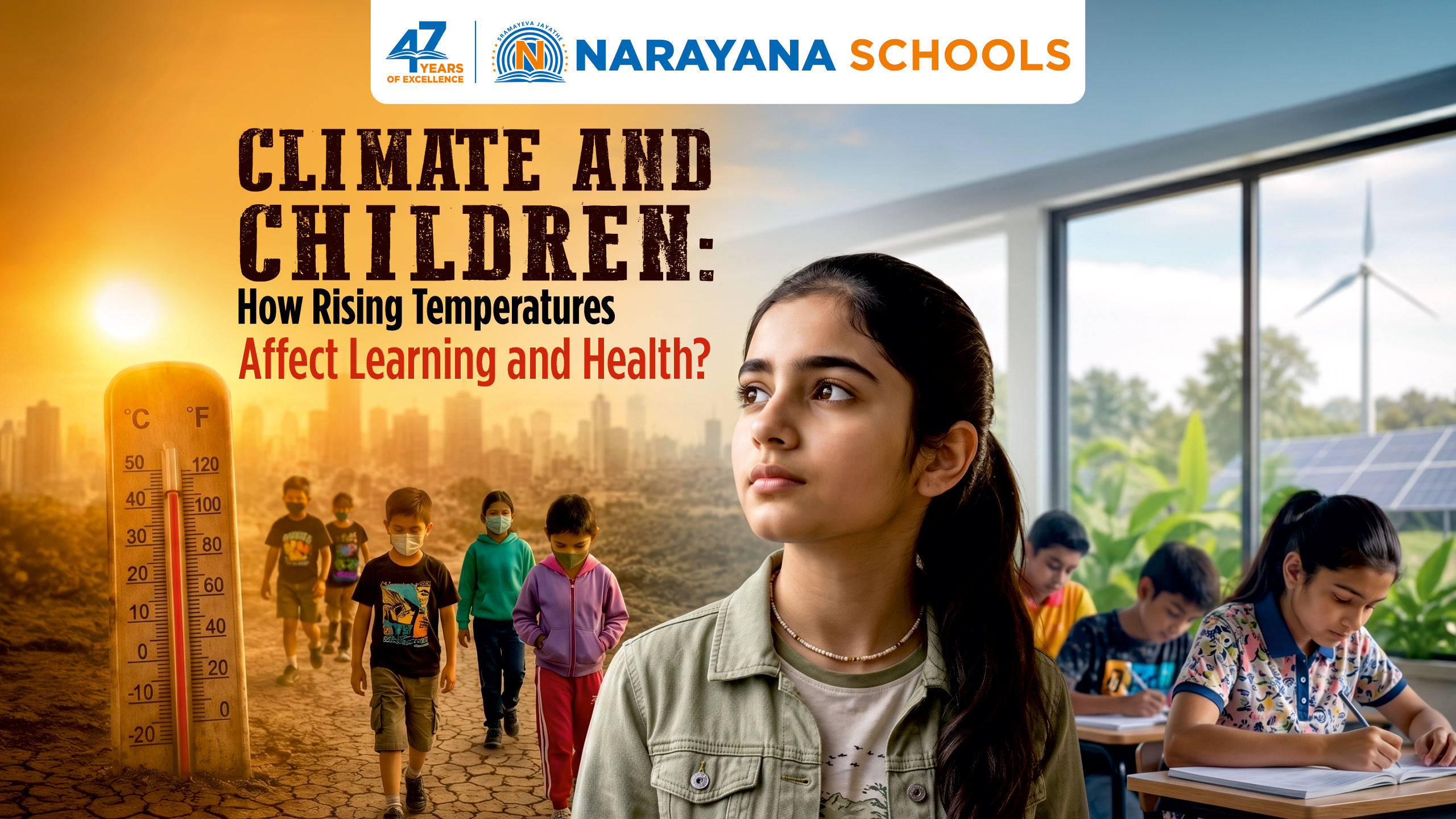 11
Across the world, climate change is no longer a distant concern. Rising temperatures are increasingly shaping how children learn, grow and stay healthy, making climate awareness for children an urgent priority for families. Why climate awareness for children is critical? Leading organisations like the United Nations (UN), United Nations International Children’s Emergency Fund (UNICEF), World Health Organization (WHO) and global research bodies highlight children as the most vulnerable to climate risks. Over 1 billion children are at extremely high risk from climate impacts globally. Climate change is now recognised as a child rights and development issue , not just an environmental concern. Impact on learning and education systems A global systematic review (2026) highlights that extreme heat creates non-optimal learning environments , affecting academic performance. Climate disruptions caused 242 million children to miss school in 2024 alone , due to heatwaves, floods and storms. Research by organisations like Overseas Development Institute (ODI) confirms that climate hazards lead to: Reduced concentration and memory Increased absenteeism Long term learning gaps Cognitive overload: The brain diverts energy to regulate body temperature, reducing focus and processing ability. Decreased attention span: Even slight rises in classroom temperature significantly lower attention and task performance. Impaired memory retention: Heat stress affects the brain’s ability to store and recall information. Physical fatigue: Dehydration, sweating and discomfort reduce participation and engagement. Sleep disruption: Warmer nights impact sleep quality, affecting next day alertness and learning capacity. Emotional irritability: Increased heat leads to stress and difficulty in emotional regulation. Learning disruptions: Power cuts, overheating devices and poor infrastructure interrupt continuity. Widening inequality: Lack of cooling and proper infrastructure in some schools increases educational disparity. Health risks linked to climate change Children are more vulnerable due to developing immune systems and higher respiratory rates (faster breathing, higher pollutant intake) . Key risks include: Heat stress and dehydration Respiratory illnesses due to air pollution Spread of climate sensitive diseases like dengue Increased risk of heat exhaustion: Children’s bodies heat up faster and cool down slower than adults. Worsening asthma and allergies: Higher temperatures and pollution levels aggravate respiratory conditions. Water borne diseases: Flooding and poor sanitation increase risks of infections like diarrhoea and cholera. Nutritional deficiencies: Climate change impacts food production, affecting access to balanced diets. Mental health concerns: Anxiety, stress and climate related fear (eco-anxiety) are rising among children. Weakened immunity over time: Continuous exposure to pollutants and extreme weather reduces overall resilience. Skin related issues: Increased exposure to heat and UV radiation leads to rashes, sunburn and infections. Reduced physical activity: Extreme weather limits outdoor play, impacting physical fitness and development. Climate change affects nutrition, mental health and overall well-being. Why this matters for India? India is among the most climate vulnerable countries for children , with rising temperatures, dense population and infrastructure gaps intensifying risks to both health and education. Increasing heatwaves, erratic monsoons, floods and air pollution are already disrupting school schedules, reducing attendance and affecting daily learning outcomes across regions. Recent global estimates indicate that 1 in 7 children experienced school disruption in 2024 due to climate events , with India contributing significantly due to its geographic and demographic exposure. Heatwaves have emerged as a leading cause of school closures in many Indian states, particularly during peak summer months, directly contributing to learning loss and academic discontinuity . Climate change is increasingly linked to developmental challenges , including reduced cognitive performance, health related absenteeism and long term educational gaps. In response, India has initiated several measures: National Action Plan on Climate Change (NAPCC): Focuses on sustainable development, climate adaptation and mitigation strategies. Climate resilient school infrastructure: Efforts to improve ventilation, green campuses and heat action plans in schools. Environmental education: Integration of sustainability and climate awareness into school curricula in line with NEP 2020. Additional critical concerns in the Indian context include: Urban heat island effect in cities, making classrooms significantly hotter and less conducive to learning. Water scarcity in many regions , affecting sanitation, hydration and overall student health. Air quality crisis , especially in metros, leading to frequent school shutdowns and respiratory issues. Digital divide during climate disruptions , where online learning becomes inaccessible for many students. Impact on rural education , where floods and extreme weather damage school infrastructure and limit access. These realities underline a growing need for climate sensitive education systems , stronger infrastructure and awareness, ensuring that children’s learning, health and future development remain protected in a rapidly changing environment. Practical steps families can take Ensure hydration and cooling: Water, ORS, coconut water, light clothing and well ventilated study spaces. Spot early symptoms: Fatigue, dizziness, headaches, dry lips, etc. Cool down and hydrate immediately. Avoid peak heat and pollution: Stay indoors between 11 am–4 pm , plan outdoor time early morning/evening. Protect from pollution: Use masks on high AQI days; watch for coughing or breathlessness. Prevent infections: Avoid stagnant water, use clean drinking water and mosquito protection. Support nutrition and immunity: Seasonal, balanced diets to build resilience. Watch overall well-being: Irritability, poor sleep or low energy can signal heat stress. Build awareness and safe routines: Encourage eco-friendly habits and coordinate with schools for safety measures. Climate change is reshaping both education and childhood health globally. Building awareness early helps children become resilient, informed and future ready . Sustainable actions today will protect both learning outcomes and the planet.
15 Jun 2026

