

Explore stories and insights
Loading...



 7
Mathematical calculations are extremely challenging and prone to errors. In such scenarios, tricks from Vedic math are quite helpful. This is particularly true when you are planning to appear for various competitive exams. To help you with this, we are here with simple Vedic math tricks for quick calculations. Since ancient times, simple strategies for performing mathematical operations such as addition, subtraction, multiplication, and division have been used in India. Vedic mathematics simplifies these mathematical operations. Vedic math concepts and ideas are widely accepted around the world. 7 Vedic math tricks for quick calculations 1. Squaring a number ending with 5 1. For this Vedic Math trick , first, multiply the unit digit of the number, that is, 5 by 5. 2. Next, multiply the number preceding 5 by the next higher number. 3. Finally, place them sequentially to obtain an accurate result. Let's say you take the number 135 for this calculation. Step 1: Multiply 5 of 135 by 5 to get 25. 5X5 = 25 Step 2: Multiply the preceding number (13 in this case) with the immediate next number, which is 14, to get 182. 13 X 14 = 182 Step 3: Finally, place them sequentially to get the square of 135 as 18225. 2. Multiplying any number by 5 For this, in the case of even numbers, divide it by 2 and add a 0 at the end of the result. For example, if you take the number 6, Step 1: Divide the number 6 by 2 to get 3. 6/2 = 3 Step 2 : Add a 0 at the end to get 30 as the result. For odd numbers, first subtract 1 from it, divide it by 2, and then add 5 at the end. Say you take a number 7. Step 1: Subtract 1 from 7 to get 6. 7 - 1 = 6 Step 2: Divide 6 by 2 to get 3. 6/2 = 3 Step 3: Place 5 at the end to get 35 as the result. 3. Multiplication of 2-digit numbers (11–19) 1. For this, add the unit digit of the smaller number to the larger number. 2. Then multiply the sum by 10. 3. Then multiply the unit digits of the two original numbers. 4. Finally, add two results (steps 2 and 3) to get the desired outcome of your problem. For example, let's multiply 12 and 13: Step 1: To multiply 12 and 13, first add the unit digit of the smaller number (2) with the larger number (13) to get 15. 2 + 13 = 15 Step 2: Next, multiply 15 by 10 to get 150. 15 X 10 = 150 Step 3: After that, multiply both unit digits (2 and 3) to get 6. 2 X 3 = 6 Step 4: Finally, add 150 and 6 to obtain the result of 156. 4. Multiplying any two-digit number by 11 In this, when multiplying a 2-digit number by 11, place both the digits at each end and place the sum of these digits at its centre. For example, take 13 x 11. Step 1: Place 1 and 3 at each end. Step 2: Add 3+1 to get 4. 3 + 1 = 4 Step 3: Place 4 at the centre to get the result of 143. 5. Subtracting any number from 100, 1000, 10000 and other multiples of 10. To subtract any number from 100, 1000, 10000… using Vedic Math trick, follow these steps: 1. If the number you are subtracting from (let’s say 1000) has more than 1-digit difference from the number you are subtracting (let’s say 23), then add 1 more zero to the left of your original number. In any case, you should add zeroes till the number of digits in your original number is 1 less than the number you are subtracting from. 2. Subtract the unit digit from 10 and each remaining digit of the number from 9. 3. Then, place them sequentially to obtain the result. To subtract 23 from 1000, we will first add zeros. Since we are subtracting from 1000, which is a 4-digit number, and our original number has 2 digits, we will add just 1 zero. = 023 Step 1: Subtract 3 from 10 to get 7. 10 - 3 = 7 Step 2: Subtract 2 from 9 to obtain 7. 9 - 2 = 7 Step 3: Subtract 0 from 9 to obtain 9. 9 – 0 = 9 Step 4: Place the number sequentially to obtain 977 as the result. 6. Dividing a large number by 5 1. First, multiply the entire number by 2. 2. Next, place a decimal right before the unit digit of the resulting number to obtain the final result. For example, take the number 333. Step 1: Multiply 333 by 2 to get 666. 333 X 2 = 666 Step 2: Place a decimal before the unit digit so it becomes 66.6, which is the accurate result. 7. Finding the square value of a number 1. Select a base number closer to the original number. 2. Calculate the difference between the base and the original number. 3. Add the original number and the difference arrived at, and multiply it by the base. 4. Add the square of the difference between the base and the original number with the result obtained above to get the final result. For example, take a number, say 102. Step 1: Take the base number to be 100. Step 2: The difference between 102 and 100 is 2. 102 - 100 = 2 Step 3: Now, add 2 to 102 to get 104. 2 + 102 = 104 Step 4: Multiply 104 by 100 to get 10400. 104 X 100 = 10400 Step 5: Add the square of 2, that is, 4, to 10400 to get 10404 as your answer. Conclusion Incorporating these Vedic math tricks for easy calculations will help you save time as well as enhance your concentration and memory. You can make instant and accurate calculations with these tricks, helping you score extremely well in exams. What you need is regular practise, and you’ll be able to make otherwise long and tedious calculations in seconds. So, embrace the wisdom of our ancestors and let it help you excel. Stay informed with the latest updates and expert insights on various topics. Join our Telegram channel to receive valuable content. Join us on Telegram: Narayana Educational Institutions – Official Don’t miss out on the fresh content and engaging conversations. Become a part of our community today!
 23 Nov 2023
 7
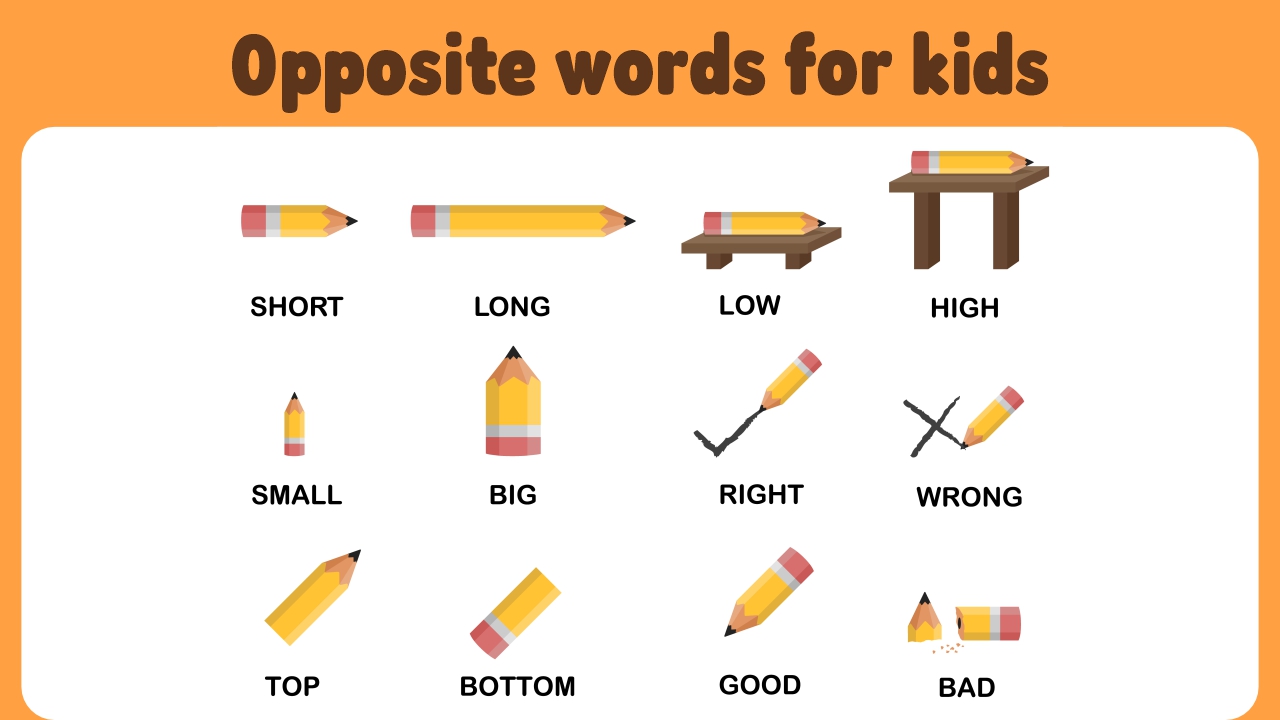
Learning opposite words for kids helps them compare different things. It allows them to develop a concrete understanding of a specific concept. Learning the basic opposite words will help improve the writing skills of your kids, as they will be able to express their thoughts more clearly than before. Let’s discover the fun of finding opposites together! List of Easy Opposite Words for Kids from A to Z 1. Opposite words starting with the letter A: 2. Opposite words starting with the letter B: 3. Opposite words starting with the letter C: 4. Opposite words starting with the letter D: 5. Opposite words starting with the letter E: 6. Opposite words starting with the letter F: 7. Opposite words starting with the letter G: 8. Opposite words starting with the letter H: 9. Opposite words starting with the letter I: 10. Opposite words starting with the letter J: 11. Opposite words starting with the letter K: 12. Opposite words starting with the letter L: 13. Opposite words starting with the letter M: 14. Opposite words starting with the letter N: 15. Opposite words starting with the letter O: 16. Opposite words starting with the letter P: 17. Opposite words starting with the letter Q: 18. Opposite words starting with the letter R: 19. Opposite words starting with the letter S: 20. Opposite words starting with the letter T: 21. Opposite words starting with the letter U: 22. Opposite words starting with the letter V: 23. Opposite words starting with the letter W: 24. Opposite word starting with the letter X: 25. Opposite words starting with the letter Y: 26. Opposite words starting with the letter Z: ? Stay informed with the latest updates and expert insights on various topics. Join our Telegram channel to receive valuable content. ?Join us on Telegram: Narayana Educational Institutions – Official Don’t miss out on the fresh content and engaging conversations. Become a part of our community today! ?
22 Nov 2023 6
Public speaking is the art of delivering speeches to a live audience. It aims to convey information or ideas to your listeners effectively and confidently. The types of public speaking include persuasive, informative, motivational, ceremonial, or entertaining, depending on specific goals, audiences, and occasions. If you are wondering how to speak confidently in public , go through the following tips to boost your confidence. 10 Ways to Speak Confidently in Public Here are a few public speaking tips listed below: 1. Preparation Effective presentation skills help the speaker to engage with the audience and convey ideas persuasively. For this, a thorough preparation is essential. It increases your confidence and improves your flow. When preparing for a presentation, make an outline of your speech about the things you are going to cover. You should ensure that you have all the material ready in advance to speak for an effective preparation. 2. Engaging the audience from the start The initial five minutes are vital for audience engagement when you can hook the listeners with a story. You can consider telling a short story or anecdote relevant to the topic you are discussing like your mistakes or achievements. The audience will relate to those experiences and try to figure out what you are going to speak about next. 3. Manage your nervousness Managing nerves is crucial for overcoming stage fright during a presentation. It's important to highlight that we're not suggesting you eliminate your nervousness altogether. Instead, the idea is to harness your nervous energy to your advantage. When you find yourself in an elevated state due to the rush of adrenaline coursing through your system, you have the opportunity to channel that energy into enthusiastic, persuasive, and passionate communication. 4. Finding friendly faces When you are presenting in front of a large crowd, find an eager audience, nodding or smiling at you. When you find yourself nervous or uncomfortable, look at those friendly faces and focus on your message. They will make direct eye contact with you, hang on to your every word and help you feel confident. 5. Taking pauses During your presentation, speak slowly and take pauses throughout your presentation. Pauses mean deliberate breaks to structure your speech. Taking pauses will help you avoid filler words, think properly and create a smooth transition. This will also help you convey your message more clearly, create interest in your audience and engage their attention. 6. Confidence in body language Body language in public speaking plays a crucial role in engaging your audience. Maintaining a good posture, eye contact and a friendly smile are essential to appear more confident and passionate about your topic. Besides, practising a stage persona works well for confidence building . 7. Focus on your message When presenting, focus on why you want people to listen and understand your message. This will not only keep you connected with your speech but will prevent distractions as well. The audience will also find this presentation valuable through this. 8. Use humour Humour is essential to engage the audience, ease tension, and make the presentation memorable. It enhances connection and communication in public speaking. However, you must also be cautious while using humour, as the audience can also misinterpret it. 9. Recognise your mistakes and move forward Recognising mistakes is crucial for growth. It will help you learn and refine your presentation skills , leading to personal development. After delivering a presentation, find out your mistakes and acknowledge the positives as well for your continuous improvement in speaking. 10. Practise Practise is the key to mastering skills, building confidence, and ensuring a polished performance. The more you become familiar with your topic, the more confidence you will gain in speaking. In addition, you can practise voice modulation , the ability to change your volume, pitch, tone and pace accordingly. Conclusion Mastering public speaking skills is more than just about effective communication. It is about personal growth. By applying the tips and techniques discussed in this blog, you're not just enhancing your communication abilities; you're investing in yourself. Remember, confidence is cultivated through practice, self-reflection, and a genuine connection with your audience. Therefore, if you are trying to find out how to speak confidently in public , consider these tips for your presentation. Stay informed with the latest updates and expert insights on various topics. Join our Telegram channel to receive valuable content. Join us on Telegram: Narayana Educational Institutions – Official Don’t miss out on the fresh content and engaging conversations. Become a part of our community today!
20 Nov 2023 7
Diwali is one of the most celebrated Hindu festivals in India and around the world. It is a time of joy, gratitude, and hope. But did you know that Diwali also has many valuable life lessons for kids? When we celebrate the return of Lord Rama, Sita, and Lakshmana to Ayodhya, their home, with all the light, glitter, and glory, we should also understand that amongst all these celebrations, there is much to learn from their journey. Here are some of those learnings: 1. Love and devotion: Diwali commemorates the return of Lord Rama to his kingdom after 14 years of exile. His wife Sita and his brother Lakshmana accompanied him throughout his journey, facing many hardships and dangers. Throughout their time in exile, each one of them was unconditionally devoted to each other. Even the devotion of Lord Hanuman towards Rama and Sita is something from which kids can learn. This teaches kids to love and respect their family and friends, no matter what. 2. The importance of duty over anything else: Rama was the rightful heir to the throne, but he willingly gave it up to honour his father's promise to his stepmother. He chose to follow his duty as a son, even if it meant losing his kingdom and living in the forest. This teaches kids to be responsible and loyal, even if it means sacrificing their own desires. 3. Value of one's word: Rama never broke his word, even when it was difficult or inconvenient. He kept his promise to the sage Vishwamitra, to his father, and to his allies. This teaches kids to be honest and trustworthy and to honour their commitments. 4. Selflessness: Rama always put the welfare of others before his own. He saved the sages from the demons, freed the kingdom of Kishkindha from the tyranny of Vali and restored peace and justice in his kingdom. He never sought any reward or recognition for his deeds. He gave the Kingdom of Lanka to Ravana’s brother Vibhishana even after having full right to rule it. This teaches kids to be selfless and compassionate and to serve others without expecting anything in return. 5. Patience: Rama faced many challenges and obstacles in his life, but he never gave up or lost hope. He patiently endured years and years in exile, the attacks of his enemies, and separation from his wife. He waited for the right time and opportunity to overcome his difficulties. He also forgave those who wronged him, such as Kaikeyi. This teaches kids to be calm and patient and to cope with stress and adversity. 6. Self-discipline: Rama was a master of himself. He controlled his senses, emotions, thoughts, and actions. He followed a strict code of conduct and morality. He respected all living beings and nature. He was humble and modest. He was a perfect role model for everyone. This teaches kids to be disciplined and virtuous and to strive for excellence in everything they do. 7. The importance of good company: There were good people all around Rama who stood by him and assisted him. His wife, Sita, was his constant companion and source of strength. His brother, Lakshmana, was his faithful assistant and protector. Hanuman was devoted and loyal to any limit. His allies, Sugriva, Vibhishana, Nala, Nila, Angada, etc., were his helpers and advisers. They all contributed to his success. This teaches kids to choose their friends wisely and to appreciate their support. 8. Victory of good over evil: And at last, one of the biggest life lessons to take away is that, no matter how dark the circumstances seem, in the end, there will always be light. Diwali celebrates the triumph of light over darkness, of truth over falsehood, of justice over injustice, and of dharma over adharma. It symbolises the eternal struggle between good and evil in ourselves and in the world. It reminds us that good always prevails in the end if we follow the path of righteousness and faith. This teaches kids to be optimistic and courageous and to fight against evil. Diwali is not just a festival of lights; it is also a festival of life lessons for kids. By celebrating Diwali with these lessons in mind, we can make our lives more meaningful and joyful. We at Narayana Schools extend our warmest Diwali wishes to you and your family and hope the festival light illuminates every aspect of your lives. Happy Diwali! ? Stay informed with the latest updates and expert insights on various topics. Join our Telegram channel to receive valuable content. ?Join us on Telegram: Narayana Educational Institutions – Official Don’t miss out on the fresh content and engaging conversations. Become a part of our community today! ?
11 Nov 2023 6
National Science Olympiad is a scholarship exam that aims to cultivate logical ability and scientific reasoning among learners. Any student between classes 1 to 12, who is passionate about science, can appear for this examination. They can belong to any board such as ICSE, CBSE or even state boards. Read further to learn some tips that can help you prepare well and secure a good rank in the NSO exam. Top 5 Tips to Crack the National Science Olympiad Here are some important tips that can help you crack the NSO with ease: 1. Get the best study material Having the right study material is the building block of any exam preparation. NCERT books prescribed by the CBSE/ICSE/State Boards may be used. Additionally, class 11 & 12 students can refer to magazines like 'Chemistry Today', 'Biology Today', 'Mathematics Today' and 'Physics For You'. To find the best study material, you can also consult with your teachers and other students preparing for these exams. These are some of the recommended books and study material for NSO ● The Official Olympiad Book of Reasoning by MTG Editorial Board ● Olympiad Reasoning Workbook by Pallavi Aggarwal ● Science Practice Cum WorkBook by MTG Editorial Board ● Learning Science For Smarter Life by Surachita Roy ● National Science Olympiad workbook by Anit Ahlawat ● MTG National Science Olympiad (NSO) Work Book by MTG Editorial Board ● Previous Years’ Papers 2. Prepare a proper study routine Preparing a study routine helps you allocate sufficient time to prepare for every subject. Preparing a routine for olympiads is even more important as you will have to balance between your schoolwork and olympiad preparation. For this, first, you need to write down the entire syllabus and analyse its level of difficulty. Accordingly, write down the duration of time you need to prepare for each topic. Once you prepare the routine, make sure to thoroughly follow it. 3. Know about the latest exam pattern Staying updated about the exam pattern of NSO will help you understand how to score the necessary marks to clear the cut-off. Following is last year’s pattern of the exam: For classes 1 to 4, there are 35 questions, and the total time allocated is one hour. The NSO exam is conducted during regular school hours. The medium of instruction for the NSO exam is English. The paper for this group is divided into three sections: 1. Section 1: Logical Reasoning 2. Section 2: Science 3. Section 3: Achievers Section For Classes 5 to 12, there are 50 questions in total, with the same one-hour time duration. The question paper for this group is structured as follows: For Classes 5 to 10: 1. Section 1: Logical Reasoning 2. Section 2: Science 3. Section 3: Achievers Section For Classes 11 and 12: 4. Section 1: Physics/Chemistry 5. Section 2: Achievers Section 6. Section 3: Mathematics/Biology 4. Practice, practice and practice To achieve perfection in your exam preparation, you must keep on practising. There are several test papers and previous years' question papers that can help you. Practising previous year’s papers and mock tests will also help you with your time management. 5. Keep revising periodically Revising your lessons periodically will help you tackle any question easily. So, when preparing your routine, keep a separate time slot for revising your lessons to keep learning seamlessly. Apart from these tips, you can also get some additional help from subject-specific tips to prepare for this exam. Subject-wise Tips to Crack the National Science Olympiad Here are some tips that you can use to prepare for each subject for the NSO Olympiad: 1. Physics ● Get the entire syllabus from the official website of the Science Olympiad Foundation. ● Allocate 30 minutes every day to practise various physics numericals. ● Go through all the experiments and Higher-order Thinking Skills (HOTs) at the chapter's end from the NCERT book. ● Prepare a short list of all the essential formulae to revise every day. 2. Chemistry ● Prepare a sheet containing all the important reactions and formulae. ● Use various mnemonics to remember essential concepts of chemistry. ● Practice numerical, balancing equations, and chemical reactions every day. ● Prepare notes with one-line pointers that will help in quick revision. 3. Maths ● Solve a minimum of 10 problems from various topics every day to improve your problem-solving skills and address your areas of weakness. ● Prepare a sheet containing all the necessary formulae so you can quickly revise your lessons using them. 4. Biology ● Check out some of the practical examples of concepts learnt in theory for better understanding. ● Practice the experiments mentioned in your biology book to get a hands-on approach for a better understanding of concepts. ● Practice diagrams with details every day for 30 to 40 minutes to understand the structure and location of various parts in detail. 5. Logical Reasoning ● Find the easy-to-attempt patterns first and make sure to answer them at the beginning to score well. ● Learn about some vedic math tricks so you can make calculations faster during exams. ● Practice as many patterns as possible so you can easily identify them when taking your exams. ● Attempt challenging questions towards the end so you do not have to waste much time while solving them. ● Practice for a minimum of 30 to 40 minutes every day, to understand various techniques of solving them at the earliest. Narayana Schools offers a comprehensive programme to help students crack NSO. Over the years, our students have successfully cleared NSO exams and secured silver and gold medals, a shining testament to our dedication. Want to learn more about how we can help you crack NSO and other major Olympiads this year? Visit us at Narayana Schools and get a head start now! ? Stay informed with the latest updates and expert insights on various topics. Join our Telegram channel to receive valuable content. ?Join us on Telegram: Narayana Educational Institutions – Official Don't miss out on the fresh content and engaging conversations. Become a part of our community today! ?"
07 Nov 2023 6
Post the pandemic, the significance of promoting physical fitness has become abundantly clear. With physical activity getting more limited every day because of our sedentary lifestyle, pre-mature health problems are being observed in all age groups. This is important, even more so for your children. As a parent, it becomes essential to encourage your child to be engaged in various physical activities. Now we understand that relevant infrastructure for their sports and other physical activities cannot always be present in every neighbourhood. So, in this blog we will suggest you many ways where you could just use space in and around your house. Here are seven creative ways to promote physical fitness in children that you can use. 7 Ways to Promote Physical Fitness in Children 1. Include exercises in daily routine: Incorporating some necessary exercises in the daily routine of your child is necessary for their consistent physical growth. It will help build both their physical and mental endurance and will teach them the importance of discipline. These can be push ups, jump squats, jumping jack, arm circles, etc. 2. Encourage walking over long distances: Wherever possible, instead of taking public or private transport, you can encourage your child to walk over long distances. This practice can help them stay fit and boost their stamina. 3. Allow them enough playtime: Sports are one of the best ways to be healthy. It is very much possible that there is already a sport which your child loves. They may meet up with their friends every day for playing it. Make a schedule and allow enough time for them to play, this will help them be physically fit and have fun at the same time. 4. Use rewards for achieving fitness goals: Parents can set some fitness goals for their children and reward them for achieving these goals. For instance, if a child completes their weekly exercise targets, such as a certain number of rounds running in a park, they can be rewarded with extra playtime, a special outing, or a small treat. These rewards keep children motivated to achieve their fitness goals. 5. Use yoga for fitness and relaxation: Yoga activities like simple stretches, asanas, and pranayamas, help children relax when they are tense and also improve the efficiency of their lungs. 6. Turn physical activity into family bonding: You and your spouse can even take out some time from the hectic schedule and work out with them. You can take your children to the local park or encourage bicycle riding on the footpath so that they enjoy their physical activities. Doing so keeps all the family members fit and establishes a strong family bond. 7. Convert physical activity into a fun game: You can also encourage your child to perform physical activities through different fun games. These games can include running in circles, jumping, Kho-kho, and more. 10 Benefits of Physical Activity in Children Following are some of the benefits that children can get from different physical activities in their daily lives: 1. Improved cardiovascular fitness: Physical activities strengthen heart muscles, reduce harmful cholesterol, and make lungs more efficient. 2. Healthy sleep patterns: Reduction of stress (specially in teens) is one of the notable advantages that help children relax and have good quality sleep. 3. Increased confidence: Physical activities help children achieve mental well-being, which can boost their overall confidence. 4. Improved concentration: You will notice that your child can focus well on their studies upon incorporating sports into their daily routine because physical activity helps enhance blood circulation to the brain, facilitating better cognitive function and attention. 5. Helps in relaxation when tensed: Yoga involving simple stretches and breathing exercises can relax the mind and body of your child when they are extremely tense. 6. Improved body balance: Sports improve the coordination between body and mind which helps in improving body balance. 7. Build stronger bones and muscles: Daily physical activities help children build stronger bones and muscles and increase the overall body’s strength. 8. Improved posture during tasks: You will notice a prompt improvement in the posture of your child if they exercise regularly. because physical activity strengthens core muscles and promotes better body alignment, leading to an upright and comfortable posture during various activities and tasks. 9. Increased body flexibility: Due to stretching and other exercises, there is a notable improvement in flexibility helping them achieve physical fitness. 10. Keep a check on body weight: Physical activities burn out excess calories in the body and keep a check on the weight of your kid. It is essential to promote physical fitness in children from an early age so they can build a disciplined and healthy lifestyle. This even helps them achieve success in any field of their choice and stay ahead of their peers. Sporting Excellence at Narayana At Narayana, we are dedicated to the overall development of students, ensuring that they thrive in academics, sports, and beyond. To achieve this, we have designed an age-appropriate physical education curriculum called nSports. Highlights of our age-appropriate sports curriculum: • Kindergarten: Emphasis on developing gross motor skills, fine motor skills, object manipulation, and balance. • Grades 1 to 5: Focus on fitness, gross motor skills, and the basics of sports such as basketball, volleyball, throwball, kabaddi, badminton, football, frisbee, kho-kho, and athletics. • Grades 6 to 10: Advanced sports skills development, with a focus on physical conditioning, competitions, and talent identification. • Junior college: Emphasis on physical fitness and conditioning To ensure all-round development of your child with a specialised curriculum for both academics and sports, contact us now . For continuous updates, expert insights, and engaging discussions on a variety of topics, join our Telegram channel. It's your gateway to an informative and interactive community. ? Join us on Telegram : Narayana Educational Institutions - Official Never miss out on the latest content and conversations across our diverse range of topics. We welcome you to our community!?
06 Nov 2023

